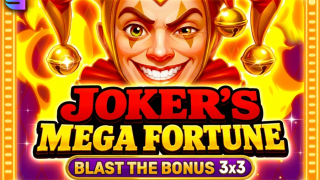
Joker’s Mega Fortune - Blast The Bonus 3x3 Demo
Table of Contents
A 100-spin detour inside Joker’s Mega Fortune – Blast The Bonus 3x3
One micro-session, from first spin to last
Imagine sitting down with Joker’s Mega Fortune – Blast The Bonus 3x3 for a quick experiment. A couple of hundred spins would sketch a fuller picture, but a 100-spin detour is enough to sense how this 3×3 machine behaves over a compact sitting.
The first 20 or so spins usually feel very contained. With just nine tiles on the screen, wins are either obvious or clearly absent. You tap spin, the symbols flip into place almost in a single motion, and you instantly see whether the jokers have lined up or a bonus frame has landed. Early on, what you notice is a trickle of small line hits: three mid-tier symbols across a horizontal line, or a diagonal connecting low icons that basically covers the cost of several spins. Nothing explosive, but your balance graph would look like a gentle zigzag around the starting point.
Because the grid is so compact, every spin looks strangely close. Two jokers locking into place with a third just out of line feels more pointed than on a 5×3 slot, where your eye is scanning 15 tiles at once. Here, any time two jokers stop on the same row or column, your brain flags it as “almost”. That sense builds as you get deeper into the set.
Somewhere between spins 25 and 60 in this hypothetical run, the first proper feature often shows up. Maybe it’s three bonus symbols filling a corner-to-corner diagonal, or a full-row joker line that triggers the Blast The Bonus 3×3 feature panel. The trigger is hard to miss. The game does a quick camera nudge into the centre of the grid, the lighting shifts slightly cooler, and those bonus icons get a quick pulse around their borders before the reels fade into the mini-bonus screen.
The feature itself tends to compress a lot of action into a very short burst. On a 3×3 slot like this, the bonus round does not sprawl. You get a small number of special spins or respins, multipliers and sticky jokers pop in and lock, and your balance bar jumps in one or two noticeable steps rather than a long incremental sequence. When you drop back into the base game after that first feature, your bankroll graph has a clear bump; you can usually see where the bonus landed just from glancing at the session history.
Past spin 60, the session in this scenario cools off. There are still hits, but more of them are minor: low stacks completing on two lines at once, or a single joker helping mid icons line up. Your balance slides down gradually, lifted here and there by slightly better spins but not fully rescued a second time. By the time you reach spin 100, you’ve probably had one meaningful feature moment plus a handful of base-game patches where two or three wins land in a small cluster.
What stands out is how often the balance meaningfully moves. On the 3×3 format, a “meaningful move” tends to be either:
- A single, larger line hit involving jokers or top symbols.
- A bonus feature that plays out in just a few beats but shifts the graph in one noticeable vertical jump.
In between those, a lot of spins are either outright misses or very small wins that barely register on your mental ledger. The math might be similar to some 5×3 games, but the way the swings present themselves feels more binary because there are fewer spots on the grid and fewer lines to track.
You end that 100-spin detour with a clear sense of shape. A modest start, a mid-session spike when the bonus ignites, then a glide back down with occasional bumps. Even players who rarely count spins will usually remember roughly when the bonus happened in the set, because the pacing jolt on such a small grid is so stark.
What that small sample really tells you
A single 100-spin run is flimsy if you’re thinking statistically. As a lived experience, it does tell you quite a bit about how Joker’s Mega Fortune – Blast The Bonus 3×3 carries itself across a short session.
The first thing it reveals is the apparent spacing of bonuses versus straight base-game cycles. On a 3×3 slot, you see bonus symbols a lot. With fewer tiles, any time two bonus icons land, it feels like you were inches away from lighting the feature. That sensation makes bonuses seem more present than they might actually be over thousands of spins. In that micro-session, you might count one triggered feature, but mentally recall four or five near-misses because the grid gives them so much visual weight.
Perception leans heavily on streaks. Ten spins with no win on a 3×3 game feel more pronounced than ten empty spins on a busy 5×4 grid. Your eye isn’t distracted by multiple almost-wins; you just see nine static symbols and nothing connecting. Then you get a patch of three or four wins in six spins, with a bonus trigger tucked in there, and it feels like the game has suddenly “warmed up”. Underneath, the core mechanics are still just turning through the same reel strips and symbol weights every spin, but your memory will anchor around those clusters.
That’s why understanding the bonus structure and symbol hierarchy matters if you care about how a 30–60 minute session might unfold. Once you know which icons actually carry weight, and how the Blast The Bonus feature is triggered, you read each spin differently. A grid with one joker and one bonus icon is no longer just “close”; it’s a specific mix of mid-term potential and short-term miss.
Device UX plays into this too. On mobile, where you might rip through 100 spins in a few minutes with quick spin toggled, that single bonus you hit can easily define the entire coffee-break session. On desktop, with a slower pace and perhaps auto-play capped at smaller batches, the same feature may feel like one beat in a longer arc.
A 100-spin detour is really a way of stress-testing your tolerance for that rhythm. If you find that one bonus spike and long strings of quick “nope” screens feel sharp but acceptable, the format will likely suit your style. If you need smoother, more incremental balance movement, the structure of Joker’s Mega Fortune – Blast The Bonus 3×3 is worth unpacking before you commit longer stretches of playtime.
Cracking the joker’s tricks: bonus structure in Blast The Bonus 3×3
Core feature triggers and how often you actually see them
Bonus access in Joker’s Mega Fortune – Blast The Bonus 3×3 leans into the tiny grid. The game uses dedicated bonus icons that feel oversized relative to the low symbols, and you typically need three of them arranged across the 3×3 to move into the feature window. The configuration might be row-based, any-position, or locked to certain lines, depending on the exact variant your casino runs, so it’s worth checking the specific trigger pattern on the info screen before you start longer sessions.
On a grid this small, the distinction between “frequent but smaller” and “rare, session-shaping” features becomes sharp. You might see:
- A more common mini feature or respin that fires off when two bonus icons land along with a joker, granting one extra chance with some sticky positions.
- A rarer, full Blast The Bonus mode that requires three dedicated bonus symbols in a specific layout and moves you into a separate 3×3 bonus board.
Because the grid is only nine tiles, the screen never feels cluttered when these setups appear. A two-bonus near-miss jumps out immediately: you see two flashing frames and a blank or low symbol in the missing spot, and you know exactly which position had to cooperate. That clarity can be a blessing and a curse. It keeps you oriented, but it also amplifies the sense of “that was so close” even when, from a probability standpoint, it was just another non-trigger spin.
Over a sustained session, what you tend to notice is that those lighter mini-features show up enough to keep the cadence from feeling flat, while the full Blast The Bonus experiences leave a more distinct stamp on your balance graph when they arrive.
Inside the bonus rounds: what changes once you’re in
Once you break into the main bonus, the game starts behaving like a compact hold-and-win or multiplier builder. The base 3×3 symbol grid gives way to a slightly stylized 3×3 bonus field, often framed in electric neon or joker motifs, where each position can lock in special chips or multiplier tags. You’ll usually get a set number of bonus spins or a respin counter that resets whenever a new special lands.
Mechanically, a typical run might look like this: you enter with a base multiplier or credit value, then each new symbol that drops onto the 3×3 either:
- Adds a flat amount to your running bonus total.
- Boosts the multiplier applied to already-locked values.
- Unlocks a corner or edge tile that previously carried a lower potential.
Because there are only nine slots, you can track every change without effort. One new icon in the top-right feels significant. Filling the board feels like a realistic, if uncommon, ambition, rather than an abstract “cover 20 positions” objective you see on larger hold-and-spin grids.
From a session perspective, each full Blast The Bonus sequence effectively condenses a batch of spins’ worth of value into 10–20 seconds. You hit the trigger, drop into the feature, watch the multipliers or special icons accumulate, then pop back out with a single, consolidated outcome tacked onto your balance. A strong result can pull a fading session back into neutral or even net-positive territory; a weaker one may still slow the downward slide enough to keep you playing another 50–100 spins.
Those short, high-focus bursts are what many players mentally classify as the “real” action. The base game is what gets you there. Understanding that relationship helps when you’re planning how long to sit with Joker’s Mega Fortune – Blast The Bonus 3×3 on a given night.
Symbols, stacks, and short grids: how the paytable works here
Symbol hierarchy in Joker’s Mega Fortune – Blast The Bonus 3×3 is intentionally simple. With only nine positions to worry about, the studio leans into a clear ladder: low-paying icons at the bottom, a couple of mid-tier emblems in the centre, and one or two high-tier joker-themed symbols at the top.
You’ll typically see:
- Low symbols: classic shapes or card ranks that usually need a full row or multiple lines across the 3×3 to make any noticeable dent.
- Mid-tier icons: thematic objects (crowns, bells, or gems) that start to matter when they connect on two or more lines at once.
- Premiums: the joker himself and maybe a special fortune symbol, paying significantly more when you land them as three-of-a-kind on a main line.
- Special symbols: wild jokers and bonus icons that either substitute or unlock the Blast The Bonus mode.
The 3×3 layout changes how you think about “lines”. Many Canadian players used to 20-line 5×3 slots expect a spread of zigzags and V-shaped patterns. On this compact grid, pay structures are usually limited to straightforward horizontals, verticals, and sometimes the two diagonals. That means each symbol you see is doing double duty: if something lands centre, it participates in four potential lines at once.
Top symbols have a noticeably sharper jump in value over mid-tier ones than they might on a busier 5×4 machine. A three-of-a-kind of a mid-tier icon might be a modest bump. A full line of the main joker can feel like a small “event” outcome in its own right, especially if it pairs with a wild or overlaps across multiple lines. You do not need huge combination counts to see meaningful movement, which suits the small-grid format and keeps the paytable easier to internalize after a few dozen spins.
Slot family resemblances: where Joker’s Mega Fortune fits among 3×3 bonus slots
Joker’s Mega Fortune – Blast The Bonus 3×3 sits in that growing niche of 3-reel or 3×3 slots that are not really about traditional line wins. It shares DNA with modern hold-and-win titles that use a tiny grid as a canvas for bonus bursts, rather than leaning fully into old-school bar and cherry nostalgia.
Compared with barebones 3-reel classics, this game introduces a more defined feature loop. You still get the tight, quick spins of a small grid, but your mental focus shifts toward chasing the bonus icons and sticky jokers that kick off Blast The Bonus. It also stands apart from some joker-branded 5×3 titles that stack features over complex line maps; here, the map is tiny, and the complexity congregates in the bonus mode.
This style tends to resonate with two groups:
- Players who enjoy quick, contained sessions where a couple of features make or break the run.
- Fans of classic jokers and fruits who want something more structured than a pure three-line stepper but less busy than a full-blown grid slot.
Marathon grinders who like to idle on 1,000-spin auto-play loops might find the game a bit intense in its concentration of action, but for coffee-break or end-of-day stints, the 3×3 Blast The Bonus format has a clean, uncluttered appeal.
From studio to screen: Joker’s Mega Fortune in the provider’s wider catalogue
Within its provider’s catalogue, Joker’s Mega Fortune – Blast The Bonus 3×3 clearly belongs to the “pocket slot” branch. The studio has been pushing out several 3×3 and 3×4 releases that prioritise fast access, short spin cycles, and sharp bonus bursts over expansive reel maps.
You see recurring design habits here:
- A pared-back base game that’s easy to grasp in under a minute.
- One primary feature mode (Blast The Bonus) carrying most of the bigger-moment potential.
- Visual emphasis on special symbols so that bonus triggers are instantly legible.
For players familiar with the studio’s heavier-weight flagship titles — the ones with multi-level free spins, tiered jackpots, or cascading reels — this 3×3 joker release feels like a step down in complexity, but not in engagement. It functions almost as an entry point into the provider’s style: you learn how they telegraph features, how they pace mini-wins, and how their bonus boards tend to escalate.
On the flip side, if your usual orbit includes only very simple three-reel classics, Joker’s Mega Fortune – Blast The Bonus 3×3 can serve as a gentle step up. The mechanics are still compact, but the bonus structure gives you a taste of the studio’s more ambitious designs without asking you to track dozens of paylines or modifiers.
Playing on the couch vs the desk: mobile and desktop UX in Joker’s Mega Fortune
Layout and visibility on smaller Canadian screens
On phones, Joker’s Mega Fortune – Blast The Bonus 3×3 feels like it was sketched for vertical play first and everything else second. The nine-symbol grid occupies the centre, but because it’s only a 3×3 block, there is plenty of room above and below for controls, meters, and branding without crowding the actual game area.
In portrait mode, the grid usually sits slightly higher than the centre point, allowing the spin button and bet adjusters to nestle into a semi-circle at the bottom of the screen. For Canadian players used to one-handed play on the couch, that thumb reach is comfortable: the main spin button is large, circular, and spaced with enough margin that you won’t accidentally tap the menu while trying to start a round.
Symbol clarity holds up well even on smaller screens. The provider uses thick outlines on the joker faces and high-contrast fills for low symbols, so when the reels stop, you immediately recognise line completions without squinting. Bonus icons tend to carry animated frames or subtle glow effects, which stand out nicely against darker reel backgrounds on modern OLED devices.
Balance, bet, and win indicators are usually tucked into compact panels either side of the grid or at the top. The typeface is sharp, but during very fast sessions with quick spin enabled, those numbers can update quickly enough that you stop consciously reading them. It helps that the game often provides a brief highlight or subtle pulse on the balance when a feature ends, so you can see at a glance whether your bankroll just took a meaningful hop.
Landscape play on tablets and larger phones reshapes the interface. The 3×3 grid moves to the left or centre-left, with control clusters either at the right edge or under the reels. Because the game area is intrinsically small, the studio tends to widen the background art in landscape, which looks nice on a tablet but doesn’t change the functional layout much. You still get large, readable buttons and a grid that occupies a modest portion of the screen, leaving plenty of negative space.
One small UX quirk: on some mobile browsers, the auto-play and settings menus can feel like they’re a tap further away than necessary. They often open via a tiny gear or stacked-lines icon near the bet controls. During a quick bus ride or TV break, you may find yourself postponing menu tweaks just to avoid hopping in and out of those panels. The trade-off is a cleaner main play area with minimal clutter.
Desktop rhythm and multi-tab play
On desktop, Joker’s Mega Fortune – Blast The Bonus 3×3 translates cleanly into a slightly framed experience. In a typical Canadian browser window, the grid appears centred, with side panels or logo banners padding out the horizontal space. Because the central play area is so compact, it remains fully visible even when the window is not maximised.
Multi-tab behaviour is friendly. You can comfortably keep the slot running in one tab while browsing hockey scores or news in another. If your casino client allows background play, auto-spin cycles will keep ticking, and the game usually handles tab switches gracefully. When you return, you see a backlog of recent results in the game’s short history strip or via a quick peek at the balance movement.
For extended desktop sessions, two factors matter: clarity at a distance and ability to downsize the window. Joker’s Mega Fortune – Blast The Bonus 3×3 handles both decently. Even on a 1080p monitor scaled down to a smaller window, those nine symbols remain distinct because they never shrink to the micro-icon level you get with some 6×6 grid games. Window resizing typically keeps the aspect ratio fixed, so you don’t end up with a stretched or squashed joker face.
Animation pacing on desktop feels slightly more relaxed than on mobile, even at identical spin speeds. The reels flip with a clean vertical sweep, there’s a very brief stop delay that emphasises the last reel, and bonus triggers are marked by a modest camera zoom and lighting shift. On large screens, that subtle zoom draws your eye, making it nearly impossible to miss a feature activation even if you’re half-focused on another window.
One minor friction point: full-screen mode can feel almost too spacious. Because the core grid stays relatively small compared to the monitor, the background art does a lot of visual lifting. If you prefer more concentrated focus, keeping the game in a moderately sized window rather than full-screen can help, especially when running multiple titles or tools side by side.
Controls, speed options, and how they shape a 30–60 minute session
Control-wise, Joker’s Mega Fortune – Blast The Bonus 3×3 offers a familiar set of levers, but how you use them can dramatically reshape a half-hour stint.
You’re typically working with:
- A primary spin button, often colour-highlighted and centrally placed.
- Bet-size adjusters, either as plus/minus taps or a drop-down bet panel.
- Auto-play controls with adjustable spin counts and sometimes loss/win stops, depending on jurisdiction and casino settings.
- A quick spin or turbo toggle, often tied to a small lightning or speed icon.
- Occasional feature pop-ups or prompts when a bonus round is about to start or has just ended.
On default speed with no turbo, a 30-minute session might encompass a few hundred spins, leaving space between each result to read balance updates and mentally tag patterns. This slower rhythm works well if you like to watch every joker and bonus icon land, and if you’re actively tracking how often features appear in a session.
Flip quick spin on, and those same 30 minutes can chew through a much larger spin count. Reels snap into place almost immediately, base-game spins become staccato, and the Blast The Bonus activations stand out even more sharply as short interruptions in an otherwise rapid-fire flow. Some players treat this setting as a way to fast-forward the base game in search of bonus rounds, accepting that they’ll pay less attention to smaller line hits.
Auto-play decisions matter here too. Shorter auto-play batches (say 10–25 spins at a time, where available) lend themselves to micro-sessions: you start a batch, watch it complete, check your balance shift, and then choose whether to re-up. Larger batches suit those who are comfortable letting the game run while they focus elsewhere on their desktop or cushion-scroll on mobile.
Feature pop-ups are mercifully restrained. When Blast The Bonus ends, you usually get a concise summary screen or a brief overlay showing the total from the feature before being dropped back into the base game. On mobile, this overlay is one tap to clear. On desktop, it often times out or disappears on the next spin. These moments help anchor your mental session log, especially if you’re the type who recalls a night’s play in terms of “that one good feature right after 9 pm.”
Pacing map: how Joker’s Mega Fortune breathes over a session
Joker’s Mega Fortune – Blast The Bonus 3×3 settles into a very specific breathing pattern once you zoom out beyond a single bonus hit. Because the grid is so small, each individual spin resolves very quickly. You see a lot of decision points in a short amount of time, but most of those decisions are binary: hit or miss.
A typical 30–60 minute session might follow a rhythm something like this:
- Short stretches of single-spin misses or very small wins that barely move the balance curve.
- Occasional “mini clusters” where you grab two or three decent line hits within 10–15 spins, often involving jokers or mid-tier symbols.
- Isolated spikes when Blast The Bonus or another feature mode kicks in, producing a single, consolidated payout that stands out on your mental graph.
What you interpret as a “warmer” session usually isn’t just more wins. It’s a combination of:
- Seeing scatters or bonus icons land more frequently, even when they don’t fully trigger.
- Hitting a couple of mid-tier joker line wins close together.
- Landing at least one bonus within a span that still feels like your current bankroll cycle, rather than deep into a long slide.
There are no on-screen signals that the underlying math has changed; what shifts is your sense of proximity. On a 3×3 like this, two bonus icons are visually loud. When you notice that they’re popping up in quicker succession, your brain flags the run as more lively, even if you’ve had a similar count of wins on another day that simply spaced them differently.
If you think in terms of bankroll curves, the shape is usually stepwise. Flat or gently sloping sections where base-game results dominate, punctuated by discrete steps up or occasional sharper drops when a longer patch of misses lines up. The game doesn’t flood you with constant micro-wins the way some low-intensity 5×3 titles do; instead, it concentrates engagement into those joker-heavy line hits and the Blast The Bonus bursts.
Once you’ve mapped this rhythm a few times, you start to feel where your personal comfort band sits. Some players are fine with a balance line that drifts and then jumps; others prefer a more even sawtooth. Joker’s Mega Fortune – Blast The Bonus 3×3 very much belongs to the jumpy side of that spectrum.
Decision points: where your choices actually matter
Even on a compact 3×3 like Joker’s Mega Fortune – Blast The Bonus 3×3, several small levers shape how a session feels. A few moments are worth thinking about before you get too deep into a run:
-
Spin speed vs attention span
Quick spin can double or even triple the number of decisions per minute. If you like to watch each outcome and track balance movement in your head, staying on standard speed makes it easier to follow the curve. If your goal is to see how the bonus behaves over a shorter real-world time, turbo will push you through more cycles but reduce how much you register individual line hits. -
Auto-play batch size
Where available, setting auto-play to small batches (10–25 spins) creates natural checkpoints. You can pause, reassess, and either continue or walk away after each batch. Longer runs shift the experience toward a background activity, which can be comfortable on desktop but means you’re less aware of how quickly you’re turning over spins. -
Manual vs set-and-forget bet adjustments
Some players adjust their stake occasionally after a feature, others lock it in for the whole session. On a 3×3 with condensed action, frequent bet changes can make it harder to read your session graph mentally. Keeping a consistent stake for at least a few dozen spins helps you gauge how the game is treating your bankroll at that level. -
Sound on or muted
Audio feedback is subtle but still marks wins and features. With sound on, you’ll notice feature triggers and larger hits more immediately, which can influence when you decide to stop or continue. Muting the game makes it easier to half-focus while doing something else, but you may end up spinning longer between “natural” stopping points because fewer cues interrupt you. -
Mobile vs desktop for longer runs
A 15-minute coffee-break stint is easy on mobile. Once you push into an hour or more, a desktop setup with clearer number panels and easier multi-tasking can make it simpler to keep an eye on how your balance has moved over the last few hundred spins. Choosing the right device for the length of session you have in mind changes how in-control the run feels.
Quick answers for Joker’s Mega Fortune – Blast The Bonus 3×3
How does the Blast The Bonus 3×3 feature actually trigger?
Most versions of Joker’s Mega Fortune – Blast The Bonus 3×3 rely on dedicated bonus symbols. You generally need three of these on the 3×3 grid in a qualifying pattern to launch the main feature. Some casinos may offer slightly different rule sets (for example, allowing any-position triggers rather than line-based ones), so the exact layout requirement can vary.
Two bonus icons on the screen often unlock a smaller effect, such as a respin with sticky positions or boosted odds for a follow-up hit, but the full Blast The Bonus board usually demands all three. Checking the game’s info section before a long session will tell you precisely which combinations count in your jurisdiction.
Is Joker’s Mega Fortune – Blast The Bonus 3×3 better on mobile or desktop?
The game feels very natural on mobile, especially in portrait mode. The 3×3 grid is easy to read on smaller Canadian screens, and the main controls sit within comfortable thumb reach, which suits quick, one-handed sessions. If you mostly play for 10–20 minutes at a time, the mobile layout makes a lot of sense.
Desktop comes into its own when you’re planning longer runs. The grid still stays compact, but the extra space helps with reading balance changes and navigating menus like auto-play or history. Multi-tab play also works well, so you can let batches of spins roll while you browse or stream in another window, then drop back in when a feature fires or a batch ends.
Are there many different symbols to learn in this slot?
The symbol set is quite lean. You get a small group of low-paying icons, a couple of mid-tier images, one or two premium joker-style symbols, and then the wilds and bonus icons that drive features. After a few dozen spins, most players can mentally rank the importance of each symbol just by colour and shape.
Because the grid is only 3×3, those few symbols carry a lot of weight. A premium in the centre position participates in multiple lines at once, while a bonus icon is instantly obvious when it lands. You don’t need to memorise a long paytable; you mainly need to recognise which pictures belong to the top tier and
More Slots from Spinomenal








| Provider | Spinomenal |
|---|---|
| Layout | 3-3 |
| Betways | N/A |
| Max win | N/A |
| Min bet | N/A |
| Max bet | N/A |
| Hit frequency | N/A |
| Volatility | N/A |
| Release Date | 2026-09-26 |