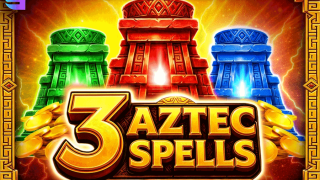
3 Aztec Spells Demo
Table of Contents
What 3 Aztec Spells immediately nails… and where it feels half-finished
3 Aztec Spells lands a few session-critical details right away: the reels are clean and legible, the three core features are clearly delineated, and the Aztec altar framing gives the whole screen a single focal point. Your eyes settle quickly. Symbols sit on dark stone tiles that keep contrast high, even when the more elaborate animations fire. On the flip side, two parts feel underdeveloped if you tend to play in longer blocks: the soundscape is competent but thin, and the symbol ladder leans heavily on a small cluster of premiums, which can make the base game blur together after a while.
A typical 45–60 minute stint has a recognisable rhythm. You move through stretches of quick-spinning base game where the low glyphs chip back small amounts, punctuated by waves of near-misses as the glowing spell scatters land on two reels, hang there for a beat, then fade. When one of the three spell features finally connects, it usually plays out briskly: a compact run of boosted spins or a focused pick/hold round, then straight back into standard play. These are not sprawling bonuses that eat half your session; most of your time is still spent on regular spins, just coloured by the question of whether “the next spell will be the one that matters”.
For someone who thinks in terms of sessions rather than one-off spins, three questions decide whether 3 Aztec Spells earns a place in rotation:
- How often do the three spells appear across an hour, and does one type dominate the mix?
- When features land, how do they actually shape your bankroll curve instead of just looking good on paper?
- Is the experience more comfortable and readable on a mobile screen during shorter bursts, or on a full desktop monitor for longer sits?
Those are the angles this review sticks with: how 3 Aztec Spells behaves over time, which features genuinely move the needle, and how device choice changes the feel of the game rather than just the resolution.
Jungle altar on a screen: theme, art direction, and visual identity
Ritual takes centre stage in 3 Aztec Spells, rather than a straight treasure hunt fantasy. Instead of cartoon explorers or slapstick animals, you get a moonlit stone altar, vines curling around the frame, and a priestess who looks mid-ceremony rather than posing for an action poster. The top of the screen is a stepped temple façade where the three spell orbs sit embedded in stone, each faintly pulsing even when nothing special is happening.
Colour choices lean into mysticism. Deep teal and jade dominate the backdrop, while warm gold is reserved for highlights: the rims of masks, the trim of the spellbook, the outline of the wild symbol. When a feature triggers, the whole screen does not explode into neon; instead, the altar glows from beneath in a steady amber, as if concealed fire pits just flared. That lighting shift makes bonus states obvious without crowding your vision with extra clutter.
Animation stays on the restrained side. Low symbols barely move, just a slight shimmer on a win. Mid-tier masks and totems rotate or snap forward a few pixels when they hit, drawing your attention to lines without turning the reels into a light show. The real motion is reserved for spell-related icons: blue runes spiral out from the spellbook during transformations, and the priestess’s eyes flash a quick green when she is part of a stronger win. Even in feature rounds, the screen rarely becomes so busy that you lose track of winning paths.
The interface keeps to stone slabs and carved buttons instead of glossy plastic UI. Bet controls appear as carved discs with glowing centres, and the spin button is a circular shield set into the right side of the altar. The whole thing reads as one cohesive “altar screen” rather than a collage of separate panels, which helps when you are deep into a session and scanning quickly.
Touchscreen rituals vs mouse clicks: mobile and desktop in 3 Aztec Spells
Desktop play in 3 Aztec Spells feels spacious. The 5×3 reel grid sits in the centre, with the temple top and spell orbs above it and a dark stone control panel beneath. Balance, bet, and win fields are separated with clear labels, and the main spin button is a large circle on the right, slightly overlapping the stone edge. Paytable and settings live in compact icons on the left, so everything important is visible without diving into multiple layers of menus.
On a phone, the altar compresses but remains recognisable. In landscape mode the reels shrink, the temple top is cropped closer, and the bottom panel folds balance and bet into a single bar. The spell orbs are still visible above the reels, though their labels are smaller; you rely more on colour and glow than text to see which spell might be on deck. Portrait mode lets the grid fill most of the middle of the screen, with a slim control bar at the bottom and a trimmed-down header up top. Background foliage and stonework lose some detail, yet the symbols remain readable.
From a UX angle, a few points matter for longer sessions:
- The spin button sits within easy thumb reach in both orientations. Autoplay is adjacent, but a second confirmation tap is required, which helps avoid unintended long runs.
- Bet adjustment uses simple plus/minus controls beside the stake display instead of a separate bet-builder screen. On smaller phones, the hitbox on those buttons can feel a bit tight if you are spinning one-handed.
- Feature explanations live in a standard help menu. On mobile, each spell’s description has its own page with compact diagrams; functional, but not something you want to parse while a bonus is already in motion.
Animation smoothness is generally acceptable across devices. On weaker phones, the fade-in of spell scatters and the pulse on near-miss spins can feel a touch slower, stretching the time between spins slightly. On a solid desktop setup, that hesitation is barely noticeable, and the game maintains a brisker tempo.
Totems, masks, and spellbooks: how the symbol ladder actually works
Symbol hierarchy in 3 Aztec Spells is clear, bordering on minimalistic. The lowest tier uses stone-carved card ranks, each etched into a different coloured slab: blue J, green Q, purple K, and red A. They blend into the stone backdrop visually, which helps readability but makes low-symbol wins feel anonymous. They are the ambient noise of your session.
Mid-tier symbols bring more personality: wooden totems with inset gems, a pair of crossed daggers, and two distinct masks (one sun, one moon). These have chunkier silhouettes and brighter edges, so you can spot them quickly. When they line up, the win is framed by a golden line and a faint sweep of light over the masks, guiding your eyes to where the payout actually came from.
Premiums tie directly into the spell concept:
- A glowing spellbook with blue runes swirling around it
- A jade amulet with a central red gem that pulses on a hit
- The priestess symbol, framed in a golden arch
- The torch-lit temple, acting as the top regular payer
Wilds appear as a golden mask with emerald eyes, clearly distinct from any regular symbol. They are easy to pick out thanks to a bright outline and a subtle flicker animation even when idle. Their own payouts are modest; their main role is to bridge gaps in premium lines. Scatters take the form of spell orbs, colour-coded to specific features and set into circular stone. They bypass payline rules and function primarily as triggers, so you read them as access keys rather than direct money-makers.
The paytable structure leans toward frequent, modest hits from card ranks and mid-tier icons, while meaningful balance movement tends to come from lines that include the temple or priestess, especially when a wild plugs a gap. That translates into many spins ending with minor chip-backs that slow your balance decline, while you quietly wait for a burst of premiums or a spell feature to create a noticeable swing.
Whispered chants and drum hits: the soundscape of 3 Aztec Spells
Audio in 3 Aztec Spells feels adequate rather than ambitious. The base soundtrack is a slow, looping piece built around low hand drums and a soft shaker-like texture, with a simple flute motif drifting in every dozen seconds or so. It sits low in the mix and does not shift dramatically when you move from base game to bonus; you get slightly busier percussion and a deeper drone under the flute, yet it remains recognisably the same tune. Across an hour, your brain starts to file it away as background noise, which keeps fatigue low but highlights its limited dynamics.
Spin sounds are clean and understated. Pressing spin triggers a short scrape, as if stone discs are turning, and the reels stop with a muted thunk rather than a sharp click. Wins are marked by a rising chime that comes in two tiers: a brief, light tinkle for very small wins, and a fuller, layered chord when you land something a few times your stake. Only larger hits extend into a longer musical flourish, with a quick drum roll underneath.
Scatter and spell cues stand out more. When two spell orbs land, a breathy chant fades in, panning slightly left and right while the last reel spins. If the third orb misses, the chant cuts off abruptly and the base loop reasserts itself, giving those near-misses a distinct emotional jolt. During the spells themselves, extra whooshes and crackles accompany transformations or special symbol drops, but the core soundtrack barely changes.
For players who like to grind sessions, the audio sits in a neutral zone. It is easy to leave it on without irritation, yet it rarely amplifies the sense of escalation when something truly important is happening on screen.
Unpacking the “3 spells”: bonus mechanics and feature rounds in detail
The title 3 Aztec Spells sets a clear expectation: three distinct spell features emerging from the same base game, each with its own flavour. For session-based play, it is more useful to understand how each behaves across dozens of spins than to memorise their names. One tends to appear as a light booster, one plays the swingy middle role, and the last is the clear pivot that can rewrite your running totals.
The game treats the trio as parallel paths rather than a strict progression. Each spell has its own scatter colour and trigger pattern, and across a long session you may see them in streaks, gaps, or occasional back-to-back chains.
How the base game feeds into the spell features
Spell-triggering symbols arrive as dedicated scatters on the main reels. You will see three different orb colours: for example, a blue orb representing the first spell, a green orb for the second, and a fiery red orb for the third. Each orb shares the same stone-ring frame, so you rely on colour and the central icon to tell them apart. They do not behave like regular scatters that pay on their own; their sole job is to open the door to features.
Trigger patterns are straightforward rather than cryptic:
- First spell: typically linked to landing 3 blue orbs anywhere on the reels
- Second spell: usually requires 3 green orbs, or occasionally an upgrade path from the first spell
- Third spell: the rarest, tied to 3 red orbs or to an upgrade chain that starts in another feature
The base game sprinkles these orbs sparingly but with a clear sense of drama. Two-orb spins are common enough that any 45-minute block will include plenty of “almost” moments. When the final reel spins with two orbs already locked in place, the reel slows slightly, the chant fades in, and the orb positions glow. Those sequences push you to pay closer attention, even though the underlying odds remain steady.
Chaining between spells is possible, though indirect. Certain outcomes in the first and second spells can award extra scatters or symbol upgrades that feed into another spell or extend the current bonus. For example, the second spell might drop additional red orbs during its free spins, effectively back-dooring you into the third spell. That overlap means your session can occasionally spike into a long run of interconnected features instead of isolated events.
First spell – the recurring boost and its real weight
Among the three, the first spell is the most frequent and feels deliberately modest. Triggered by landing 3 blue orbs, it usually awards a small batch of free spins with a single enhancement: either one premium symbol becomes stacked on all reels, or a random low symbol upgrades to mid-tier whenever it lands. Visually, a blue aura wraps around the chosen symbol, and a faint rune circle spins behind the reels.
Functionally, this spell has two roles. On the emotional side, it provides regular bursts of excitement so that long stretches of base spins do not feel empty. On the numbers side, it behaves mostly as a top-up. Across a typical session, you can expect to see this feature a handful of times, sometimes even twice in a 15–20 minute window if orb patterns run hot. Results tend to cluster in a fairly tight band: enough to refill part of what you have spent over the last few dozen spins, but not often pushing you into serious overall profit.
Over time, the first spell tends to look like this:
- Many triggers end somewhere in a modest range relative to your stake for the feature, depending on which premium is chosen and how often it connects.
- Because the special symbol is not locked into fixed positions, you are still at the mercy of regular reel distribution; some entire features limp along with scattered small hits.
- The highlights come when the stacked premium blankets three or four reels and combines with wilds. Those glimpses of stronger potential keep the feature from feeling purely routine.
For a session-minded player, expectation management is key. This spell behaves more like a recurring rebate with a slim chance of spiking than a hidden jackpot round. It softens the downward slope of your bankroll graph and occasionally buys you an extra half-hour of play.
Second spell – where accumulation and volatility start to matter
The second spell slots into the middle of the trio: less common than the first, more involved mechanically, and noticeably swingier. It usually comes from 3 green orbs landing, or from hitting a specific combination during the first spell that upgrades you. The trigger animation shifts the screen lighting toward green, and the priestess steps closer to the reels with raised hands as runes radiate outward.
This feature revolves around stickiness and build-up. You might enter with sticky wilds already placed on random positions, or with a multiplier that increases whenever a designated symbol appears. A typical structure looks something like this:
- You receive a limited number of free spins.
- Special symbols (for example, green rune tiles) either lock in place as wilds or increase a global win multiplier.
- The real payoff happens near the end, when all the accumulated elements finally interact. Early spins that looked empty can suddenly become important once the final layouts and multipliers are set.
From a session perspective, this is where variance steps up. Outcome spread is much wider than in the first spell:
- Some runs barely land any special symbols, finishing with a handful of small wins that feel weaker than a strong first-spell result.
- Others slowly build a network of wilds or a sizeable multiplier, and a single premium-heavy spin near the end can deliver a punchy hit.
Because of that range, the emotional arc here is different. The opening spins feel like setup: you watch to see whether sticky positions land in useful spots, whether the multiplier climbs, and whether premiums show up at all. The final couple of spins carry most of the tension, as you can usually tell whether the feature is fizzling or sitting one good spin away from something meaningful.
Realistically, the second spell has a higher typical ceiling than the first but also a higher rate of underwhelming outcomes. Over an hour, one decent hit from this feature can offset several weak first-spell rounds, yet waiting for it to show up in time can be uncomfortable if your balance is already trending down.
Third spell – the ritual that can actually flip a session
The third spell, wrapped in red light, feels like the real destination in 3 Aztec Spells. It arrives either via 3 red orbs in the base game or through an upgrade path inside the other spells, which explains how a session can suddenly pivot even after a long stretch of quiet spins. The trigger sequence is the most theatrical: the screen darkens, temple torches flare bright orange, and the three spell orbs above the reels merge into a single blazing disc before the bonus layout appears.
Mechanically, this spell often fuses elements from the earlier ones and pushes them further. A common approach is a hold-and-spin style bonus with growing values:
- Only special coin or gem symbols land, each showing a cash value or multiplier.
- You start with a limited number of spins, and each time at least one special symbol lands, the spin counter resets.
- Certain symbols carry modifiers, such as doubling all visible values, adding their value to others, or unlocking extra rows.
The grid can subtly shift as the feature progresses, with stone blocks cracking open to reveal deeper rows. Every new symbol landing triggers a sharp audio hit and a glow line that links it to the running total at the bottom of the screen.
This is where the game’s win potential feels most concrete. Over many sessions:
- A fair number of third-spell rounds will be solid but not spectacular, especially if you fill only part of the grid and land few modifiers. Those features deliver a medium bump, enough to claw back a chunk of a longer losing phase.
- A good portion of triggers will produce strong, clearly impactful wins that materially change your running total, sometimes wiping out an hour of slow decline.
- A small minority of features, particularly those where you unlock all rows and land multiple value boosters, can push your session into distinctly positive territory.
Because the third spell is relatively scarce, it functions as a natural pivot point. Many players mentally divide their time into “before the big spell” and “after the big spell”, using its outcome as a cue to either wrap up or reset.
The presentation reinforces that feeling. Candlelit backgrounds, heavier drums, and the constant possibility that “one more symbol might reset the spins again” create a genuine spike in tension. When the feature ends with a small total, the drop in energy is obvious. When it hits well, the slow counting of values has a satisfying weight to it.
What wins really look like in 3 Aztec Spells
Talking about win potential in 3 Aztec Spells makes more sense when framed as layers that show up across an entire session rather than chasing a single max-win number. The game broadly divides outcomes into three bands: everyday base game results, small to medium feature outcomes, and the rare larger hits that mostly anchor to the third spell.
Base game wins form the groundwork. Most spins either miss entirely or return small amounts from low and mid-tier symbols, often single-line hits with card ranks or a mask stretching across three reels. If you watch over 45–60 minutes, you will notice:
- Frequent small returns that cover a slice of each spin’s cost.
- Occasional larger line wins where two or three paylines connect at once, especially when a wild completes a temple or priestess combo.
- Infrequent but memorable “base-only” spikes, such as a full line of temples with a wild, which can rival or exceed a weaker feature.
Outcomes from the first spell sit on the second layer. Their frequency and modest range mean they shape the texture of your bankroll graph. Many first-spell rounds will:
- Land in a zone where you end up with a small net gain or mild loss relative to the cost of the triggering spins.
- Sometimes flatten out your curve for a while, essentially paying back what you have spent recently.
- Occasionally jump higher if the stacked premium connects across multiple lines with help from wilds.
The second spell injects more volatility. Its distribution tends to look like:
- A noticeable share of “quiet” rounds that barely rise above a good base game hit.
- A central band where you get a clear, satisfying lift that shifts your session numbers but does not transform them.
- A smaller slice where sticky wilds or multipliers line up with premiums in the final spins, producing genuinely large returns relative to your stake.
The third spell is where the biggest realistic outcomes cluster. Over extended play:
- Disappointing third-spell rounds happen; a half-filled grid with few modifiers can end with only a modest improvement.
- A solid proportion of triggers generate strong wins that materially change your running total, sometimes erasing a long downward patch.
- A rare subset reach the kind of result that feels like a natural endpoint for the session, often involving near-full grids and stacked modifiers.
Your personal sense of 3 Aztec Spells’ generosity will depend heavily on how often you see the second and third spells in your own timelines. Several hours with only weak features can make the game feel stingy, whereas a single well-timed strong third spell can make the entire experience read as generous.
What does stand out is that excitement is spread across layers. Strong base-line hits and better-than-expected first spells happen often enough to keep you engaged, even if the real “session stories” tend to revolve around how your bigger spells landed.
Session pacing and rhythm in 3 Aztec Spells
Looked at through a bankroll-slope lens, 3 Aztec Spells settles into a recognisable tempo. Base spins resolve quickly, with short stop animations and minimal lag between results. If you skip or shorten win celebrations, the spin count per hour can climb quite high.
The pacing is built around specific punctuation beats:
- Short runs of uneventful spins where low symbols dominate but each spin resolves briskly
- Periodic clusters of blue-orb sightings leading into first-spell triggers that lightly reshape your balance
- Less frequent sequences of green or red orbs that hint at access to the more impactful spells, where even near-misses slow the perceived time between spins
Autoplay keeps that rhythm steady, while feature interruptions and near-miss slowdowns break up any sense of mechanical repetition. Across a 60-minute play, you tend to remember the session as a sequence of “spell attempts” and outcomes rather than a blur of anonymous spins.
One subtle pacing trait is the compact length of the features themselves. None of the spells stretches into very long bonus rounds. Even the stickier second spell and the hold-style third spell wrap up within a manageable window. That leaves a larger share of your time in the base game compared with more bonus-heavy titles, suiting players who prefer a steady grind with sharp peaks instead of extended bonus marathons.
The altar’s first impression: theme, art direction, and visual identity in motion
Spending real time with 3 Aztec Spells reveals a visual identity that holds up during long sessions. The altar framing stays constant, but small shifts keep it from feeling like a static painting. Whenever a spell triggers, the torch flames at the edges surge higher, casting different shadows on the stone columns. Dropping back into the base game, those flames settle and a faint mist creeps across the steps below the reels, hinting that the ritual is still simmering in the background.
Symbol motion supports that sense of continuity. Low glyphs flicker briefly and then sink back into the stone. Masks and totems lean forward just enough on wins to feel physical without crowding the grid. Spell orbs remain the most animated elements, pulsing quietly even between spins, which keeps your peripheral vision keyed in on potential feature triggers.
Colour and lighting choices make long sessions easier on the eyes. The dominance of cooler greens and blues, with gold used sparingly, means your screen does not feel overexposed even in darker rooms. When bonuses hit, the warmer glow and heightened contrast announce the change of state clearly but avoid the kind of flashing overload that can become tiring if you are playing for an hour or more.
Slot fingerprint
- Three distinct spell features that shape the session into repeated “ritual cycles” rather than one-off bonuses
- Compact, fast-resolving features that keep most of your time in the base game with sharp, focused peaks
- A clean altar-style layout where spell orbs and premiums are easy to track even on mobile
- Audio that leans understated, with scatter chants doing most of the emotional heavy lifting
- Win profile built around modest first-spell top-ups, swingy second-spell bursts, and a rarer third spell that can flip the session narrative
Decision points
- Choosing whether to play on mobile portrait for quick bursts or desktop for clearer tracking of spell orbs and feature triggers
- Deciding how much to lean on autoplay versus manual spinning, especially if you like to pause when you see streaks of orbs or premiums
- Toggling win celebrations and animation speed to either maximise spins per hour or slow things down for more deliberate play
- Treating the outcome of a strong second or third spell as a natural stopping point, or continuing the session to see whether another big ritual appears
- Adjusting your typical session length based on how recently you have seen the rarer third spell, particularly if you prefer sessions that end on a high note
More Slots from Spinomenal








| Provider | Spinomenal |
|---|---|
| Layout | N/A |
| Betways | N/A |
| Max win | N/A |
| Min bet | N/A |
| Max bet | N/A |
| Hit frequency | N/A |
| Volatility | N/A |
| Release Date | 2026-09-21 |