Wheel of Horrors Demo
Table of Contents
A hundred spins in the dark: how Wheel of Horrors actually feels
A single session snapshot: 100 spins, one uneasy arc
Imagine loading up Wheel of Horrors at a Canadian-facing casino, setting your stake to a middle‑of‑the‑road $1 per spin, and committing to an even 100. The screen is mostly dark, all bruised purples and rusted reds, that big cracked midway sign arching over the reels. During the first dozen spins, nothing particularly dramatic turns up: a few low-paying card-style symbols line up, a medium premium brushes across three reels, the balance dips a few dollars, then claws some of it back. What stands out more than the wins is the rhythm; the reels fall with a kind of slow mechanical drag, then settle in a staggered pattern that lets your eye check each column in turn.
Those early spins lean heavily on suggestion. A masked figure symbol lands just above the payline and hangs there for a half-second too long before snapping into place; a ringmaster appears twice on reels one and two and then leaves an empty window on reel three, the game holding that final stop for a breath. The UI quietly tallies up $0.20, $0.40, $0.80 wins, while your starting $100 rolls down to $94 without much protest. The game isn’t trying to dazzle you out of the gate; it behaves more like a haunted house hallway where the creaks and flickers matter more than what is actually jumping out.
By the time you drift into the middle of the session, somewhere around spin 40, the balance has sagged into the low $80s. That drop doesn’t feel brutal, just persistent, like paying small change to keep walking deeper into the carnival grounds. Then a small turning point arrives: a cluster of premium horror attractions land across four reels, one of them stacked, and the screen finally wakes up. The lights along the reel frame flare, the winning symbols bleed colour into the neighbouring tiles, and the win counter climbs in a smooth roll to $22. For a brief moment, the math and the theatre align, and your bankroll jumps back to $98, close enough to even that your memory quietly resets.
The second half of the 100-spin run never really tops that. You get a few echoes of that medium win — a three-of-a-kind masked figure, some four-line hits of the low pays — but nothing that meaningfully pushes you into profit. The mood shifts from “will it ignite?” to “how much of this ticket did the carnival take?” The near-misses get a bit more blatant: two high-premium ringmasters land with empty space between them, the reels stall on columns four and five more often, and you start recognizing certain dud patterns before they finish rolling. The animations stay moody, the fog keeps sliding along the bottom of the screen, but the balance keeps drifting down.
When the hundredth spin thuds into place, you’re sitting on roughly $76. Not a disaster, not a miracle, just a noticeable $24 shaved off over fifteen or twenty quiet minutes. What lingers is less the money and more a feeling of almost: the way the masked figure kept appearing in fragments, how the ringmaster’s hat brim sometimes just clipped the visible area above the reels before disappearing, how that one decent win briefly made the whole carnival blaze. You walk away with a couple of visually sharp moments lodged in your head, and the sense that the game is tuned to live in that gap between tension and payoff.
Why that session behaves that way: hidden numbers under the horror
That 100-spin story captures less a lucky or unlucky streak and more the outline carved by Wheel of Horrors’ underlying math. The little runs of nothing, the scattered mid-sized hits, the single standout win that almost resets your balance — that pattern grows out of the combination of long-term return, volatility, and how often any spin connects with a win line. It doesn’t come across as a smooth trickle of paybacks. It plays like a series of long, slightly oppressive corridors with the odd room that suddenly lights up.
Wheel of Horrors seems to sit in the mid‑ to high‑return band typical for modern video slots, likely somewhere in the low to mid ninety‑percent range. Canadian sites sometimes carry different configurations, so the exact percentage will depend on the operator, but the general sensation stays consistent: over time, the game trims your balance slowly, then occasionally hands you enough to feel like you’ve been given a reprieve. That $24 loss over 100 spins lines up with that idea. You don’t crash down to half your bankroll, yet there’s never a sense that the game is trying to keep you perfectly even.
Volatility does most of the personality work here. Wheel of Horrors leans away from constant $0.10 and $0.20 relief wins on a $1 bet and more toward fewer, more noticeable payouts. The hit frequency feels moderate, with entire five‑ or six‑spin sequences where nothing happens but visual ambience, then a spin where three different lines connect at once. It is a slot that makes you watch the reels rather than just your balance. The pacing is measured, and when something connects, the animations and sound cues broaden out to match.
That framing matters because it sets expectations for everything else you see and feel. Once you recognize that the numbers under the surface are tuned for mood and unease rather than a constant stream of tiny rewards, the long silences between wins stop feeling like glitches and start reading as part of the design. The following sections dig into how the visuals, the math, and the betting range interlock to create that very specific “hundred spins in the dark” sensation.
Blood‑red curtains and flickering bulbs: Wheel of Horrors’ visual identity
Setting the scene: a haunted carnival, not just another graveyard
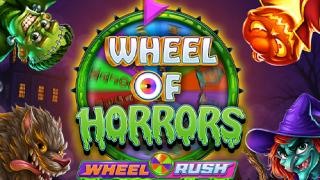
Wheel of Horrors steps away from the usual tombstones‑and‑bats template and instead plants its reels in the middle of a decaying carnival midway. The backdrop shows crooked game stalls with peeling paint, sagging canvas banners that droop into the upper corners of the screen, and a rusted Ferris wheel silhouette barely visible through layered mist behind the reels. Nothing in the scene is static: strings of broken bulbs swing slightly in an unseen breeze, and the fog loops across in slow, uneven drifts that feel more like breathing than a simple video loop.
Colour choices do a lot of the atmospheric heavy lifting. You get deep, bruised purples in the sky and shadow, rusted reds around the reel frame and curtains, and that specific sickly green you see in old fluorescent tubes that should have been replaced years ago. Against that, the symbols sit on slightly desaturated reel strips, which actually helps legibility; the low-paying card suits and numbers are rimmed with pale edges, while the premium horror attractions use sharper contrasts and heavier highlights. On a regular laptop display, even with the darker aesthetic, it’s surprisingly easy to scan wins at a glance. The designers resist the urge to drench everything in pure black, which keeps the reels readable rather than murky.
Motion between spins feels unhurried. Small ember-like motes drift across the front of the reels, sometimes passing “in front” of the symbols, sometimes behind them, giving a mild parallax effect. When you press spin, the reels fall with a certain mechanical weight, and the background elements barely accelerate; the carnival stalls and Ferris wheel stay locked in their slow decay while the foreground does the work. When a win lands, though, the game allows itself a sharp cut: the winning symbols surge in brightness, the curtains along the reel frame flare, and the ambient fog compresses inward as though being pulled toward the centre.
One neat touch lies in how the interface is folded into the carnival apparatus. The spin button is styled as a cracked midway wheel with metal studs, sitting in a slot at the bottom that looks like it was carved into the wooden ticket counter. The balance and bet readouts are set on faded placards bolted to the sides of the frame, as if they were once price boards for games long abandoned. None of it feels like a generic control panel pasted on top of a picture; the UI looks physically attached to the haunted set, which helps the entire screen read as one coherent object rather than art plus overlay.
Character work on the reels: who actually lives in this slot
On the reels, the carnival’s cast carries the theme. The top-tier premium is a ringmaster who looks halfway between human host and something else entirely. He’s drawn with thick, confident line work around the coat and hat, but his face has thinner, jitterier lines, like an etching that was redrawn several times. There’s a subtle asymmetry to his eyes if you look closely; one is just slightly more open than the other, which gives him an unnerving alertness even when nothing is moving. When a win involving him triggers, the shadows under his hat brim deepen and his teeth catch a thin strip of that sickly green light.
Below him sits a masked figure, face completely covered except for two oval holes that reflect a faint, moving glint. The designers lean on texture here: the mask surface looks like cracked porcelain lit from a single side, with hairline fractures catching highlights as the reels stop. Opposite that is a symbol of a carnival attraction, something like a distorted funhouse entrance with teeth for an archway, rendered in thicker contour lines and heavy shading that makes it pop from the reel strip. You can read at a glance that these are the symbols that matter, simply from how much ink and contrast they carry.
Low-paying symbols are still themed, but with lighter treatment. Instead of plain letters and numbers, the J, Q, K, and A are fashioned from twisted marquee tubing, each letter outlined with tiny unlit bulbs. Their line weight is much finer than the premiums, and their colours are flatter: an off‑gold K, a dull blue J, the occasional chipped red A. This creates a clear visual hierarchy. Even when multiple lines hit at once, your eye goes first to the thick, richly shaded premiums and then down to the thinner, more neutral lows.
Idle motion is kept restrained, which suits the tone. On non‑winning spins, some of the human‑like faces have a barely visible breathing loop; the ringmaster’s chest rises and falls one or two pixels, and the shadow across his face subtly shifts. The masked figure sometimes catches a distant flash of green in one eyehole, almost like a passing reflection from the Ferris wheel behind the reels. Cloth elements — the ringmaster’s coat tails, the banners behind some of the attraction symbols — sway just a hair, enough to keep the screen alive without turning it into a cartoon. It reads as a haunted carnival that is waiting, not one that is constantly jumping.
Animation timing and the way horror is suggested rather than shouted
Pacing is where Wheel of Horrors really leans into its horror tone. Reel stops are staggered: the first column snaps into place fairly quickly, the second hesitates for a split‑second longer, and by the time the fourth and fifth reels are coming down, the pace has slowed to a crawl. Occasionally, particularly when a strong combination is possible, one of those late reels will seem to “stick” for a beat, a slight stall before the symbol locks in. That hesitation only lasts a fraction of a second, but it’s enough for your brain to sketch both outcomes.
Win animations mirror that sense of building then releasing tension. When a line connects, the involved symbols don’t immediately burst into fireworks. Instead, their outlines thicken and darken first, the colour saturates, and then they pulse outward with a faint bloom effect that spills into neighbouring tiles. The ringmaster’s symbol, for example, doesn’t just flash; a ring of marquee bulbs around the reel frame sputters on, a few bulbs failing to light, and the screen seems to flex toward the middle before the win amount begins counting up. On larger wins, faint cracks spider across the glass effect over the reels, holding for just a moment before resetting, as if the slot itself almost couldn’t contain the pressure.
The game is comfortable with silence. There are full losing spins where the audio drops back to almost pure ambient hiss and distant metal creaks, and the only on‑screen motion is the lazy fog slide and a few shifting shadows. Those empty beats make the occasional big animation feel louder without actually cranking the brightness or speed too high. When you do hit something decent, the game allows that moment to breathe: the win count‑up is neither rushed nor dragged out; it occupies a few seconds that feel exactly as long as the visual flourish demands.
Even losing spins get small, tasteful touches. If a particularly promising pattern fizzles out, some of the bulbs in the reel frame briefly dim, and the fog thickens for a second before thinning again. Sometimes a banner in the backdrop tears a little more, or a distant carnival ride light fizzles out in a puff of static. These gestures are tiny, and you might not consciously notice them in the first few minutes, but they stop the screen from feeling like a flat “nothing happened” void. It all plays into that sense of a location with its own slow, unsettling life.
Interface clarity in low light
A dark slot can easily become a legibility mess, especially on the kind of smaller laptop screens a lot of Canadian players actually use. Wheel of Horrors handles that tension between style and usability with more care than most. The bet controls sit in a slightly lighter wooden slab at the bottom of the screen, with rounded edges that separate them from the deep shadows behind the reels. Text on those controls uses a clean, sans‑serif font in a pale ivory tone, which keeps numbers readable even at reduced window sizes.
The balance and last win readouts are anchored near the lower corners on weathered signboards. Despite the thematic dressing, the key figures stand out thanks to high contrast and sensible spacing. You do not have to hunt for your remaining bankroll; your eye drops naturally to the lower left, where the number is framed but not interfered with by decorative elements. The font weight is consistent, which matters on long sessions when your eyes start to tire; nothing is so ornate that it becomes a puzzle.
Spin results are quick to parse. When a win lands, only the winning lines receive heavy visual treatment, and line indicators are understated: faint glowing traces that connect symbols without scribbling all over the reels. The win amount pops up near the centre‑bottom, right above the spin button, in a size that reads clearly without dominating the screen. You are not forced to scan three different corners to understand what just happened; the game has a simple hierarchy of information, and it sticks to it.
For multitaskers tabbing between a game, a streaming window, and maybe a box score on another monitor, this clarity is easy to appreciate. You can glance back at Wheel of Horrors and immediately see if something notable happened or if the last spin was another atmospheric miss. The horror lives in the art direction, not in having to squint at muddy controls.
Under the mask: how Wheel of Horrors’ math model actually plays
RTP as a mood, not just a percentage
From a numbers standpoint, Wheel of Horrors feels like it lives somewhere in that common mid‑ninety percent return zone you see on a lot of video slots in Canadian lobbies. Exact configurations can shift from site to site, so it is worth checking the stated value in the game info panel wherever you play, but your balance line across a few hundred spins supports the idea that the game is designed to give back a decent share over time while still leaning into suspense.
On a practical level, that means a 100‑spin stretch like the one described at the top — starting at $100, ending near $76 — sits comfortably within the game’s personality without things feeling especially brutal. Over thousands of spins, the math wants you to converge toward that theoretical return, but in the shorter, more human‑sized sessions most people actually play, what you feel is suggestion rather than law. The slot slowly taxes your bankroll, then punctuates that with visually satisfying wins that often restore a chunk of what was shaved away.
Emotionally, that sort of return level carries a “gate fee” vibe. You are not walking into a hyper‑greedy house where every spin feels like a punch; instead, you are paying incrementally to stay immersed in the haunted carnival, with occasional refunds in the form of nicer hits. When you do connect with something that has a bit of weight, the size of the win feels decent relative to what you put in, especially given the game’s willingness to let those moments linger with generous animation time. The trade‑off is that the long‑term expectation remains tilted slightly against you, which becomes clearer if you chain several 100‑spin sessions back‑to‑back.
Volatility and the shape of your balance line
Volatility is where Wheel of Horrors shows more personality. The game is not chasing the ultra‑choppy, feast‑or‑famine experience some high‑volatility titles favour, where your first 100 spins might see nothing meaningful at all followed by one enormous event. Instead, it seems to settle into that upper‑middle band: long sequences where nothing significant happens, but with enough small and medium wins dotted through to keep the balance graph from turning into a sheer cliff.
In play terms, that means accepting that you will see patches of five, eight, sometimes even ten empty spins where your only feedback is visual. The reels come down, patterns suggest, and then row after row of mismatched bulbs and letters lands. That can be quietly draining when you are on a fixed bankroll. Then, almost abruptly, you get a spin where several mid‑tier character symbols align across multiple lines, and your $1 bet returns $10, $15, $20 in one go. The overall trend might still be downward, but it is drawn as a series of gentle slopes punctuated by sudden upward steps.
Consider two different players running that 100‑spin session. One hits their medium win early, say on spin 18. Their balance jumps from $92 back to $108, and they spend the following 80 spins slowly sliding down from that peak, ending near or just under their starting point. The second player doesn’t hit any serious connection until spin 73; they dip all the way down to $60, then bump up to $82 with that one better hit, and finish the set somewhere around $70. Both sessions reflect the same underlying volatility and return, but the emotional arc feels very different.
The slot nudges you to think in clusters rather than individual spins. When something lands, it often lands in pairs: a medium win followed a few spins later by another decent but smaller hit, then a lull. Your balance line starts to resemble a series of craggy hills rather than a smooth diagonal. That shape is part of the charm if you like watching patterns start to form and then either materialize or evaporate. It can also be frustrating if you are someone who wants a more constant drip of small wins to reassure you that “something is happening” every few spins.
Stakes in the shadows: betting range and bankroll sizing
Stakes in Wheel of Horrors usually cover a broad enough range to suit most Canadian bankroll styles, from cautious low‑stakes sessions to more assertive mid‑stakes play. Minimum bets are typically very accessible, often in the $0.10–$0.20 area, while maximum bets can climb into amounts that only matter to high‑rollers. Exact limits can change between casinos, but the structure is standard: you set a base stake (sometimes via coin value or line settings), and the total wager updates cleanly in the UI.
Given the volatility profile, the game tends to reward a slightly more conservative approach to session planning. Working with a $50 deposit and hovering around $0.50 per spin effectively buys you a hundred spins with a reasonable chance of either walking away with a modest loss and a few notable hits, or landing one or two bigger wins that push you into the black. Pushing that same bankroll into $2 spins tightens the window considerably and makes those mid‑length losing stretches feel much sharper. The slot’s slow‑burn tension is easier to appreciate when you have enough runway to ride out the quieter periods without feeling cornered.
Neighbours in the nightmare: comparisons to adjacent slots
Among spooky‑themed games, Wheel of Horrors sits in an interesting niche. The haunted carnival angle gives it a slightly different flavour than the standard gothic graveyards and Victorian mansions. Compared with more cartoon‑leaning horror slots that fill the screen with exaggerated monsters and neon slime, this one feels more restrained and textural. It comes closer in mood to the handful of “derelict funfair” titles out there, but leans harder into low light and slow motion, trading slapstick jump scares for a quieter unease.
On the mechanical side, it feels comparable to mid‑ to high‑volatility horror titles where the base game carries more of the weight. Rather than peppering you constantly with tiny wins and elaborate mini‑games, Wheel of Horrors uses its regular spins as the main stage, with a math curve that sits a little gentler than the starkest high‑volatility thrill rides. If you are used to very spiky games where nothing happens for twenty spins and then a single feature attempt dominates your memory, this one will feel more like an extended, uneasy walk through a very carefully lit midway.
Marquees and masks: symbol hierarchy and paytable shape
The structure of the paytable follows a familiar curve but is expressed cleanly through the symbol design. At the bottom, you have the twisted marquee‑letter J, Q, K, and A symbols delivering small wins that rarely cover your stake, but that sometimes stack across multiple lines to soften a losing run. Above them sit a tier of mid‑paying horror attractions — things like a snarling clown booth or a warped shooting gallery sign — that pay respectably when you land four or five of a kind, especially across several active lines.
The real attention, and most of the payout potential, rests with the character premiums. The masked figure, the ringmaster, and any other top‑tier faces form the upper rung of the hierarchy, with five‑of‑a‑kind hits capable of turning a dull patch into a meaningful spike in your session graph. You can sense this structure even without opening the paytable: larger wins almost always feature at least two reels thick with these faces, often in partial stacks that echo the theatrical key art. That intuitive clarity helps; after a short while, you know exactly what you are rooting for the moment the first two reels lock in.
Common mistakes & traps
Wheel of Horrors invites a few very specific missteps that show up again and again when people talk about their sessions. Some are about money, some are about mood, and a few are simply about misreading what the game is actually doing.
One of the most common is treating it like a fast, low‑volatility grinder and upping the bet size too quickly. The deliberate reel speed and modest hit frequency can trick you into thinking you need bigger stakes to “make something happen”, but that just magnifies the impact of the quieter stretches. A steadier stake lets the game’s pacing breathe without turning every empty spin into a sting.
Another frequent trap is reading the visual drama as a sign that a major payout is just around the corner. The game is generous with near‑miss theatrics: reels that stall when a key symbol could land, shadows that tighten around strong patterns, and symbols that glow even when they are not completing a line. Those moments create atmosphere, not promises. Chasing them aggressively, especially by bumping your stake after a series of “almost” screens, is a reliable way to dig a deeper hole.
A third pitfall lies in underestimating how quickly the gentle downward drift can add up over time. Losing a quarter of your starting bankroll over 100 spins might not feel catastrophic, but repeating that two or three times in a row without adjusting expectations or stakes can quietly erode your session budget. The game’s moody ambience can make it easy to lose track of that slow erosion if you are mostly focused on the visuals instead of the numbers.
There is also a tendency for some players to fixate on a single symbol, usually the ringmaster, and mentally treat anything else as “wasted” spins. That mindset can make the many medium‑tier wins built from masked figures and attraction symbols feel less satisfying than they actually are in terms of keeping you afloat. Paying attention to the full symbol ladder, not just the very top rung, gives a more honest sense of how the game is treating you.
Finally, it’s easy to misjudge session length with Wheel of Horrors. Because the spin pace is slightly slower and the ambience is dense, twenty minutes can slip by much faster than you expect. Planning for a certain number of spins instead of “I’ll stop in a bit” helps keep the session from stretching far beyond what you initially had in mind.
Where Wheel of Horrors falls a little short
For all its craft, Wheel of Horrors does have a few rough edges that are worth being candid about. The first is that the deliberate reel speed, while thematic, can start to feel sluggish if you are used to snappier games or if you like to get through a lot of spins in a short window. There is atmosphere in those staggered stops, but there is also a cost in terms of pace.
The volatility band, sitting in that upper‑middle space, can also feel slightly indecisive. You do not get the constant peppering of tiny wins that makes some low‑volatility slots feel chatty, yet you also do not see the kind of rare, explosive base‑game moments that define the sharpest high‑volatility titles. For some players, that means the emotional payoff does not quite match the tension the visuals set up.
Another small weakness lies in symbol variety. While the core cast is strong, extended sessions can make the reel set feel a bit samey; you are looking at the same faces and stalls over and over, with relatively few surprises in how they are arranged. The art direction is good enough that it holds up, but a touch more variation in the mid‑tier symbols could have helped the game stay fresher over longer runs.
Lastly, the darker palette, though handled carefully, still depends a lot on your screen and ambient lighting. On a dim phone screen or an older laptop panel, some of the subtler background details and low‑contrast animations can disappear into the murk, leaving the game feeling flatter than it looks in ideal conditions.
Quick answers: Wheel of Horrors FAQ
Is Wheel of Horrors suitable for small bankrolls?
It can be, as long as you keep the stake modest. The volatility means you should give yourself enough spins to ride out lean stretches, so pairing a low bet size with a fixed spin count usually works better than jumping in at higher stakes.
How “scary” is the theme, really?
The tone is eerie rather than gory. You get unsettling characters, a decaying carnival backdrop, and some tense animation timing, but nothing that crosses into graphic horror. It feels closer to an old haunted midway than a splatter movie.
Does the game pay often, or does it rely on rare big hits?
Expect a middle ground. You will see runs of empty spins, then clusters of small and medium wins that lift the balance in noticeable steps. Huge hits are less common, but the base game is active enough that you are not just waiting for one event.
Can I change the speed of the spins?
Some casinos or versions may offer a quick‑spin toggle in the settings, while others stick to the default pacing. It depends on the implementation, so it is worth checking the options menu on the version you are playing.
Is Wheel of Horrors better for short sessions or long ones?
It leans slightly toward longer, more measured sessions, where you have time to see the balance line rise and fall in those small hills. Short hit‑and‑run bursts can work, but the game’s personality comes through more clearly when you let a few dozen spins unfold.
More Slots from Iron Dog Studio





| Provider | Iron Dog Studio |
|---|---|
| RTP | 95.00% [ i ] |
| Layout | N/A |
| Betways | N/A |
| Max win | x10000.00 |
| Min bet | 0.1 |
| Max bet | 25 |
| Hit frequency | N/A |
| Volatility | High |
| Release Date | 2026-10-21 |