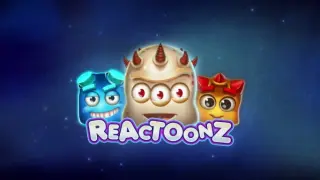
Reactoonz Demo
Table of Contents
Reactoonz Slot Review Overview
What is Reactoonz and why do players talk about it?
Reactoonz is a 7x7 grid slot from Play’n GO that has turned into a bit of a cult favourite at Canadian online casinos. Instead of traditional reels and paylines, you get a colourful board filled with bouncing cartoon aliens that drop into place, explode in clusters, and chain into long cascades of wins.
Players talk about Reactoonz for a few reasons:
- It doesn’t use standard free spins. Everything happens on the main grid through modifiers and wilds.
- The gameplay can flip from “nothing’s happening” to absolute chaos in a single spin when the Quantum features and Gargantoon line up.
- It mixes arcade‑style fun with serious high‑volatility potential in a way that’s quite distinctive.
The slot is fast, noisy, and sometimes brutal. Sessions can feel quiet for a while, then suddenly one spin will charge multiple meters, transform the entire grid, and drop a huge wild Gargantoon for a shot at a big hit. When that happens, the screen lights up and it’s hard not to lean in a bit closer.
Who is this slot best suited for? (casual players vs high‑risk fans)
Reactoonz is not a relaxed, low‑variance fruit machine where you slowly grind small wins. It sits much closer to a high‑risk, high‑reward grid game.
It tends to suit:
- Players who enjoy volatile games and are comfortable with long stretches of small or no wins.
- Fans of cluster slots like Jammin’ Jars or other Play’n GO “toon” titles who like building towards big features.
- People who enjoy visual chaos and chain reactions rather than simple single‑line hits.
It can still work for casual players, especially those who like playful themes and low minimum bets, but it is important to understand that the balance swings can be sharp. Anyone who prefers a steady trickle of predictable payouts might find it a bit stressful, especially if they expect frequent bonus rounds.
Quick snapshot of key facts (provider, release date, format, standout mechanics)
Here’s the quick rundown of what matters before you dive in:
- Provider: Play’n GO
- Release date: 2017
- Format: 7x7 grid, cluster pays
- RTP: Typically around 96.00%, but can vary by casino version
- Volatility: High
- Hit style: Cascading clusters, chain reactions, feature‑driven
- Top mechanics:
- Quantum Leap charge meters with 4 different modifiers
- Fluctuating symbols that add wilds
- Random Instability wild drops
- Gargantoon feature: a walking stack of giant wilds that split and re‑drop
It’s a pure feature‑driven grid slot. There is no separate bonus round. Everything comes from building clusters, charging meters, and hoping the modifiers stack in your favour on the main screen.
First Impressions: Theme, Atmosphere & Visuals
General theme and setting (quirky aliens and sci‑fi lab vibe)
Reactoonz takes place inside a strange sci‑fi chamber where a cast of cartoon aliens is being studied, prodded, and occasionally blasted off the grid. The background looks like a glowing lab with dials and energy tubes, and the centrepiece is the 7x7 playing area, floating slightly forward like a viewing window.
Off to the side, you’ll see Gargantoon, the big multi‑eyed alien sitting in his pod, watching over the grid. As you win and fill the Quantum meters, he gets more animated, hinting that something bigger is coming. The whole thing feels like a mix between a kids’ cartoon and a physics experiment, with just enough sci‑fi flavour to keep it from feeling too cute.
The tone is playful rather than serious. Even when the game is eating your balance, the bouncing aliens and soft neon colours keep it from feeling too harsh. It’s more like watching a chaotic arcade screen than a traditional slot cabinet.
Art style and animation quality
Graphically, Reactoonz has aged remarkably well. The aliens are drawn with bold outlines and clean shading, each with distinct shapes and expressions, so you can quickly tell them apart even when the grid is packed.
There’s a satisfying sense of motion throughout:
- Winning clusters wobble and pulse before vanishing.
- New symbols drop with a soft bounce, like jelly creatures landing on glass.
- When features kick in, you’ll see beams, vortexes, or cross‑shaped cuts slice through the symbols.
The Gargantoon animation is the highlight. When the feature is ready, he doesn’t just appear. The entire chamber flickers, he roars to life, and then slams onto the grid as a massive 3x3 wild block before breaking apart into smaller pieces over subsequent cascades.
Visually, it is deliberately busy, but the art direction keeps it readable. Even in a messy cascade, you’re rarely confused about what just happened, and the colour coding of symbols makes it easier to follow the action at a glance.
Sound design, background music, and how “busy” the game feels
The soundtrack is a mix of soft sci‑fi ambience and quirky bleeps. During quiet spins, you hear low electronic hums and occasional alien babbles. When wins land, the soundscape ramps up with chiming notes and cartoonish effects that match the popping clusters.
Key audio cues include:
- Small wins: light pops and chimes, quick and unobtrusive.
- Quantum features: a distinct “charging” sound as each bar fills, then a more dramatic cue when a modifier triggers.
- Gargantoon: a heavier, almost “boss fight” style sound as the lights flash and the grid shakes.
Over longer sessions, some players might find the audio a bit intense, especially when the game enters long chains of cascades and the sound effects stack on top of each other. Luckily, you can lower or mute the sound in the settings without affecting gameplay at all.
Visually and audibly, it is a “busy” game. There’s something happening every few seconds. Anyone who prefers calm, minimalist slots might find Reactoonz a bit overwhelming, while players who enjoy sensory feedback will likely appreciate the constant movement.
How Reactoonz feels to play on desktop vs mobile (layout, controls, performance)
On desktop, the 7x7 grid sits comfortably in the centre of the screen with the control panel below. The Quantum meters and Gargantoon pod are tucked to the right, easy to watch out of the corner of your eye while focusing on the main grid.
On mobile, the layout is tightened up but still readable:
- The grid scales well to portrait mode, with the aliens remaining distinct even on smaller screens.
- Buttons are large enough to tap without misclicking.
- The meters and Gargantoon are still visible, though you rely more on animation and sound cues than on small text.
Performance at most Canadian casinos is smooth as long as your connection is stable. The constant animations and cascades mean it’s not the lightest slot, but modern phones and tablets handle it well. The pacing actually feels quite natural on touchscreens, where rapid tapping between spins is common.
Grid Layout & Core Mechanics
7x7 grid and cluster pays system explained
Reactoonz uses a 7x7 grid instead of reels. Every spin, 49 symbols drop in from above to fill the board.
There are no paylines. Instead, the game uses a cluster pays system. You win when:
- 5 or more matching symbols touch each other horizontally or vertically (diagonal contact doesn’t count).
These clusters can be any shape, as long as each symbol in the group is connected to another of the same kind through a side, not just a corner.
The layout feels closer to a puzzle game than a classic slot. You’re scanning for pockets of matching aliens, watching them pop, then seeing how the new symbols fall into the gaps to potentially link up fresh clusters.
Cascading wins and symbol drops (how rounds flow)
Once a winning cluster is formed:
- The cluster pays according to its symbol and size.
- All winning symbols are removed from the grid.
- Remaining symbols fall down into the empty spaces.
- New symbols drop from above to fill the top.
If this creates a new cluster, the process repeats in the same paid spin. This is what gives Reactoonz its long “chain reaction” potential. A single spin can stretch into a series of small and medium wins, charging meters and triggering features along the way.
There is no hard limit to how many cascades you can get from one spin. In practice, the chain stops once no more clusters form and no features remain to be triggered, but some rounds can run for several seconds as the grid keeps reshuffling itself.
How wins are evaluated and paid (cluster size, adjacency rules)
Payouts in Reactoonz depend on two things:
- The symbol type (low‑value one‑eyed aliens vs high‑value two‑eyed aliens).
- The size of the cluster (minimum of 5, with higher rewards for larger clusters).
Only horizontal and vertical adjacency counts. A symbol touching a match only by a corner is not considered part of the same cluster.
A 5‑symbol match is the smallest winning cluster. As the cluster grows (for example 8, 12, 15 of the same alien), the payout per spin increases. The biggest hits usually come from very large clusters of high‑value aliens, often assisted by wilds and modifiers that clear out low‑value clutter and pull similar symbols together.
Energy meter / Quantum Leap basics (high‑level overview before details)
Every time you land winning clusters, the game charges an energy meter called the Quantum Leap. It is displayed as a set of bars to the right of the grid.
Key basics:
- Each win fills the meter by a certain number of “charges” based on the number of symbols in your winning clusters.
- Filling a bar triggers one of four Quantum features (Implosion, Incision, Demolition, Alteration).
- You can chain multiple features in one spin if you fill multiple bars from cascades.
- If you fully charge the meter with all four features queued and keep winning, you eventually trigger the Gargantoon feature.
The core loop is simple: win clusters, charge meters, watch modifiers fire, and hope they connect into something bigger. When it flows well, the whole thing feels like an elaborate chain reaction you set off with a single click.
Symbols & Payouts in Reactoonz
Low‑value one‑eyed aliens
The low‑value symbols in Reactoonz are the one‑eyed aliens. They come in several colours and shapes (small blue, green, orange, and yellow blobs, for example), each with its own payout table.
On the grid, they serve two main purposes:
- They create small clusters that keep the Quantum meter ticking.
- They clutter the board and reduce the chances of forming big clusters of premium aliens.
In terms of raw value, they do not pay much even in large clusters compared with their two‑eyed counterparts. However, they are important for fuelling the modifiers. Demolition, in particular, targets these symbols for a reason, clearing them away so that better symbols can connect.
High‑value two‑eyed aliens
The premium symbols are the two‑eyed aliens, larger and more detailed in design. These are where your more meaningful base‑game wins come from, especially in cluster sizes of 10 or more.
A big chunk of the game’s potential lies in:
- Clearing out the low‑value aliens.
- Converting sections of the grid into one or two types of two‑eyed aliens.
- Using wilds and modifiers to link them into long chains.
Land a large cluster of the top‑paying two‑eyed alien and the spin can become a genuine highlight. The game’s features are largely built around increasing the odds of these premium clusters forming, even if they do not land often.
Special symbols (Gargantoon and wilds)
There are two key special symbol types in Reactoonz:
-
Wilds
- Substitute for any regular alien.
- Appear via several features (Fluctuating symbol wins, Instability, Implosion, Gargantoon).
- Help connect clusters that would otherwise be split.
-
Gargantoon symbol
- Not a symbol in the base set, but a special wild that drops during the Gargantoon feature.
- Starts as a 3x3 giant wild block on the grid.
- After one cascade, splits into two 2x2 blocks, then into multiple 1x1 wilds.
Gargantoon is essentially a wild generator. When it lands in the right place, it can turn the entire grid into overlapping clusters, creating the game’s biggest hits when paired with a good spread of premium aliens.
Payout structure and where most wins typically come from
In everyday sessions, most of your wins come from:
- Small to medium clusters of low‑value aliens.
- Occasional medium clusters of two‑eyed aliens, often assisted by wilds.
- Minor improvements from single Quantum features that partially tidy the grid.
The larger, memorable payouts usually involve:
- A good board layout already in place (lots of the same premium alien).
- One or more modifiers that line up to clear junk and create new clusters.
- Gargantoon landing in a section of the grid where it connects multiple premium clusters.
You don’t rely solely on Gargantoon for any return, but the biggest wins almost always involve him in some way, usually combined with one or two helpful Quantum features earlier in the spin.
Viewing the paytable and understanding the numbers
You can access the paytable from the menu or “i” icon in the game interface. It shows:
- Each alien symbol with its payout for different cluster sizes.
- Explanations of the Quantum features, Gargantoon, and special mechanics.
- Information on RTP and rules like adjacency.
When looking at the numbers, a few points are useful:
- Check the jump between medium and large cluster sizes for the two‑eyed aliens. That’s where the real value lies.
- Note how modest the low‑value alien payouts are, even in larger clusters. They are useful for keeping your session going, not for massive hits.
- Remember that all wins are shown as multiples of your total bet per spin.
Understanding the paytable helps set expectations. Big multipliers require big clusters, and big clusters usually require the features to cooperate.
Math Model: RTP, Volatility & Hit Frequency
Theoretical RTP of Reactoonz (and how it can vary by casino)
The standard theoretical RTP for Reactoonz is around 96.00%, but many casinos in Canada may offer slightly different RTP versions depending on their agreement with Play’n GO. Some sites might use lower RTP settings (for example, around 94% or just under).
You can usually find the exact figure in:
- The in‑game information menu.
- The help or “game rules” page provided by the casino.
RTP is a long‑term theoretical average, not a guarantee. Over a short session, you can be far above or below that number. Still, it is worth checking to avoid playing a significantly reduced version if you have alternatives.
Volatility level and what that means in practice
Reactoonz is a high‑volatility slot. In practice, that means:
- Many spins or sets of spins will return small wins or nothing at all.
- A smaller portion of spins will trigger long cascades and multiple features.
- A very small fraction of spins will combine those features in a way that results in large or “big win” outcomes.
The game is designed to create an uneven experience, where the potential for explosive results comes at the cost of quieter or losing stretches. It rewards patience and a bankroll that can handle swings rather than short, high‑stake bursts.
Hit frequency and the rhythm of wins and dead spins
Hit frequency in Reactoonz tends to be moderate in terms of “any win”, because small clusters form reasonably often on a 7x7 grid. However, the meaningful hit frequency (wins that noticeably move your balance) is lower, especially without features.
The rhythm typically looks something like this:
- Multiple spins where you get one or two small clusters, maybe a minor feature that doesn’t quite land.
- The occasional “nothing” spin where the board just refuses to connect.
- Sudden sequences where a good initial board leads to multiple cascades, charging several meters, and a strong feature outcome.
It’s a stop‑start pattern, with bursts of activity and long chains broken up by patches of very basic spins. When the game quiets down, it can feel a bit flat; when it wakes up, it can feel like everything is happening at once.
Bankroll behaviour: streaks, swings, and session length considerations
Because of the volatility, bankroll management is critical. You can:
- Experience long losing patches where features simply do not line up.
- Hit a decent string of medium wins in a relatively short timespan, especially if Quantum modifiers fire often.
- Occasionally get a Gargantoon run that recovers an entire session or more.
For most players, it helps to:
- Plan for longer sessions, not short “five‑spin” tests, if you want to see what the game can do.
- Use a modest stake size relative to your total balance.
- Be comfortable walking away after a big hit, since the game doesn’t have a “hot” or “cold” memory.
Reactoonz is not ideal if you only want a few quick, low‑stress spins. It behaves more like a game you settle into for a while, accepting that the ride may be lumpy.
How Reactoonz compares to “typical” Canadian online slots in terms of risk
Compared with a lot of standard 5‑reel video slots at Canadian sites, Reactoonz sits on the riskier end:
- Volatility is generally higher than classic 20‑line games or popular branded slots.
- The gameplay is more feature‑dependent than many regular slots, so when the features are quiet, the returns can feel dry.
- The maximum potential is usually higher (relative to stake) than a typical low‑medium volatility slot.
If you’re used to bonus‑heavy, medium‑volatility games, Reactoonz will likely feel swingier, but also more capable of producing dramatic single‑spin outcomes when the grid, features, and Gargantoon all line up.
Betting Range & Stake Options
Minimum and maximum bet ranges (and why they may differ by site)
The exact betting range in Reactoonz can vary by casino, but the structure is straightforward: you choose a total bet per spin, not coin sizes or lines.
Common ranges at Canadian online casinos are roughly:
- Minimum bet: Often around $0.20 or $0.10 per spin.
- Maximum bet: Can be up to $100 per spin at some sites, though some operators cap it lower.
Differences depend on:
- The operator’s settings and regional policies.
- Any responsible gambling caps or limits specific to that site.
Always check the in‑game bet selector at the casino you’re using, as it will show the exact limits allowed for your account and currency.
Adjusting the stake and what changes (and what doesn’t)
When you change your bet size, the following things change:
- The absolute value of each win (since all payouts are multiples of your current stake).
- The potential size of big hits, including Gargantoon outcomes.
What does not change:
- The odds of landing any feature or win at a given spin.
- The RTP or volatility profile.
- The behaviour of Quantum meters or symbol distributions.
A larger bet simply scales the numbers. The underlying math model remains identical.
Recommended stake sizing relative to your bankroll
Because Reactoonz is high‑volatility, a conservative stake is usually sensible. A common rule of thumb for this kind of slot is to:
- Aim for a stake that gives you at least 150–300 spins within your bankroll if you want a decent chance to see multiple features and possibly Gargantoon.
For example, if you have a $60 bankroll:
- A $0.20 spin gives you roughly 300 spins in theory.
- A $0.40 spin cuts that in half.
Of course, actual session length depends on wins and losses, but a smaller stake relative to your balance helps you ride out the dry spells that often precede the better sequences. It also makes it easier to stop on your own terms rather than being forced to quit early.
Autoplay, turbo modes, and responsible use
Many versions of Reactoonz include an autoplay option where you can:
- Choose a set number of automatic spins.
- Sometimes set loss and win limits, depending on the regulator and casino.
Some casinos also offer a fast play or “quick spin” style setting that shortens animations between spins, making the game feel more rapid.
If using autoplay on a high‑volatility slot like this:
- Decide your maximum loss for the session before you start.
- Use stop limits if they are available, especially on losses.
- Avoid raising stakes aggressively after a loss streak in an attempt to “catch up”.
Reactoonz can spin quickly when sped up, so it is easy to run through more spins than expected without clear boundaries. Keeping an eye on time and balance is important, particularly during long autoplay sessions.
Reactoonz Slot Features & Bonus Mechanics
Overview of feature structure (no traditional free spins, all in‑grid)
Reactoonz breaks from the classic “base game + free spins bonus” model. Everything happens on the main grid. There is:
- No scatter symbol to trigger a separate free spins round.
- No bonus wheel or pick‑and‑click side game.
Instead, the slot is built around:
- Quantum Leap charge meters that release four different modifiers.
- Random features like Instability.
- Fluctuating symbols that generate wilds.
- The Gargantoon sequence, which acts as the “main event” feature.
This means you’re never “waiting for scatters”. Every spin has a chance to build towards something, even if it doesn’t always get there. The excitement comes from watching the meters and seeing how far a single spin can be pushed.
Quantum Features: How the Charge Meters Work
How wins charge the Quantum Leap meter
Each win in Reactoonz fills the Quantum Leap meter by a set number of charges based on the number of symbols removed.
In simple terms:
- Every symbol in a winning cluster contributes to the meter.
- Multiple clusters in one cascade add up.
- As cascades continue, the meter can fill multiple bars in a single paid spin.
The meter is divided into four segments, each tied to one of the Quantum features. You charge them in order, and they sit waiting to be unleashed once the natural cascades finish.
Number of charges needed per feature
While the exact numbers are shown in the rules, the important idea is:
- A certain amount of charge fills the first meter and triggers its feature.
- Additional charge fills the second, then third, then fourth meter.
- Once a meter is full, the related feature is queued and will trigger after the current cascade finishes.
If you manage to fully charge all four meters in one spin, you are extremely close to triggering Gargantoon. At that point, even small extra wins feel important because they can tip the meter into the final stage.
What happens when you chain multiple features in one round
When several meters are filled in the same spin:
- The features are stored in a queue.
- Once no more natural wins occur, the queued features play out one by one.
- Each feature can create new wins and cascades, which can in turn top up remaining meters or build towards Gargantoon.
In a strong spin, you might:
- Fill meter 1 and 2 from early clusters.
- Trigger the first two modifiers.
- Those modifiers create new clusters, adding enough charge for meter 3 and 4.
- End up with all four features firing, and then Gargantoon.
These are the spins where the game feels like it’s snowballing, with the grid constantly reshaping itself and the potential climbing step by step.
The Four Quantum Modifiers Explained
Implosion: effect on symbols and wild creation
Implosion targets a handful of symbols on the grid and transforms them into wilds while removing adjacent symbols. The exact number and pattern are defined in the rules, but in practice you see:
- Several symbols turning into wilds.
- A small area around them being cleared away.
This has a double effect. It both creates wilds that can connect new clusters and opens up space on the grid for fresh symbols to drop in, potentially leading to more cascades. Implosion is often useful when the grid feels “stuck” with scattered symbols that refuse to line up.
Incision: cross‑shaped cut and matching symbols
Incision takes the central symbol of the grid and creates a cross‑shaped slice through the board. All symbols along that cross turn into the same symbol type as the centre.
In practice, this can:
- Generate a large cluster if the chosen symbol is already present elsewhere.
- Set up future cascades by creating long lines of matching aliens.
The outcome depends heavily on which symbol is selected. A cross of high‑value two‑eyed aliens can be significant, while a cross of low‑value aliens is more about charging the meter and reshuffling the grid.
Demolition: clearing low‑value aliens
Demolition focuses on the low‑value one‑eyed aliens. It removes all instances of one or more low‑pay symbols from the grid.
The result is:
- A big clear‑out of weaker symbols.
- A fresh drop of new symbols into the empty spaces.
Demolition is particularly important because it strips away clutter and improves the odds of premium symbols connecting. On a board full of junk, this feature can feel like hitting a reset button, often leading to a noticeable change in momentum.
Alteration: transforming one symbol type
Alteration picks one specific low‑value symbol and transforms all instances of that symbol into another symbol type.
Depending on the board, this can:
- Turn a scattered low‑value symbol into a matching high‑value one.
- Create or extend clusters that were just out of reach.
Alteration is more subtle than Demolition but can be very effective when it targets a symbol that already appears in a decent number on the grid. A well‑timed Alteration can be the final push needed to form a big cluster or chain into the next Quantum feature.
Fluctuating Symbols & Random Instability
Fluctuating symbol mechanic and extra wilds
On every spin, one of the low‑value aliens is marked as the Fluctuating symbol. You’ll see it highlighted on the side panel.
If a winning cluster is formed using this marked symbol:
- The winning symbols are removed as usual.
- A number of wilds are added to the grid in their place.
This mechanic quietly feeds extra wilds into the game during normal play. Over time, those extra wilds help connect clusters and charge the Quantum meter more efficiently. It’s not as flashy as the main features, but it often plays a role in building up stronger boards.
More Slots from Play'n GO

| Provider | Play'n GO |
|---|---|
| RTP | 96.51% [ i ] |
| Layout | 7-7 |
| Betways | Cluster Pays |
| Max win | x4570.00 |
| Min bet | 0.2 |
| Max bet | 100 |
| Hit frequency | N/A |
| Volatility | High |