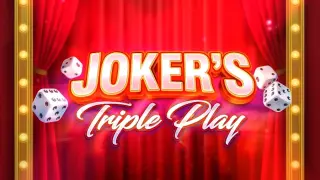
Joker's Triple Play Demo
Table of Contents
Where Joker's Triple Play sits if you like classic fruit machines with a twist
If you’re used to old-school 3-reel fruit machines that mostly live and die on bars, bells, and sevens, Joker’s Triple Play occupies a very particular niche. It keeps that compact 3x3 feel and the familiar cherries-to-sevens pay ladder, but injects enough “modern video slot” behaviour to stop it feeling like a museum piece. The Joker symbol, stacked higher-value fruits, and the way lines criss-cross the grid push it away from pure nostalgia and into a slightly more tactical space, especially for players who watch their bankroll closely. You still get that sense of “one good spin can flip the session”, but without the avalanche of features you see in newer grid or megaways titles.
From a bankroll-conscious perspective, Joker’s Triple Play is leaner than a feature-heavy video slot that siphons off spins into constant side mechanics. There are no long animated detours, no buy buttons flashing in your face, and no sprawling bonus ladders to learn. Most of what matters is happening on the three reels in front of you: stacked symbols, the Joker’s interactions with lines, and a paytable that leans harder on line density than on single-symbol knockout hits. That makes it easier to estimate what your session might cost, and what a “good” hit actually looks like in multiples of your stake rather than just in raw dollars.
This review stays squarely on the practical side. It looks at win potential in realistic terms, digs into betting range and bankroll sizing for Canadian players, and unpacks how the math model actually feels once you’re spinning. Theme, visuals, and symbol hierarchy are covered, but only briefly. Bonus rounds, audio design, and mobile specifics are left to one side, because those don’t change the core question: what does this game actually do to your balance over a few hundred spins?
The people most likely to “get” Joker’s Triple Play are those who already enjoy stripped-back 3-reelers but want a bit more bite than a flat bar-and-seven machine. If you live for complex feature chains or cinematic free spins, this will probably feel undercooked. On the other hand, if you’re wary of games that waste half your time on marginal side features and you want something where most spins resolve quickly and clearly, this slot will make sense almost immediately.
Win potential in Joker’s Triple Play: ceiling vs what actually happens
On paper, Joker’s Triple Play advertises a max win that sits in the modest end of the modern spectrum. You’re not looking at a 10,000x fantasy top prize here; the ceiling is more in line with traditional high-end 3-reelers, somewhere in the low-thousands of your stake when everything lines up. For a game that leans on classic fruit-machine structure, that’s fairly respectable, but it’s not trying to compete with the huge multipliers you see on very volatile video slots.
Realistically, though, a typical bankroll-conscious session is not about hitting that notional cap. If you’re spinning in the $0.20 to $1.00 range, the kind of top outcomes you might see in an hour when things go well are more often in the 30x to 150x stake window. That might mean a full line (or several lines at once) of red sevens, or a spin where the Joker lands in a way that upgrades a board full of mid-tier fruits into overlapping wins. Those hits are big enough to reset a sagging balance or book a tidy profit, but they don’t warp the entire risk profile of the game.
The actual construction of those heavier hits is worth mentioning. Joker’s Triple Play leans on stacked premium symbols on each reel, so every now and then you see two reels load up with sevens or bells, and the third reel either makes or breaks the spin. When the Joker drops in the right spot, it can complete multiple lines simultaneously across the 5-line pattern, giving you that satisfying moment where the whole grid lights up before the counts roll through. The game’s visual language supports this: premium stacks slide into place with a slightly slower stop, and the Joker has a subtle glow that makes those close calls stick in your mind.
From a risk-and-reward standpoint, noticeable wins (say, 5x stake and up) arrive less often than the stream of 1x to 3x line hits that mostly recycle your bet. You’ll often see several spins of small cherries or lemon connections that return a fraction above or below stake, then a gap, then an above-average hit that actually moves your balance. The big ceiling is there for marketing purposes, but the lived experience is a mix of modest recoups and occasional stronger spikes, with the true top-end outcome sitting in the “nice if it shows up once in a blue moon” category rather than something you build a plan around.
Betting range and bankroll sizing for Canadian players
Stake limits and what they mean once you start spinning
Most Canadian-facing online casinos tend to offer Joker’s Triple Play with a minimum bet around $0.10 or $0.20 per spin, and a maximum that often sits somewhere between $50 and $100, depending on the operator. The exact range can be tweaked by each site, but that’s the band you usually see when you load up the game in a Canadian lobby. The lower end is friendly enough for testing the waters, and the upper end leaves room for higher-stakes players without turning it into a pure high-roller machine.
The spacing on the bet ladder matters more than players sometimes realize. Joker’s Triple Play usually gives you fairly fine increments in the lower to mid ranges: you might go from $0.20 to $0.30, then to $0.40, $0.50, and so on, rather than jumping from $0.20 straight to $1.00. That smoother scaling makes it easier to find a stake that feels meaningful without overshooting your comfort zone in a single click. It’s especially useful if you like to bump your bet a notch when you’re ahead, because you can do it in 10- or 20-cent steps rather than doubling your exposure outright.
On very small bets like $0.10 or $0.20, the game still feels coherent. The paytable is linear, so the numbers just shrink in proportion, but the relative weight of hits remains the same. A board full of bells at $0.20 still feels like a “moment” even if the dollar figure is modest, because the multiples are intact. Where some feature-heavy video slots make micro-stakes feel pointless due to long, expensive bonus chases, Joker’s Triple Play stays practical: most of what matters happens on the base spin, so you’re not locked behind high-cost entry fees to see the game’s better outcomes.
Building a session budget around Joker’s Triple Play
Because Joker’s Triple Play leans into a medium-to-high volatility profile, you need to think in terms of how many spins your bankroll translates into, not just the raw cash number. A $20 balance at $0.20 per spin is about 100 spins. At that level, you’re giving yourself enough runway to see the game cycle through a mix of small hits and the occasional stronger connection. It won’t feel like a long session if the game is running cold, but it’s at least a reasonable sample.
At $0.20 per spin with $20, a typical one-hour session is possible but not guaranteed. If the game is behaving near its average, you might see your balance oscillate between $10 and $30 over that hour, with one or two 20x–50x hits propping things up and a fair amount of grind in between. On $0.50 stakes with a $50 bankroll, you’re in a similar ballpark: around 100 spins again, but each win and loss moves the meter more sharply. You might feel the tilt sooner when a few bad patches clip $10 in a short stretch, even though the underlying math hasn’t changed.
Once you get to $1.00 per spin with $100, the psychology shifts. You still roughly have those 100 base spins of “theoretical runway,” but individual results now look more serious. A 50x hit is a $50 swing, which feels substantial, and a sequence of no-return spins can peel off $20 in under a minute if you’re clicking quickly. In this range, a one-hour session often turns into 150–200 spins if you’re not pacing yourself, so budgeting needs to assume you might spin more aggressively once you’re in the flow. A realistic expectation over 100–200 spins is seeing your balance double on a good run, slowly erode when the medium wins don’t land, or hover in a band around 60–140% of your starting amount when the hit distribution stays balanced.
Joker’s Triple Play is not a slot where you buy a bonus and resolve your fate in one spin; it’s about how long you can stay in the “middle zone” where your bankroll isn’t collapsing and you’re still alive for one or two significant hits. Structuring a session budget means picking a stake that gives you at least 100 spins without real stress, then accepting that anything more is a function of how the distribution swings during that run.
Adjusting bet size mid-session without sabotaging your stats
Changing stake size is less about “unlocking” better outcomes and more about matching the game’s swinginess to your current balance. With Joker’s Triple Play, the math profile is fixed regardless of stake. A $1 spin has the same relative probabilities and payout multiples as a $0.20 spin; the difference is only in intensity. If you move from $0.20 to $1.00 after a losing run, you’re not improving the odds of a comeback, you’re just raising the stakes on the next sample of the same curve.
Where stake changes make sense on this slot is in two main scenarios. First, when you’ve had a decent upswing at a low or middle stake and now have a buffer. Moving from $0.20 to $0.40 when you’re already ahead by $20 doesn’t change the math, but it does convert future decent hits into amounts that matter more to you, without exposing your original deposit as heavily. Second, when you misjudged your initial bet and see your session shrinking too fast; dropping from $1.00 to $0.50 or $0.30 can stretch what’s left into something playable rather than an abrupt halt.
Using tiny “test spins” before committing a larger stake can also be sensible with a game like this, though not for mystical reasons. A few $0.20 spins let you gauge how you feel about the hit rhythm, the Joker behaviour, and the paytable before you decide if it’s worth playing at $1 or more. You’re not testing whether the slot is “hot”, you’re checking if the pattern it offers matches your risk tolerance that day. For a volatile-leaning 3-reel game, that quick scouting can save you from locking yourself into a stake that feels too jumpy once you’re actually engaging with it.
Flat betting is usually the calmer approach here. Keeping the same stake for most of your session lets the math play out without you reacting to every short-term swing. Mild progression, like stepping up your bet by one rung after a sizeable win and stepping down after a sustained downswing, can be acceptable if it’s pre-planned and modest. What tends to cause damage is aggressive “chasing” behaviour, where you rapidly double or triple your stake just because a string of misses or near-misses has irritated you. On Joker’s Triple Play, the swings can be sharp enough that this approach turns a manageable loss into something lopsided very quickly.
Bankroll risk tolerance: who this slot suits
Low-risk players who prefer smooth, low-volatility games should approach Joker’s Triple Play with shorter, more defined sessions and lower stakes. For someone who might usually spin at $0.50 on a very gentle 5-reel video slot, this game might feel more appropriate at $0.20 or $0.30. Setting a modest budget, giving it 50–100 spins, and then stopping whether you’re up or down is a way to experience the game’s spikes without letting its sharper moments drag you into longer-than-planned play.
Medium-risk players, comfortable with fluctuations but not wild swings, are probably the natural audience. In this bracket, a player with $50–$100 who usually bets $0.30–$0.60 per spin on standard games can take a similar or slightly lower stake here and accept that their balance will fluctuate more per spin. The trade-off is the chance at those meatier 50x–150x outcomes that a true low-volatility slot rarely offers. For that group, Joker’s Triple Play feels like a deliberate choice: more variance for a clearer shot at meaningful session-defining hits.
High-risk players, especially those who like pushing upper stakes, will notice that Joker’s Triple Play’s top win cap is lower than some hyper-volatile titles. However, the volatility is still sufficient to do real damage if you overcommit. A $500 bankroll at $5 or $10 per spin can disappear quickly in an ugly streak, precisely because there are no elaborate safety nets like frequent free spins to buoy your balance. Even aggressive players benefit from respecting the streakiness here, perhaps by splitting their bankroll into several shorter sessions or mixing this slot with a calmer game to average out the swings over time.
Under the hood of the Joker: how the math model actually feels
RTP range and what it means for long-term expectations
Most versions of Joker’s Triple Play you’ll see in Canadian casinos hover in the mid-96% RTP area, give or take a few tenths of a percent depending on configuration. Some operators may offer variants slightly lower or higher, so it’s worth glancing at the in-game info panel or the casino’s game details before you settle in. The key point is that this percentage is baked into every spin; the game doesn’t “warm up” or “cool down” over time in any meaningful statistical sense.
Translating that to human terms, a theoretical 96-something percent return means that over a very large number of spins, the game is designed to return that share of all wagered money to players collectively. For an individual session, you’re going to see far larger deviations. A player might turn $50 into $200 in 15 minutes, while another might burn through the same amount in the same time frame with nothing to show. The RTP is not a ceiling on wins or a floor on losses; it’s the long-run average baked into the math.
Where that nuance matters most is for grinders who put thousands of spins into a game. A small difference in RTP, say 96.3% vs 95.8%, has more impact the more you play. Over 100 spins, the difference is largely swallowed by randomness. Over 10,000 spins, it becomes a noticeable edge or disadvantage. If you’re the type of player who likes to park on a single slot for weeks or months, checking which Joker’s Triple Play version you’re actually getting is a sensible step. For casual players who drop in for short sessions, the more significant factor is volatility, which dictates how those wins and losses are distributed within the same long-run return.
Volatility: the shape of Joker’s Triple Play swings
Volatility on Joker’s Triple Play feels squarely in the medium-to-high bracket, and you can sense that fairly quickly. The distribution of wins leans towards small hits that keep you ticking over, punctuated by occasional larger connections that actually make you sit up. It’s not a punishing “nothing for 50 spins” monster most of the time, but it is quite capable of running cold for enough spins to hurt if you’re pushing higher stakes.
In practical terms, you’ll see a lot of spins where you either lose the full stake or get back a small portion via a low-pay fruit line. Those small returns often sit below or near your spin cost, so your bankroll drains gradually unless better hits intervene. Every so often, though, the reels will align into a cluster of sevens, bells, or high-paying fruits, sometimes with a Joker nudging extra lines across the paygrid. That’s where the volatility shows its hand, handing you 20x, 50x, or occasionally more in one go.
The psychological side is subtle. When the game strings together a mix of small wins and near-miss premium stacks, it’s very tempting to think “it’s about to hit” and nudge your bet up. Similarly, a run of no significant returns over 30–40 spins can push you toward either chasing or stubbornly hanging on “until it turns.” Recognizing that these stretches are simply one expression of the underlying variance, not a signal, helps keep you from using Joker’s Triple Play as an emotional feedback loop. A measured approach means deciding your rough session length and budget first, then letting the math express itself within that framework.
Hit frequency and the reality of “keeping the reels busy”
Hit frequency on Joker’s Triple Play feels reasonably high in terms of “any win”, but much lower when you narrow it down to wins that genuinely push your balance upward. You’ll often see clusters of spins where cherries or lemons land in small combinations, almost as a constant background noise. These hits keep the reels visually active and chip a few cents back into your balance, but after a while you notice that many of them pay 0.5x to 0.9x your stake, so your bankroll is still inching downward even though the win counter flashes frequently.
The contrast comes when a medium or premium symbol stack finally lines up. Suddenly the same hit frequency that felt shallow now delivers a satisfying jolt. A single spin with multiple line hits across stacked bells or sevens can undo twenty marginal spins in one shot. This creates a rhythm where you rarely feel like “nothing is happening”, but you do need to remind yourself that not every flash on the screen is a meaningful event for your session outcome.
If you like a very high proportion of spins returning at least something, Joker’s Triple Play will tick that box, but with the caveat that many of those wins are effectively partial losses in disguise. From a bankroll perspective, it’s useful to mentally separate “activity” from “profit”: the game can look busy while still slowly eroding your balance, then sporadically snaps you back to even or ahead with a heavier connection. Understanding that pattern makes it easier to decide whether the hit frequency here suits your temperament, or whether you’d prefer a calmer slot where fewer, clearer wins land with less background noise.
Neon fruit and a grinning wild: Joker’s Triple Play identity
Visually, Joker’s Triple Play takes the classic fruit-machine palette and pushes it into a slightly neon, digital direction. The background is a dark, almost midnight-blue gradient, with faint geometric lines that give a sense of depth without crowding the screen. Reels sit in a metallic frame with subtle reflections, and the fruits — cherries, lemons, plums, oranges — are rendered with clean, high-contrast shading that pops nicely on both desktop and mobile.
The Joker character is the main visual hook. When he lands, you see a small flicker of animated light around his hat and collar, just enough to distinguish him from the static symbols without dragging out the spin resolution. Premium symbols like red sevens and gold bells have a glossy finish with thin white highlights that catch the eye the moment they land in a row. There’s no narrative cutscene, no sprawling backdrop story; the visual identity is closer to an upgraded casino cabinet than a themed adventure, which suits the math-forward, no-fuss gameplay.
Fruits, sevens, and the Joker: how the symbols are stacked
Symbol hierarchy in Joker’s Triple Play follows a familiar ladder but with a couple of small twists that influence how wins feel. At the bottom you have the low fruits: cherries, lemons, and likely plums or oranges, depending on the exact variant you’re playing. These appear often and form the bulk of your small “activity” wins. Mid-tier symbols typically include watermelons and grapes, paying several times more than the lows for a full-line hit and acting as the bridge between the grind and the more noticeable payouts.
Near the top sit the bells and red sevens, which form the core of the strong line hits. Landing three red sevens on a line usually delivers one of your better base game outcomes, especially when it happens across multiple lines due to the 3x3 and 5-line structure. The Joker symbol usually plays a special role, often acting as a wild and sometimes offering separate higher payouts in its own right when stacked. Because symbols are stacked on each reel, you’ll have spins where the entire grid is one or two symbol types, making even low-tier hits feel satisfying simply due to the visual density. This structure reinforces that sense of “everything or not much” that defines many of the game’s key moments.
Slot fingerprint
- Compact 3x3 fruit-machine layout with 5 fixed lines and heavy symbol stacking.
- Joker wild that can land in clumps and convert near-miss fruit boards into overlapping line wins.
- Visual tone closer to a modernized casino cabinet: dark backdrop, neon-fruit gloss, and minimal clutter.
- Medium-to-high volatility feel, with lots of small fruit wins masking a more jagged underlying curve.
- Win potential capped in the low-thousands of stake, with realistic stronger outcomes clustering in the 30x–150x range.
Where it falls a little short
- Headline max win is modest compared with some modern high-volatility slots, which may put off players hunting for extreme multipliers.
- Frequent low-paying fruit hits can blur the line between genuine wins and partial losses, making it easy to misread how your balance is actually doing.
- Visual variety is limited; if you’re not into classic fruit themes, the minimalistic art direction may start to feel repetitive.
- Limited feature depth means there’s less to discover over repeated sessions; the game reveals most of its behaviour fairly quickly.
- Swingy stretches can feel punishing at higher stakes, especially since there are no elaborate bonus modes to soften the blow when the Joker doesn’t cooperate.
More Slots from Play'n GO







| Provider | Play'n GO |
|---|---|
| Release Date | 2026-09-17 |