Clash of Gods: Anubis vs Hades Demo
Table of Contents
Clash of Gods: Anubis vs Hades in the context of its provider’s habits
Studios leave fingerprints. After a dozen releases from the same provider, you start recognizing them before the title screen even fades. Clash of Gods: Anubis vs Hades feels like one of those games where the team tried to stretch their formula without throwing it out. You can still see the old bones, but they have at least tried to hang some new muscle on them.
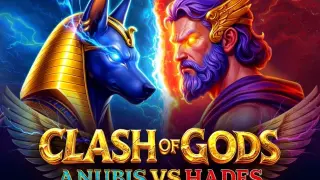
This provider tends to lean on medium‑high or outright high volatility, a headline RTP in the mid‑96s with the occasional lower setting for more restrictive markets, and feature structures that revolve around layered free spins or a hold‑and‑win side mode. Visually, they like a heavy, almost glossy 3D look with lots of side‑panel framing, animated characters glaring at the reels, and a UI that hugs the bottom of the screen. Clash of Gods sits very much in that visual lane, with Anubis and Hades flanking the reels and staring each other down like they’ve been pulled from two different earlier games and glued into one.
Beneath the surface, though, there is more of a tug‑of‑war mechanic than they usually attempt. Instead of “Egyptian free spins” or “Greek god multipliers” slapped on a generic 5×3 grid, the slot actually leans into the versus angle. Progress on one side often feels like it’s coming at the expense of the other, and the bonus round leans hard into that feeling. For a studio that usually keeps things fairly straightforward, that alone marks Clash of Gods as a mild experiment.
From a seasoned player’s point of view, this does not read like a lazy re‑skin. It is also far from some untested experiment that will terrify risk‑managers. It sits in that cautious iteration space: familiar enough that you can read it in a few dozen spins, but with enough asymmetry between the two gods that it warrants a bit of exploration if you already speak this studio’s language.
Familiar patterns that keep resurfacing
Anyone who has a history with this provider will spot a few tells immediately. They like collection meters that creep along the sides of the reels, repeatedly nudging you towards “just a few more spins” to see what happens when they fill. They enjoy persistent modifiers in free spins, the kind where wilds, multipliers, or special symbols stick from one spin to the next. And they have a habit of bolting on a secondary feature that behaves a lot like hold‑and‑win, even if they dress it up with a different name.
Clash of Gods: Anubis vs Hades borrows all of these ingredients. The two gods have their own meters, one glowing in cold blue beneath Anubis, the other smouldering orange under Hades. Symbols tied to each god feed those bars, nudging you towards unlocking “their” version of the feature. When the bonus is active, there is that now‑familiar sense of a growing state: modifiers stacking, positions locking, and the game trying to sell you on momentum.
The math feels like the usual home ground too. Volatility is clearly up there; base game hits drift in at a modest clip, with bonus access gated tightly enough that you notice gaps between features. RTP is presented as a range, which is very much on brand for this studio, as they like to give operators multiple settings. If you have played their other myth‑themed titles, you will recognize the broad rhythm: a slow build, occasional sharp spikes, and extended periods where you are watching meters inch forward and hoping the game decides to cooperate before your balance sags too far.
Where Clash of Gods: Anubis vs Hades actually pushes their catalogue
Despite all the reused bones, there is at least one genuine new angle: the dual‑god framing is not purely cosmetic. The game wants you to notice which side is “winning” the internal tug‑of‑war. Anubis symbols fuel one meter, Hades symbols fuel the other, and certain base‑game modifiers flip the momentum back and forth. When one side hits a threshold before the other, the nature of your next bonus round shifts.
That means the feature structure has more flavour than the studio’s usual “enter free spins, watch multiplier go up” template. Anubis‑leaning bonuses tend to focus on more controlled, incremental upgrades and slightly more frequent, smaller hits. Hades‑leaning ones skew to the higher‑risk end, with more empty spins offset by those chunky, stacked‑symbol moments that either make or break the whole round. You are not picking a side on a menu; you are watching the reels push you in one direction, then deciding whether to keep feeding that trajectory or try to drag it back.
The mood shift that comes from pairing Egyptian afterlife with Greek underworld is more than a coat of paint too. Past games from this studio usually camp inside one mythology and call it a day. Here, you have two visual and mechanical identities clashing in a single frame, which gives the bonus rounds a more distinct personality. It feels less like a one‑off novelty and more like a test drive for a broader “versus” system they may reuse later, especially if data shows that players actually lean into favouring one god’s style.
Trust, track records, and what seasoned players tend to notice
With this provider, experienced players usually check three things: how transparent the RTP settings are in the help screen, how spiky the hit frequency feels on the reels, and how honest the feature description is about its limitations. They have a reasonable reputation for publishing proper RTP ranges, but, like most studios, they let casinos pick. That means one lobby can run the generous setting while another quietly dials it down, something Canadian players are probably used to by now.
Clash of Gods: Anubis vs Hades sits comfortably in their usual territory. There is that published range for RTP, a volatility tag that might as well say “don’t expect smooth, low‑risk sessions,” and a feature description that shows the dual modes without overselling the odds of seeing the top outcomes. You will still want to glance at the rules to confirm the exact RTP your casino is using, because it does vary. If you are used to this provider’s previous myth releases, you will likely fall into the rhythm quickly: sporadic base‑game interest, then a fairly decisive “was this bonus worth the wait?” judgement every time you trigger the gods’ clash.
Is it worth learning one more of their titles? For anyone burnt out on their hold‑and‑win clones, this one is at least more engaging. The versus flavour gives your sessions a bit of extra context; you are not just waiting for scatters, you are watching which god your balance is hitching itself to. That will not revolutionize your bankroll, but it does stop Clash of Gods from blurring entirely into the studio’s back catalogue.
Underworld vs underworld: how Clash of Gods: Anubis vs Hades looks on screen
The concept is neat enough: Egyptian afterlife colliding with Greek underworld, both layered into a single battlefield behind the reels. On one side, Anubis stands in blue‑lit jackal armour against a backdrop of desert tombs and star‑heavy night sky. On the other, Hades looms in volcanic reds and oranges, rocky cliffs and distant lava flows flickering in the background. The screen feels split down an invisible line, yet the reels sit squarely in the middle, floating above a cracked stone altar that seems to belong to neither world.
Colour is used aggressively. The Egyptian half leans into cold blues, gold trim, and sharp white glows on symbol edges. Hades’ corner burns with ember highlights, rude oranges, and blackened stone. When the game tips toward one god, the background subtly shifts that palette; more blue torches flare up during Anubis‑favoured spins, while Hades triggers extra sparks and drifting ash. It is not subtle in an artistic sense, but it is very clear in a gameplay sense, which matters more over time.
Visual identity that goes beyond another myth reskin
Character work does some quiet heavy lifting. Anubis is rendered taller and calmer, standing upright with a staff, barely moving except for the occasional slow nod or grip adjustment. Hades, by contrast, hunches slightly forward with a more aggressive stance, cloak flickering as if caught in a constant underworld draft. The way the lighting catches their armour and faces does more for the mood than any text blurb could. When you are on an Anubis‑tilted streak, the scene feels cooler, more measured, as if the game is promising structured upgrades. When Hades starts dominating, the ambient flickering and hotter hues create the impression that something big could hit, or nothing at all.
In terms of UI, the studio largely behaves itself here. Bet controls sit in a low, compact strip below the reels, with a clear, white font on dark stone tiles. Balance and win readouts are big enough to read easily on a laptop screen, and the counters for each god’s meter are colour‑coded in a way that actually helps: blue for Anubis, orange for Hades, with progress rings that sit just far enough from the reels that they never obscure symbols. During feature rounds, the game adds a few extra labels and counters, but they fade in cleanly without blocking the lines you need to see.
A couple of small animation touches stand out once you have spent a while with it. Anubis’ eyes glow more intensely when his meter ticks over a threshold, and Hades’ cloak whips up tiny embers every time his aligned symbols land in a promising pattern. Scatter landings send faint ripples outward across the stone frame, like a shockwave rather than a full‑screen flash, which is easier on the eyes during longer sessions. The studio has a habit of overdoing particle effects; here, they show a little restraint, keeping the focus where it belongs: on what is actually happening on the reels.
Sound of the afterlife: audio cues in Clash of Gods
Sound design lands firmly in “cinematic myth” territory, but with a slightly darker edge than usual for this studio. Under normal spins, you hear a blend of low underworld drones and distant choral hums, with the occasional metallic clink that feels like chains moving somewhere behind the reels. Percussion sits far back in the mix, only really stepping forward when one of the gods starts to push their influence. It is moody without being overbearing, at least for the first few hundred spins.
Spin sounds have that polished, slightly glassy quality the provider likes: a soft rushing whoosh as the reels roll, a crisp tile‑on‑stone click when they stop. Smaller hits are acknowledged with short, dry stabs of strings or drums, different for each god’s symbol set. Near‑misses on the feature use a familiar trick: the ambient noise pulls back, a rising tone cuts in, and the final reel lands with a more dramatic thud. There is enough variety in these cues that you do not hear the exact same pattern every time, but the game definitely uses sound to nudge your attention any time the math wants you to notice a close call.
When the speakers tell you more than the reels
One of the more useful aspects of the audio design is how it differentiates between Anubis‑driven and Hades‑driven moments. If a spin leans heavily toward Anubis symbols and his meter jumps, you get a slightly brighter, echo‑laden chime with a faint Egyptian scale twist. When Hades gains ground, the response is lower and rougher, with a short growl of brass and a rumbling undertone. You can actually tell, with your eyes away from the screen, which god just benefitted from that last spin, which says something about how deliberately the cues are mapped.
Bonus triggers crank everything up but not to the usual deafening degree. The entrance to the feature hits with a thick drum roll, a choir swell, and a shouted line from whichever god “won” the pre‑feature tug‑of‑war. Retriggers layer in extra melodic lines rather than just stacking more volume, and big wins get a dedicated fanfare that is assertive without shredding your ears. For anyone managing a longer bankroll session, that restraint matters. You still get the dopamine‑friendly surge of sound when something significant happens, but it does not punish you for keeping the game open for an hour.
Choosing sides: bonus mechanics in Clash of Gods: Anubis vs Hades
Feature‑wise, the game keeps the menu fairly tight. The base game can throw in occasional modifiers where one god temporarily asserts control over certain reels, adding extra wilds or boosting the chance of their own high‑pay symbols landing in stacks. The real focal point is the free spins mode, which always belongs to either Anubis or Hades depending on whose meter reached its trigger point first. There is also a buy‑feature button on some versions, letting you shortcut straight to the clash, though its availability depends entirely on local rules and the individual casino.
So you are basically dealing with a single main feature that wears two faces, not a sprawling mess of side games. With a dual‑god theme, it would have been very easy for the studio to drown the slot in competing gimmicks, and at least they avoided that trap.
Anubis vs Hades feature flow in plain language
The primary bonus trigger comes from landing the required number of special god symbols and scatters within a spin, but the meters you have been feeding during base play matter. As you spin, each Anubis or Hades emblem that hits contributes to its respective meter. Once one of those meters crosses a threshold, any subsequent qualifying scatter combination will lock you into that god’s version of the feature until the free spins round has played out.
When Anubis takes control, you are usually looking at a setup where certain positions become marked and then stay that way for the duration, with each marked spot acting as a booster for future special symbols. New Anubis symbols that land in marked spots might upgrade into wilds or multipliers, and those upgrades persist. The volatility flavour there is more about slow, cumulative improvement. You might not see huge individual spins, but a round where those upgrades actually connect can grind out a surprising total, especially if the marks cluster towards the centre reels.
Hades’ feature feels wilder. Instead of gradual upgrades, he tends to flood the reels with bursts of stacked symbols, sometimes combined with temporary multipliers that apply to a given spin rather than the whole round. That means more blanks, more whiffs, and then the occasional board where everything lines up and the count shoots up in a hurry. From a player’s side, it feels like choosing between a grinding, positional bonus (Anubis) and a swingy, “all‑or‑not‑much” sequence (Hades), even though you are not technically choosing at the moment of trigger. Your earlier spins set the stage.
There are a couple of side mechanics worth clocking. Each god’s meter does not always reset fully between features; depending on the implementation your casino is running, some progress may carry over in a limited way, which influences how “priced in” your next bonus feels. There is an optional gamble on some builds where you can risk a modest portion of your initial free spins to upgrade the feature to a more volatile version, typically adding extra multipliers or more marked spots. And where regulations allow, the buy‑feature cost is pegged high enough that it is clearly meant as a spike tool, not as a sustainable grinding strategy.
The numbers behind the gods: math model as it feels in play
On paper, Clash of Gods: Anubis vs Hades lines up with the provider’s favourite recipe: a headline RTP that lives somewhere in the mid‑90s, with a handful of alternative settings that slide a bit lower for certain markets, and a volatility label that leaves no doubt you are in high‑risk territory. Hit frequency in the base game is middling; you will see wins often enough to avoid complete boredom, but a fair portion of them are the kind that barely move your balance bar.
In actual play, the math personality comes across through the tug‑of‑war between the two gods. When Anubis has the upper hand, you tend to see a steadier trickle of medium‑ish hits and a slightly more forgiving bonus. It still whiffs, but there is usually at least some consolation value. When Hades dominates the meters, the whole slot feels a size more aggressive. You might go a run where you wonder whether the game has quietly turned off wins, then suddenly catch a wall of stacked symbols that rewrites the story.
Because RTP can vary by operator, two players talking about “how the slot feels” may not be describing the same thing. A Canadian‑facing site running a higher setting will make the grind between bonuses less punishing than a venue that chose the stingier configuration. The underlying structure is the same, though: play is built around those god‑specific features, and your bankroll arc will largely be defined by how many of those rounds land in the top third of their potential payouts versus the bottom third.
Betting range and bankroll sizing: where Clash of Gods gets real
Bankroll talk is usually where seasoned players stop caring about lore and start caring about numbers. Clash of Gods: Anubis vs Hades follows the modern video slot pattern: a low minimum bet that lets casuals dabble, and a fairly high ceiling for those who want to push stakes. Exact figures will depend on the casino, but you are typically looking at modest cents per spin on the floor, scaling up through the usual steps into territory that can chew through a mid‑range budget very fast.
What matters more than the max is how the game behaves across different bet levels. This provider tends not to change the underlying math when you slide the stake; the proportions of small, medium, and large hits stay roughly the same, and the feature frequency does not suddenly spike just because you nudge the bet size. Your real lever is the number of spins you can reasonably afford before you either hit a decent feature or decide you have had enough.
On a high‑volatility slot like this, a tiny bankroll paired with a high bet size is essentially asking to be cleaned out during a single bad run of Hades‑heavy spins. If you are working with, say, a $50–$100 session budget, staking near the minimum and letting yourself get 300–500 spins will give you a much clearer feel for the dual‑god mechanics than going in at $2–$3 a spin and hoping the first bonus lands early. Half the point of this design is watching the meters swing; you cannot really do that if you are forced to bail after 30 spins.
A more practical approach for Canadian players who like testing the water would be something along these lines: start at or near the minimum for at least a couple hundred spins, purely to see how the game distributes Anubis and Hades progress on your account. If you notice that one side keeps edging out the other and you enjoy that flavour of bonus, you can edge the stake up slightly for a second block of spins, assuming your balance allows it. If, on the other hand, your early experience is a long streak of lifeless Hades rounds that never connect, you will know this particular flavour of high volatility is not lining up with your risk tolerance.
One thing worth noticing is how the feature buy, where available, relates to your usual stake. On many implementations, the cost sits at a multiple of your bet that essentially consumes a decent chunk of a casual session budget in a single shot. That might be fine if you treat it as a once‑off punt at seeing the slot’s top end. It is far less friendly if you are tempted to use it repeatedly, since the underlying high volatility does not magically soften just because you paid to skip the base game.
The game also tempts you indirectly through those meters. When Anubis’ bar is nearly full, walking away or cutting your stake can feel psychologically awkward. The same goes for Hades if you are chasing his destructive streak. From a cold perspective, that meter value is already baked into the math; the game will pay what it intends to pay over long sequences, regardless of whether you personally “cash in” a nearly full bar. Treat the progress as flavour, not as a promise.
For players who like to set structure around their sessions, it helps to think of Clash of Gods in terms of “feature cycles.” A cycle might be, for example, up to two bonuses, or a fixed number of spins, whichever comes first. Choose a bet size where you can comfortably afford two such cycles with your session money, and be willing to leave if both cycles underwhelm. That keeps the slot from turning into an endless chase for “one good Hades round” that may or may not arrive before the numbers catch up with you.
High volatility and flashy dual gods make great trailers. They are far less forgiving if you insist on playing them like low‑variance grind machines.
Quick paytable sanity‑check
Before putting real money into Clash of Gods: Anubis vs Hades, it is worth verifying a few concrete points in the help and rules section:
- Confirm the exact RTP value your casino is using and whether multiple versions are mentioned.
- Check how many scatters or special symbols are needed to trigger the bonus, and whether the god meters influence that requirement.
- Look at how Anubis and Hades features differ in terms of extra wilds, multipliers, or stacked symbols, so you are not surprised when one mode feels harsher.
- See whether any meter progress carries over between sessions, or if everything resets when you close the game.
- If a feature buy or gamble is offered, read the odds or at least the stated rules, so you understand what you are risking beyond your base bet.
Spending two minutes on those screens usually pays for itself once the reels start moving.
Where it falls a little short
Clash of Gods: Anubis vs Hades is rarely dull, but it does have some edges that seasoned players will notice.
First, despite the versus framing, you do not actually choose your side in any meaningful way; the reels and meters do the deciding for you, which can feel slightly at odds with the title. Second, the difference between Anubis and Hades bonuses is sometimes more cosmetic than the marketing suggests, especially on weaker rounds where both modes limp to similar totals. Third, the game leans heavily on those meters as a tension device, and if you happen to hit a stretch where both stay stubbornly low, the base game can start to feel like busywork.
There is also the familiar annoyance of variable RTP. The slot is sold on some attractive headline specs, but your experience as a Canadian player will depend on what setting your chosen casino actually implemented, and the game does not shout that from the rooftops. Finally, while the visuals are strong, the split underworld concept can come off as visually noisy on smaller screens, with a lot of glowing elements competing for your attention around the edges.
If you can live with those quirks and you already appreciate this studio’s style, Clash of Gods: Anubis vs Hades has enough of its own identity to justify a closer look. Just treat the gods as what they are: two different flavours of the same underlying risk, not supernatural shortcuts to beating the math.
More Slots from BGaming







| Provider | BGaming |
|---|---|
| RTP | 96.50% [ i ] |
| Layout | 5-5 |
| Betways | 15 |
| Max win | x10000.00 |
| Min bet | 0.2 |
| Max bet | 260 |
| Hit frequency | N/A |
| Volatility | High |