3 Supercharged Diamonds Demo
Table of Contents
Neon facets and charged reels: how 3 Supercharged Diamonds frames its world
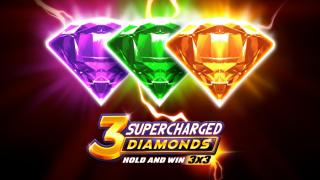
3 Supercharged Diamonds walks into a crowded corner of the slot universe: classic gems, fruit, and sevens. On paper that sounds familiar. On screen it looks a little different. The reels sit in a dark, almost charcoal void, edged with chrome and traced in neon cyan, magenta, and electric purple. It feels less like an old fruit machine and more like a display cabinet in a high‑end jewellery store that has been wired to the grid.
What stands out first is the sense of pressure in the visuals. The diamond symbols do not just land; they pulse with a soft halo, as if holding current. The metallic reel frames catch occasional streaks of light that travel along the edges when something notable happens. Even simple fruit symbols get a subtle gloss highlight that travels across the surface in time with the spin. The whole presentation quietly signals that the game leans away from gentle, steady value and toward periods of build‑up followed by sudden releases.
That core idea of charge, storage, and release runs through both the art and the mechanics. Charged frames appear behind diamonds. Meters fill in discrete steps. When a feature finally connects, the screen brightens in a very specific way: whites get sharper, the neon deepens, and there is a visible “snap” into a more saturated palette. It feels like someone flicked a higher‑voltage breaker.
This review sticks with that thread. Rather than catalogue every symbol or bet size, the focus stays on how 3 Supercharged Diamonds looks, moves, and paces itself, and how those aesthetic choices map to the math model, features, and the way a real session tends to unfold.
Visual voltage: theme, art direction, and identity of 3 Supercharged Diamonds
The basic layout presents as deceptively standard: a 5‑reel grid with familiar icons — cherries, lemons, bars, bells, red sevens, and, of course, three differently coloured diamond symbols that sit slightly larger than everything else. The background is almost black but never flat; there is a faint geometric mesh, barely visible, that catches glints of purple light when reels stop on higher‑value combinations. It gives the impression that the entire cabinet is resting on some kind of energy lattice.
Colour is used with more intent than you usually see in a fruit‑style slot. Lower‑tier fruits lean into warm colours with softer edges: matte reds, gentle yellows, and oranges that feel almost analogue. The diamonds, by contrast, are cut with hard edges and rendered in cold blues and violets that shift as they spin. When the reels are in motion, it often looks as though these gems are refracting a hidden light source from behind the grid. The contrast between flat fruit and faceted gemstones is deliberate; your eyes are pulled to those potential “charge carriers” before you even learn what they do.
Small motions do a lot of heavy lifting. Regular wins trigger quick, clean line highlights, with a thin neon stripe tracing the winning path. Diamond wins linger a fraction longer, and the symbols themselves “tilt” in 3D space, catching a brighter flare along one edge. In charged states, you sometimes see tiny particles being pulled into diamond frames from surrounding reels, almost like static electricity. These details are easy to miss when you are focused on the numbers, but once you notice them, they make the whole thing feel more reactive.
Bonus sequences shift that visual language. Instead of the dark cabinet look, the background warms up slightly, with more backlighting on the reel edges and a slow‑moving glow behind the central play area. The diamonds now emit a broader aura, and charge indicators become much more pronounced, with small arcs travelling between neighbouring symbols when values upgrade. That change in lighting communicates risk and reward without a single line of text: you have stepped into a higher‑pressure state where the stored energy might finally be released.
Small graphic touches that hint at the mechanics
Even before you read the rules, 3 Supercharged Diamonds telegraphs what matters. Diamond symbols sometimes land with a faint ring around them, like a circular gauge. On some spins that ring remains thin and static. On others it thickens, segments light up, or colour shifts from blue to purple, then to a hot pink when it reaches a peak level. You start to sense that these stones are not just high‑pay symbols, they have a memory.
There are also small rectangular meters tucked into the top corners of the screen. Their exact position can vary by operator setup, but the idea is consistent: a sequence of pips or segments that fill as diamonds appear or get “supercharged”. You might not understand the thresholds at first, but you do see that the game is counting something in the background. Those meters rarely reset on every spin, which is your first hint that accumulation across spin cycles matters.
Overlay effects help you read the game’s intentions. When a spin lands two diamonds and misses the third needed for a feature trigger or upgrade, a thin electric outline sometimes traces the empty reel position where that missing piece would have gone. It lingers for a heartbeat, then fades. That single, almost petty highlight does two things: it calls attention to near‑misses, and it tells you that diamonds in specific spots have a different weight than random clutter. Over a few dozen spins, you begin to anticipate slots on the grid where “something good could happen”, simply because the visuals have nudged your attention there again and again.
These touches mean that by the time you actually open the rules panel, you already have a working sense of which symbols matter, which meters are important, and which parts of the screen you should watch when the reels slow down. The UI has quietly trained you.
Under the hood: how 3 Supercharged Diamonds actually plays on the math side
On the numbers front, 3 Supercharged Diamonds sits in a familiar band of modern video slots: medium‑to‑high volatility with a headline return‑to‑player percentage that most casinos list in the mid‑90s. Exact figures can vary by site and configuration, so it is always sensible to check the version your chosen casino uses. The key point is that the design leans away from constant tiny line wins and leans into more concentrated value through features and charged diamonds.
On a spin‑by‑spin level, that means you will see quite a lot of non‑winning spins. When wins do land, many are small, often barely above your wager. That may sound harsh, but it creates space for the game to stack more weight into its bonus rounds and fully charged diamond hits. To make that palatable, the hit frequency on low‑tier outcomes is tuned so that you do not go long stretches with absolutely nothing happening on the reels. The maths and visuals work together to keep a hum of activity, even if that activity is mostly symbolic charge building.
You feel that “stored potential” in how the slot handles accumulations. Charges or collections often persist over multiple spins, which gives you a sense of continuity. Even if your credit meter is sliding down, part of your brain tracks the meters and frames, and that tracking is a big part of the game’s emotional pacing.
RTP and volatility as a felt experience, not a number on a screen
Spend half an hour with 3 Supercharged Diamonds and it often feels like a sequence of micro‑chapters rather than a flat stream of spins. Early on, you will usually see the game introduce its core loop: a win or two on fruit lines, a couple of minor diamond appearances that add a sliver of charge, maybe a teaser where two supercharged symbols land and the third reel slows quite noticeably. The balance might dip, but the game is busy teaching you how “good spins” are supposed to look.
In the middle of a session, variance reveals itself. You may run into a run of 10–15 spins where only one or two produce wins of any size. During those lulls, you rely heavily on the visible progress bars and glowing frames to keep interest. Occasionally, the slot compensates with a cluster of medium hits: a line of sevens upgraded by a multiplier, or a partial diamond feature that does not explode but at least restores a chunk of what you have cycled. These are the stabilizing moments that stop the experience from feeling punitive.
The big swings come from fully charged diamonds and dedicated bonus rounds. These do not appear often, and that rarity is exactly what you feel when you look back over a 60‑minute play window. A typical hour might include one or two “proper” feature hits, a handful of partial or low‑end bonuses, and a lot of groundwork where you are essentially paying for the right to spin the wheel of chance on those higher‑impact events. The theoretical RTP number is just the averaged outcome of those peaks and valleys stretched across thousands of sessions; in the moment, what you actually notice is how your own run sits somewhere along that rollercoaster.
Charged gems and feature sparks: how the bonus mechanics tie into the theme
Bonus structure in 3 Supercharged Diamonds revolves tightly around those titular stones. There is usually a main feature that triggers when you land a certain number of diamond symbols, often with a requirement that at least some of them be in a charged or “supercharged” state. That main feature tends to take one of two familiar shapes depending on variant: either a dedicated free spins sequence with enhanced diamonds, or a hold‑and‑spin style round where diamonds lock and accumulate values.
Whichever version you encounter, the underlying idea stays consistent. Diamonds act as containers. You either build charge on them in the base game and then release that charge during a short feature, or you land special “supercharged” versions that immediately start a more volatile side game. In both cases, the art pushes the idea of accumulation: diamonds gain extra facets, grow brighter, or attract small arcs of light as they level up, and only when you hit a certain threshold do they discharge into coin wins or multipliers.
This gives the bonus moments a different feel from base‑game line wins. Instead of a simple “land and pay” flow, features are about incremental steps: fill this meter, upgrade that diamond, reach one more spin extension. The stronger your position going into the feature, the more you feel that stored energy waiting for a release.
When the screen lights up: key trigger moments
Trigger moments in 3 Supercharged Diamonds have a specific visual cadence. As soon as two key diamonds land, the remaining reels often slow slightly, and a faint hum or light flicker spreads across the grid. The background mesh brightens by a notch, and the charge rings on the landed gems animate more intensely. Whether you hit the third piece or not, that pause marks the spin as special.
The frequency of full triggers is modest. Expect to see a scatter of near‑misses long before you land a clean entry into the best‑paying version of a feature. That is where the near‑trigger states become a big part of the experience. You might have meters sitting at two‑thirds, diamonds glowing at medium charge, or a partially filled collection bar. Each spin that nudges those elements forward raises the stakes, even if the credit change on that single spin is negative.
Those “almost there” spins are also where tension lives. When you have one segment left on a meter, or you need one more special symbol to unlock the supercharged tier of a bonus, the game leans into its lighting tricks. The missing segment pulses faintly between spins. The outline of the meter stays lit instead of resetting to a dim state. It is subtle, but it means that even after a losing spin, the screen still looks “primed”, and you feel compelled to see whether the next spin finally pushes things over the threshold.
From modest clusters to supercharged hits: realistic win potential
On the promotional side, 3 Supercharged Diamonds usually advertises a maximum win that sits in the familiar multi‑thousand‑times‑bet range. As with most modern slots, that number is technically achievable but statistically remote. The more useful perspective for regular play is what solid and great outcomes tend to look like in everyday sessions.
A “good” run for many players will be one where a feature or two lands within a reasonable span of spins, and at least one of those features pays several dozen times the stake. That sort of outcome is strong enough to either give you a profit on the session or extend your playtime significantly. It will not hit the top end of the game’s potential, but it will feel like the slot is doing what it promised: converting stored charge into a clear, satisfying payout.
A “great” run, the kind you remember and maybe screenshot, usually involves either multiple features landing in a relatively short window, or one single round where diamonds reach their higher charge levels, multipliers stack, and the end tally comes out in the triple‑digit multiples. Those spikes are less common, but they are what anchor the long‑term math. In between sit a lot of middling outcomes where a feature triggers, teases some upgrades, but ultimately lands somewhere only slightly above what you have already cycled through.
What a memorable win looks like on 3 Supercharged Diamonds
Imagine a base‑game stretch where you have been spinning for twenty minutes. You have seen a handful of line wins on fruits and a nice cluster of sevens that briefly pushed you ahead, but the real draw has been a diamond meter that now sits one segment shy of full. On the next spin, a single blue diamond drops in the right spot, the final pip fills, and the screen performs that characteristic snap into higher saturation. You enter a feature where the diamonds you have been feeding suddenly convert into sticky symbols with assigned cash values, and each extra diamond that lands either boosts those values or extends the round. When the final spin ends, your balance has jumped by, say, 80–120 times your bet. The numbers are solid, but what you remember is the transition from “almost ready” meters to a board full of glowing gems.
A different scenario: you are slightly down, the session feels flat, and then a surprise trigger hits with three fully charged diamonds appearing without much build‑up. The game drops you into a shorter, more swingy bonus where you get only a handful of spins, but every diamond carries a hefty multiplier. You see one reel fill with upgraded gems, the win counter climbs into triple‑digit territory, and your previous losses get wiped out in under a minute. It is not the advertised maximum, but emotionally it lands as a rescue.
The rarer, high‑end spikes combine the two ideas. You enter a feature with a decent setup, then hit a sequence of extra diamonds or re‑triggers that keep extending the round. Visually, the grid starts to look crowded: more and more positions are covered in bright, high‑level gems, and charge arcs jump between them almost constantly. Each new upgrade pushes the win counter higher in visible chunks. By the time the last spin finally hits a dead end, the numbers on screen feel in step with what you have been watching: a full board of supercharged stones cashing out their stored energy in one burst.
The rhythm of the spin: session pacing and how 3 Supercharged Diamonds breathes
Pacing is where 3 Supercharged Diamonds has a clearer identity than many other gem‑and‑fruit slots. Rather than a flat, almost metronomic sequence of spins, it tends to cycle through phases: calm accumulation, heightened anticipation, then a release event of varying size. The transitions between these states are not always dramatic, but you can feel them if you pay attention.
The tempo of the base spin is relatively brisk. Reels drop with a decisive click, symbols resolve quickly, and win evaluations appear without long delays. That keeps the low‑stakes part of the experience moving. What slows things down are potential triggers: partial diamond setups, almost‑full meters, or early hits in a feature that leave you one step away from a meaningful upgrade. In those moments, the game almost seems to inhale, holding the spin a fraction longer, leaning into slow‑motion reels and exaggerated glows.
Emotionally, the cadence is a mix of low‑level hum and occasional spikes. There are stretches where nothing particularly interesting happens, but the presence of visible charge mechanics and subtle UI signals keeps you leaning forward. You are rarely more than a few spins away from at least some kind of “twitch” in the system, whether that is a minor meter fill or a proper feature entry.
Base game flow: the background hum
During ordinary base‑game play, 3 Supercharged Diamonds often feels like a neon‑lit conveyor belt. Fruits land often enough to generate small, almost token wins. A couple of cherries here, a bar combination there, nothing that radically shifts your balance but enough to prevent the credit meter from draining in a straight diagonal line. These hits resolve quickly, with minimal animation beyond a flash of colour and a brief highlight.
The more interesting moments are when diamonds drop in among that noise. Even a single uncharged diamond landing in an otherwise mundane spin tends to trigger a small visual flourish: a quick glint across its edges, or a faint surge in whatever meter it is feeding. You might not win much on that spin, but the screen tells you that something has advanced in the background. That tiny pulse of feedback breaks the monotony.
Occasional mid‑tier line wins, especially involving sevens or bells, act as breathers. They often come without any elaborate setup, landing out of nowhere and giving your balance a temporary bump. The game treats these as punctuation marks rather than centrepieces. The big focus remains on those diamonds and their charged states. Over twenty or thirty spins, you start to think less in terms of individual outcomes and more in terms of “chapters” based on how close your charge systems are to a payoff.
Feature anticipation and the “almost there” effect
Where 3 Supercharged Diamonds becomes more emotionally charged is in the build‑up to features. The slot is quite willing to show you near‑miss states: two diamonds glowing at medium charge, a meter sitting with one empty segment at the top, a reel covered in minor gems when you know you need one specific symbol to lock things in. The UI encourages that focus, leaving partial fills and charged frames visibly active between spins.
As soon as you recognize the main trigger conditions, these states start to dominate your attention. A meter two steps from full feels mildly interesting. One step away feels urgent. The same goes for diamond frames: a lightly glowing stone is a curiosity; a hot, pulsing one is a promise. The game leans into that difference. Spins at the brink of completion are framed more dramatically, with prolonged reel stops and extra flashes around relevant symbols. You may find yourself watching only the reels that can affect your progress, barely noticing what lands elsewhere.
Once the feature finally triggers, there is a brief sense of release, then a new kind of anticipation kicks in. Features themselves have their own micro‑pacing: early spins where you assemble the base of your setup, middle spins where potential upgrades start to appear, and final spins where you hope for just one more extension. The “almost there” effect repeats at a smaller scale inside the bonus: one diamond away from a board upgrade, one spin away from a dead end, one multiplier short of a really strong payout.
This layered anticipation is what gives 3 Supercharged Diamonds its particular rhythm. Even when the raw numbers are not going your way, the presence of visible progress and repeated near‑completion states keeps your attention actively engaged. You feel like you are navigating a sequence of thresholds, always nudged towards chasing the next one.
Quick paytable sanity‑check
Before committing real money, it is worth spending a minute in the rules panel to ground what you are seeing on screen. For 3 Supercharged Diamonds, a short checklist helps.
Confirm which diamond symbols actually drive the main features. Some variants separate “regular” diamonds from special supercharged versions, and only the latter count toward certain triggers or jackpots. You want to know exactly which icons to care about.
Check how the charge or collection meters behave. Do they reset on a feature trigger, on every spin, or only when a specific condition is met? The way those meters clear or persist has a big impact on how you interpret session pacing and whether it feels sensible to keep going when you are one step from a threshold.
Have a quick look at the ranges for base‑game symbol combinations versus feature outcomes. If most of the higher multipliers are locked behind bonuses or fully charged states, it helps to mentally treat base wins as maintenance and avoid expecting them to carry the whole session.
Finally, verify the RTP value and any mention of multiple RTP configurations. If the rules indicate a range (for example, different percentages possible), that means the casino chooses a specific setting. It is useful to know what your site lists for this title, especially if you are comparing it to alternatives in the same lobby.
Common mistakes & traps
3 Supercharged Diamonds has a fairly transparent surface, but there are some common pitfalls that crop up once you start chasing its more volatile side.
One frequent mistake is overvaluing partial progress on meters. Seeing a bar almost full or diamonds halfway charged can create a feeling that you are “invested” and should keep spinning until completion. Remember that the slot does not track your past wagers; those meters are just state flags. Walking away one step short feels bad, but the game is not any closer to paying you out in a statistical sense than it was five spins earlier.
Another trap is assuming that any feature trigger is automatically big. The branding around “supercharged” diamonds can set expectations of explosive outcomes, yet many bonus entries will produce only modest wins, especially if you go in with a weak setup. Treat early features as part of the grind rather than guaranteed game‑changers, and you will be less frustrated when some of them fizzle.
A subtler issue is ignoring the difference between charged and uncharged diamonds. On a busy screen, it is easy to mentally count every gem as equally valuable. In reality, only specific charge levels or framed versions may unlock the stronger feature modes. Misreading the visuals can make you think you have “missed” something important when the rules never promised a trigger in that configuration.
Some players also fall into the habit of using quick‑spin nonstop during base play, then switching it off only when meters look promising. That mismatch can distort your sense of pacing. The game is tuned visually around standard spin speed, especially for near‑miss cues. If you skip all the small feedback loops and only slow down for high‑stakes spins, the whole experience starts to feel more binary and more stressful than it needs to be.
Finally, it is worth resisting the assumption that two or three weak sessions in a row mean the slot is “cold”. With a medium‑to‑high volatility profile, you will occasionally have periods where features are scarce or unhelpful. That does not imply that a big win is “due” soon. The math does not remember, and chasing a perceived turning point just because meters looked good in the last few spins is one of the easier ways to overshoot your comfort zone.
FAQ: 3 Supercharged Diamonds in everyday play
Is 3 Supercharged Diamonds more of a grind or a high‑risk spike game?
It sits somewhere between the two. The base game has enough small hits and visual activity to feel like a steady grind on the surface, but the real money is clearly concentrated in features and fully charged diamonds. If you prefer very even, low‑variance play where most spins return something close to your stake, this may feel a bit swingy. If you like the sense that a few key events can reshape the whole session, its structure leans into that without going to the extreme of ultra‑rare, all‑or‑nothing bonuses.
How often should I expect to see the main bonus round?
There is no fixed guarantee, and the frequency can vary with luck over relatively small sample sizes. What you can expect is a pattern where you see quite a few near‑miss states and partial progress on meters before a clean trigger shows up. Some sessions will deliver a couple of bonuses in quick succession; others may stretch out the wait. That unevenness is part of how the volatility expresses itself.
Do the charge meters mean I am “due” for a big hit?
Meters and charged frames show game state, not a promise. When a bar is nearly full, it does mean you are close to a specific feature condition, but it does not change the underlying odds of landing the symbol you need on the next spin. The feeling of being “due” comes from visible progress, not from any memory in the math model. It is better to treat meters as information about how a feature works rather than as a guarantee that something huge is about to happen.
Is it better to stop after a big win or keep going while the game feels hot?
From a pure math perspective, each spin is independent. A strong feature or a big cluster of wins does not make the following spins any more or less generous in a statistical sense. What does change is your own comfort level and bankroll position. Many players prefer to lock in a portion of a large win and then decide calmly whether to continue later, rather than chasing the feeling of a “hot streak” in the moment.
Why do some features feel underwhelming even when they are hard to trigger?
That is a side effect of how medium‑to‑high volatility games are structured. The same trigger condition can lead to a wide spread of outcomes, from “barely above base‑game win” to “session‑defining spike”. When a feature arrives after a long wait and pays on the low end of that range, it can feel like a let‑down. The game balances those modest bonuses against rarer, much stronger ones, and the average is what feeds into the advertised RTP rather than any single experience.
More Slots from Playson








| Provider | Playson |
|---|---|
| Layout | N/A |
| Betways | N/A |
| Max win | N/A |
| Min bet | N/A |
| Max bet | N/A |
| Hit frequency | N/A |
| Volatility | N/A |