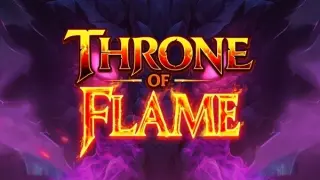
Throne of Flame Demo
Table of Contents
When the flames ignite: how Throne of Flame changes once features are active
Throne of Flame feels almost restrained until things catch. The base spins move at a measured pace, reels gliding with a slightly weighty inertia, embers drifting lazily behind the grid. Then a feature sparks and the whole screen tightens, as if the game exhales and decides this spin actually matters.
You notice it in stages. A subtle glow creeps up the sides of the reels when key symbols land, the background furnace brightens a notch, and the slow-burning ambience sharpens into more urgent accents. The change is less about flashy effects and more about how the slot starts to lean in with you, hinting that the numbers under the hood are lining up for something more interesting.
During quiet stretches, Throne of Flame plays like a fairly measured, line-based game with regular small hits and the occasional perk to keep you from zoning out completely. Once features are active, it suddenly behaves like a high-drama piece of theatre: stacked premium symbols stretch across multiple reels, modifiers hang in the air for a beat before resolving, and you find yourself tracking specific spots on the grid as if they were live coals. The shift makes it feel as though two different personalities are taking turns with the same set of reels.
That dual personality shapes how you perceive volatility and win potential. The calmer periods can feel almost methodical, with modest feedback and just enough movement to suggest the game is ticking along. When a feature chain kicks off, outcomes become lumpier: several spins in a row carry significant promise, even if only one of them actually lands a memorable win. The sense of power is less about any single mechanic and more about how the slot rearranges its mood around those windows of heightened chance.
From ember to blaze: the feel of a “switched-on” screen
A “switched-on” screen in Throne of Flame becomes easy to spot once you have seen it once. The reels speed up a hair, the symbol halts become snappier, and small embers that usually drift lazily in the background start swirling more aggressively towards the centre of the grid. It feels as if the game is literally drawing your gaze to the middle three reels, where most of the heavy lifting tends to happen.
Premium symbols arriving stacked do not just slide into place. They thud in, each tile giving off a brief flare that lingers for a fraction of a second, enough to make you register that this reel has just become important. If a feature symbol lands and the game is deciding whether to trigger, the whole grid pulses gently with a darker orange tint, and the sound level jumps a notch without actually becoming loud. Those tiny touches are what make you instinctively lean closer to the screen and start counting reel positions without thinking about it.
The tension peaks when multiple feature-related elements line up at once. For example, a wild modifier might hover briefly above the reels like a molten crown, held there by a sustained note, before slamming down and locking symbols in place. During these moments, your focus narrows: you are no longer watching five separate reels but one continuous band of potential, waiting to see whether the right icon lands in the one gap you are staring at.
Once the feature ends, the screen relaxes almost abruptly. The embers return to their slow drift, the reel spins lengthen slightly again, and the soundtrack slips back into its lower, more repetitive loop. There is often a faint afterglow animation on the throne behind the reels, as if the metal is cooling down. That visual “cooling” captures the emotional dip pretty well; you go from heightened attention to a more observational mindset, reassessing whether to keep pushing or let the session wind down.
Feature-heavy stretches and what they imply for outcomes
Every so often, Throne of Flame bunches its excitement together in short, punchy clusters. You might trigger a main bonus, follow it with a mini-feature a dozen spins later, then see enhanced wilds or boosted premiums reappear before you have time to mentally reset. These clusters create the feeling of a “run” where the game seems willing to test its higher-potential side repeatedly.
It is worth keeping in mind that a run of feature entries does not automatically equal a run of big payouts. You can hit three bonuses in quick succession and come away with one decent result and two that barely move the balance. But the very fact that you are returning to the feature zone repeatedly changes your expectations. You start evaluating the session in segments: that whole 30-spin window felt like the hot part, even if the actual numbers on the balance line are modest.
Understanding these hot windows helps frame both short and long sessions. If you are only planning a quick sample of 50–80 spins, you might see nothing more than a tease of the game’s top gear and leave with the impression that it is slow-burning. In a longer sit-down, those same feature clusters stand out as the natural peaks, times when you might raise your stake slightly or simply pay closer attention because the slot is clearly capable of swinging harder. The design nudges you toward that mindset by clustering its moments of high promise rather than spacing them out evenly.
Audio sparks in Throne of Flame: sound cues and attention
Sound design in Throne of Flame is more reserved than the name suggests. The base game hums along on a low, smouldering drone, like a forge heard from the next room rather than right beside your ear. Soft crackles and an occasional metallic clink punctuate the silence, giving the reels a grounded, almost weighty character when they spin.
The interesting part is how the game layers sharper cues on top of that restraint when a spin starts to matter. Rising tones track symbol drops on the more important central reels, and a short, tight drum hit fires when a key premium locks into place. Feature symbols have their own chime: a hollow, slightly echoing clang that seems to come from the throne in the background. When two such symbols land, that clang is followed by a thin, rising whistle that holds until the final reel stops, acting as a clear heads-up that something significant might be landing.
What helps is that the soundtrack never completely drowns out those cues. The background loop dips in volume the instant a feature sequence begins, leaving room for wild stingers, scatter chimes, and the small “sizzle” effect that plays when a stacked symbol expands. It means you do not have to stare at the screen to know when to care; a handful of very specific sounds tell you when to look up from another tab or from your phone. For anyone used to playing multiple games or watching TV while spinning, that subtle audio hierarchy makes Throne of Flame easier to follow without feeling noisy.
The studio behind the throne: where Throne of Flame sits in the catalogue
Within its studio’s line-up, Throne of Flame comes across as the more intense cousin of their usual fantasy fare. While many of their earlier titles leaned into gentle, almost storybook worlds with forgiving payout curves, this one clearly aims for a grittier, “metal and fire” tone, both visually and in how it delivers win potential. You can feel a shift from colourful whimsy to something closer to a dark-forge epic, even before the first feature triggers.
There are still plenty of familiar design fingerprints. The layout keeps to a traditional five-reel frame, the spin and bet controls look almost identical to the studio’s other recent releases, and the way free rounds are counted in a clean, compact bar at the top of the screen will be instantly recognizable to anyone who played their earlier titles. Modifier icons also follow a similar vocabulary: glowing borders around upgraded symbols, a shared colour code for wilds, and that slightly delayed reel stop whenever a significant symbol is passing through the final reel.
Where Throne of Flame diverges is in how much weight it puts on those momentum spikes. The studio’s previous releases often tried to smooth things out, spreading medium results across both base play and features. Here, more of that potential is packed into concentrated windows. Base play feels a bit leaner in exchange, and bonus rounds carry a heavier sense that this is where the session will be decided. For fans of the provider who always wanted them to push their mechanics a little harder, this slot feels like a deliberate step in that direction.
Reading the fire: win potential in Throne of Flame
Win potential in Throne of Flame sits comfortably above relaxed, low-risk games, yet it still lives within the mainstream range that most Canadian online casinos favour. It is not a niche ultra-extreme slot that spends ages doing nothing and then occasionally explodes for mind-bending totals. Instead, it is tuned to suggest serious peaks while still giving enough feedback in the middle to keep regular sessions coherent.
Thinking about potential in layers is helpful. At the bottom, you have the everyday results: the singles and modest multi-line hits that recycle a portion of your stake and keep you spinning. Above that lies the band of wins that actually feel meaningful compared to your bet size, where a single outcome can nudge your balance back toward even or into a light profit. Floating above both, in a very narrow slice of the experience, are the true “inferno” moments where the slot finally flexes the full intent of its title.
Structurally, Throne of Flame directs more of its promise into those upper layers by using its feature rounds as compressed delivery systems. The most memorable outcomes tend to arrive not as isolated spins but as sequences: a bonus that starts slow, picks up through stacked premiums or multipliers, and then delivers one or two standout individual spins within the round. That pattern gives the game a kind of narrative arc whenever things go well, which makes even mid-sized hits feel more satisfying than if they had just appeared out of nowhere.
Small wins and steady embers
On an ordinary run, most spins in Throne of Flame resolve as small embers: a line of low-paying symbols here, a scattered pair of mid-paying icons there, sometimes boosted by a stray wild. These outcomes often return a fraction of your stake, occasionally matching it or slightly exceeding it. They are not spectacular, but they create a rhythm. You see movement on the balance meter, hear short confirmation sounds, and register that the game is still “breathing,” even during quieter periods.
These small results also tend to cluster around certain reel configurations. A single stacked low symbol landing on the first reel frequently sets up a chain of minor connections across the grid. When that happens, the reels shimmer briefly with a pale orange overlay as all winning lines are drawn at once, before the total is tallied. It is a small, efficient flourish that visually distinguishes “token” wins from losing spins without making them seem more dramatic than they are.
In terms of wins that actually shift how a session feels, you are usually looking for outcomes that cover a few dozen spins’ worth of stakes in one go. Those do appear in the base game, especially when stacked premiums combine with wilds, but they are much more common once you are inside any of the slot’s enhanced modes. A typical player might reasonably expect to see one or two such balance-shifting hits during a longer session if the slot is being cooperative, though that will of course swing significantly from one playthrough to the next.
Mid-range hits: when the flames actually matter
The band of wins most people will remember from Throne of Flame sits in the mid-range: those moments when the screen lights up properly, the win counter does not stop after a quick flick, and you watch the total climb enough to feel like the game finally gave something back. From a stake-relative perspective, these are the outcomes that cover a noticeable part of your buy-in or even put you ahead, without touching the extreme top end.
They usually come from a few recognizable patterns. One is the fully charged screen of mid-tier symbols linking across four or five reels, sometimes helped by a roaming wild that chooses precisely the right column to land in. Another is a bonus sequence that piles modest wins for several spins and then drops a late highlight when stacked premiums overlap with a feature-boosting modifier. The game accentuates these moments with a slightly different win-count animation: the numbers roll up in a more deliberate, segmented way, accompanied by a ringing, metallic chord that feels thicker than the light plinks of small hits.
Emotionally, this range is where Throne of Flame feels the most satisfying. You walk away from those wins thinking that was decent, even if you did not get close to the slot’s hard ceiling. The spin or bonus felt eventful enough, the audiovisual build-up matched the outcome, and you ended up with a concrete gain rather than just an impression of potential. For many players, especially those not pushing high stakes, these are the results that define the game more than rare maximum-style screenshots.
Chasing the inferno: rare top-end sequences
Every now and then, the slot makes it clear that you are stepping into rarer air. The background behind the throne deepens from standard orange to a more molten red, thin heat-lines ripple up the sides of the reels, and the soundtrack leans into a sustained, chorus-like tone that feels less like a jingle and more like a warning siren. That is the game’s way of signalling that its upper potential is in play.
These moments often come when several favourable elements align: stacked premiums already on the grid, an active modifier promising extra wild coverage or multipliers, and one or more remaining spins in a feature round. You watch the reels spin knowing that, for a brief window, the math is leaning heavily in your favour. When everything connects, the result can be a screen so saturated with high-value symbols that the individual lines almost blur together. The win-counter animation changes again here, slowing dramatically while fiery arcs sweep across the frame, clearly marking this as an outlier event.
It helps to recognize how thin that slice of the experience really is. The statistical reality is that most sessions will not see those full inferno sequences, no matter how long you sit. You might encounter several mid-range highlights, a few “almost” screens where one reel refuses to cooperate, and a handful of feature rounds that flirt with greatness before settling into decent territory. Understanding that the true top-end is built for rarity helps keep expectations in check, especially if you are drawn in by promotional material that focuses on the biggest theoretical wins.
Session snapshots: realistic outcomes over time
Thinking about Throne of Flame in terms of session profiles can help anchor expectations. A short exploratory visit of, say, 50–100 spins at a moderate stake often feels like skimming the surface. You may trigger a mini-feature or at least see the reel and sound behaviour that leads up to one, but you are just as likely to get a general sense of the base-game temperament: recurring small wins, a couple of promising setups that fizzle, and perhaps one hit that stands out compared to the rest without being spectacular.
Extend the session into the 200–400 spin range and the game’s streaky personality becomes more visible. You might go through a quieter phase where the balance drifts downward through a combination of losing spins and token returns, then hit a patch where several features arrive closer together. In one such patch, a solid bonus might claw back a big chunk of the earlier loss; in another, two or three underwhelming features might simply slow the decline rather than reverse it. Both patterns are plausible. Both feel distinct from the smoother, more linear progression of a classic low-variance slot.
Very long sessions, especially at higher stakes, are where the full spread of outcomes emerges. One player might experience a brutal evening where hot windows refuse to translate into anything above the mid-range and the balance erodes despite multiple promising setups. Another might find that a single, well-timed bonus sequence more than compensates for an hour of unremarkable spins. The structure of Throne of Flame amplifies those differences because so much of its power is held in condensed bursts rather than distributed evenly. Keeping that in mind can make those stretches of uneventful play feel less like a failure and more like waiting to see whether the next peak chooses your session or someone else’s.
Pacing map: how Throne of Flame ebbs and surges
The rhythm of Throne of Flame is built around contrasts. For stretches of 20 or 30 spins, you might experience a fairly even pattern: a string of small, mostly forgettable wins punctuated by a single spin that returns a bit more than the others, then back to modest outcomes again. The soundtrack settles into its low, forge-like hum during these periods, and the reels feel almost unhurried, as if the game is letting you drift into a comfortable tempo.
When the slot begins to warm up, the change is usually gradual rather than instant. You start seeing more near-miss feature symbols, often landing on reels one and three with a hinting chime, and more stacked versions of mid-tier icons appearing just above or below the payline. There may still be losing spins in between, but the visual density of “almost” outcomes increases. In a subtle detail, the spin button’s rim glows slightly brighter after a near-miss, as if the game is flagging the spin as part of a transition.
Once you enter a proper hot patch, the surges come more frequently. Features appear in closer succession, and the average spin simply feels busier: more wilds, more partial premium stacks, more reels stopping with that tiny half-beat delay the slot reserves for promising moves. Not every one of these sequences leads to a big payout; some will deliver nothing more than a moderate win that looks larger than it is because of the visual spectacle. However, that concentration of higher-potential setups within a relatively short timeframe is usually a decent signal that you are in one of the game’s warmer phases.
Eventually, the energy ebbs. You might notice several spins in a row where the background glow cools to its base-level orange, the sound mix loses its heightened accents, and the reels stop in a more uniform, almost metronomic pattern. At that point, you are often back in a more neutral space, waiting for the next ramp-up. Learning to recognize these shifts does not change the underlying odds, but it does give you a clearer sense of where you are in the game’s pacing at any given moment.
Betting range and bankroll sizing in Throne of Flame
Throne of Flame covers the usual bet spread Canadian players expect: low minimums suitable for casual spins and upper limits that will interest more committed bankrolls, though specific figures depend on the casino offering it. Stake adjustments are smooth, with no odd jumps between common bet levels, which makes it easy to fine-tune your risk.
Because the slot channels so much of its promise into features and clustered hot windows, it tends to reward a slightly more patient approach to bankroll management. Short-hit “probe” sessions at higher stakes can easily run into a quieter patch and feel punishing. Many players find that starting at a conservative bet and giving the game room to cycle through its cooler and warmer phases offers a clearer picture of what it can actually do. From there, nudging the stake up or down based on how the session is unfolding becomes less about chasing and more about matching your bet size to the kind of ride you are getting.
Throne of Flame beside its peers: where it sits among adjacent slots
Set alongside other fire-and-fantasy slots, Throne of Flame shows a few clear distinctions. Compared to gentler, cartoon-ish titles that lean on frequent mini-features and constant motion, this game feels denser and more deliberate. The reels do not shower you with tiny modifiers every other spin; instead, they hold back, building up their bigger moments in a more obvious way. That gives the slot a slightly older-school backbone, even though its visuals and UI are unquestionably modern.
Within the family of “throne” or “royal power” themed games, Throne of Flame charts a middle path. Some competitors focus almost entirely on lavish presentation, stuffing the screen with animated banners and massive character portraits while delivering relatively modest win potential. Others go in the opposite direction, stripping the frame down to bare symbols and pouring everything into ultra-high volatility. Throne of Flame keeps a detailed backdrop — the molten throne, the shifting chains, the heat shimmer at the top of the frame — but it stops short of obscuring the reels themselves. You always have a clear view of where important symbols are and where they might land next.
Mechanically adjacent slots that emphasize feature streaks often adopt a very choppy feel: long sequences of nothing broken by sudden, overwhelming cascades of action. Here, the studio makes a conscious effort to bridge those extremes. The base game is not hyper-generous, yet it does scatter enough small wins and partial setups to smooth the road between feature clusters. If you are used to games where you either hit a bonus or feel like nothing is happening, Throne of Flame’s quieter signals — the stacked lows, the gently glowing modifiers, the light reel delays — offer a more gradual build-up.
In terms of perceived potential, it situates itself above the breezy “coffee break” titles but below the ultra-spiky cult favourites that advertise astronomical maximum wins. The trade-off is that its headline numbers feel achievable enough to be believable for regular players, while still leaving a sense of ambition. If you enjoy the general feeling of chasing bigger moments without stepping into the most extreme corners of the genre, this slot sits comfortably in that middle-ground.
Where Throne of Flame may feel slightly more niche is in how clearly it wants you to pay attention during its hot windows. Some adjacent games automate more of the spectacle; you trigger a feature, watch it play out like a mini-movie, and collect the result. Here, you are subtly encouraged to read the reels as they spin, identify when stacked premiums or modifiers are lining up, and react to each spin inside a bonus as its own event. That makes it particularly appealing to players who like to read a slot’s mood rather than simply clicking and waiting for the summary screen.
Where it falls a little short
Throne of Flame has personality, but it is not without its rough edges. A few of them stand out once you spend some real time with the game.
First, the gap between the visual drama of some setups and the eventual payout can occasionally feel jarring. When the throne glows deep red, the reels vibrate, and the soundtrack leans into its big crescendo, you instinctively expect a sizeable result. On more than one occasion, that build-up resolves into a fairly modest win, leaving a bit of emotional whiplash. The slot is far from alone in doing this, but the intensity of its cues makes those moments more noticeable.
Second, the base game can feel slightly lean for players who prefer a high frequency of small features. The slot does deliver regular low to mid-sized wins, but it does not bombard you with mini-modifiers, character cameos, or constantly shifting reel behaviours. For some, that restraint will be a plus; for others, especially those used to highly “gamified” modern titles, it might come across as a little sparse between bigger events.
Third, the feature clusters that define its hotter sessions cut both ways. When a series of bonuses land close together and underperform, the experience can feel more frustrating than in a game where feature triggers are rarer but more evenly matched with their build-up. There is a sense of a wasted window that lingers, particularly if you have already invested a fair number of spins leading up to that run.
Lastly, the audio mix, while cleverly layered, leans heavily on a small set of motifs. In longer sessions, the main background loop’s steady forge-hum and the repeating metallic chimes can begin to feel slightly monotonous. Muting is always an option, but given how well the slot uses sound cues to signal important moments, it would be nice to have just a bit more variety.
More Slots from Stakelogic





| Provider | Stakelogic |
|---|---|
| RTP | 95.98% [ i ] |
| Layout | 5-3 |
| Betways | 243 |
| Max win | x5000.00 |
| Min bet | 0.1 |
| Max bet | 100 |
| Hit frequency | N/A |
| Volatility | Med-High |