Storm of Seth 2 Demo
Table of Contents
First impressions: how Storm of Seth 2 feels over 20–30 spins
Storm of Seth 2 throws you straight into that familiar ancient Egypt mood, but what stands out first is the tempo, not the theme. Over the initial 20–30 spins, the game feels a bit like standing near a brewing sandstorm: long stretches of quiet, some dusty gusts of small wins, and the occasional heavy rumble from feature teases.
The base game rhythm leans toward medium-to-high volatility. You’ll see pockets of dead spins where the reels stop with a blunt, almost muted thud, followed by short bursts of hits. Small wins arrive often enough to keep the session from feeling frozen, but they rarely cover your full bet size. That gives the early spins a slightly “grindy” flavour, especially if you’re playing at modest stakes and tracking the balance closely.
Feature teases show up with a little theatre. Storm clouds dim, a low rumble creeps into the soundtrack, and Seth’s silhouette can flicker at the edge of the screen when scatters land on the first two reels. Over 20–30 spins, you usually see a couple of those semi-promising setups where the third or fourth scatter just misses. It’s not non-stop teasing, but it happens often enough that you start waiting for “the one” that finally connects.
This pacing suits patient bonus hunters more than players who want constant, low-level fireworks. If you prefer a slow build where the first half hour is about staying in range and waiting for the storm to finally break with a strong feature, Storm of Seth 2 is tuned toward that style.
A. Pacing snapshot: what the first half hour is really like
In the first half hour, the slot settles into a pattern that feels deliberate rather than chaotic. Spins roll in smoothly, symbols drop with a light bounce instead of a sharp snap, and win animations are short and readable without dragging the tempo.
Small line hits land every few spins, often built from the mid-tier artifact symbols instead of just card ranks. These wins tend to sit in the 0.2x–0.8x bet region, so the credit meter moves, but not enough to erase a run of losing spins. Now and then, a stronger premium connection or wild-assisted hit pops up and nudges your balance back toward where you started.
Dead spins feel clean rather than punishing. The reels stop, symbols lock, and the game moves on without lingering. There’s no slow-motion reveal unless something is actually being teased. That keeps the pace brisk, even when the slot is in a stingy patch.
Mini-features or storm-style modifiers, if they’re part of your version, tend to appear occasionally rather than every few spins. Seth may sweep across the reels in a sandstorm, converting symbols or dropping wilds. It doesn’t happen often enough to rely on, but when it does, the visuals kick up a notch: the sky shifts to a deeper copper tone, sand particles swirl over the reels, and the audio drops into a heavier, bassy pulse.
This early stretch feels comfortable for players who appreciate a disciplined tempo. Those who crave constant pick-and-clicks, pop-ups, or frequent side features may find the first 20–30 spins a bit too restrained.
B. Early session risk profile
Before checking any numbers, the volatility of Storm of Seth 2 comes through in how your bankroll moves during the first 50–100 spins. At low or medium stakes, the balance usually trends down gradually, interrupted by occasional bumps from better-than-average hits. It doesn’t behave like a penny-chip slot where every second spin pays a tiny amount, but it also doesn’t wipe you out in ten spins unless the bet size is too aggressive for your bankroll.
Streakiness is easy to notice. It’s common to hit 6–10 spins with nothing or just token card-rank wins, then 3–5 spins in a row where wilds show up more often and mid/high symbols decide to line up. Those “warm patches” often come with stronger sound cues: the backing track swells slightly, and win sounds chain together, giving a sense of momentum.
By the time you hit 60–80 spins, the emotional read on the slot is usually clear. If you’ve seen a couple of solid base hits or a feature, the volatility feels “earnest” rather than cruel. If the bonus keeps dodging you and the best you’ve seen is a 3x or 5x win, the game can feel like it’s holding back, and you start framing the session around landing that one big feature to justify the outlay.
It often starts feeling worth sticking around once you’ve seen at least one major tease or partial storm feature. That’s the point where you’ve committed some spins, you understand how your chosen stake drains or holds, and you’re deciding whether to ride out the next 50–100 spins hoping the storm finally breaks in your favour.
C. First-time player checklist before hitting spin
A quick look at the info panel before diving in helps set expectations and avoids awkward surprises mid-session:
- Check the displayed RTP. Storm of Seth 2 is usually offered in multiple RTP versions, which can vary between Canadian-facing casinos. The percentage is often listed on the first page of the paytable or in a separate “Help” or “i” menu.
- Confirm whether your bet size is shown in cash or coins. Some versions allow a coin-based view, which can make the true dollar value less obvious at a glance.
- Skim the feature description, especially how scatters or storm symbols trigger the main bonus and whether any multipliers carry over between spins.
For a first session, running 50–100 demo spins is useful. That sample is enough to see how often small wins land, how “pricey” the game feels at your usual bet level, and how frequently the main feature teases or triggers.
A few quick settings worth adjusting:
- Turbo or quick spin: enable it if you like a snappier feel, but consider keeping the standard speed while you’re still learning the symbol set and storm visuals.
- Sound: the audio mix leans atmospheric, but if you’re on mobile in public, muting the music and keeping just sound effects preserves feedback without drawing much attention.
- Auto-play: if available in your region, set strict loss limits and single-win caps. With a volatile slot like Storm of Seth 2, this avoids an absent-minded 200-spin run chewing through more than you intended.
Once those basics are dialled in, the first 20–30 real-money spins feel more controlled and less like a blind plunge into the sandstorm.
Sands and storms: theme, visuals, and atmosphere
This sequel leans into the Egyptian setting with a darker, more dramatic tone than the usual sunlit temple slot. The reels are framed by stone pillars etched with jackal-headed carvings, while the backdrop shows a desert skyline under thick, swirling clouds. Warm orange light from braziers glows at the base of the reels, but the sky above shifts between dusk and near-night whenever storm features threaten to appear.
The art direction sits between semi-realistic and stylized. Symbols have crisp outlines, and the colour palette mixes sandy beiges with deep purples and electric blues. It isn’t minimalist, yet it avoids clutter, which keeps the screen readable even at higher spin speeds or on smaller devices.
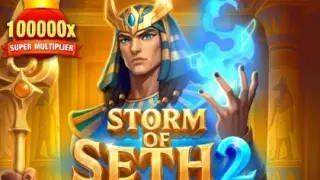
Seth typically appears as a muscular, jackal-headed deity in dark armour with glowing eyes. He may stand beside the reels, occasionally turning his head or lifting his staff when scatters land or storms trigger. He doesn’t dominate every spin, which keeps his appearances feeling like actual moments rather than constant noise.
A. Ancient Egypt with a storm twist
Instead of a bright postcard of pyramids, the setting feels like a tense moment before a major celestial event. The desert horizon is visible but often half-obscured by drifting sand clouds. Lightning flickers behind distant obelisks, and the overall lighting favours twilight over clear daylight.
High-value artifact symbols echo that mood: cracked stone tablets emitting faint purple light, a storm amulet with swirling energy trapped inside, and an ornate staff crowned with a lightning motif. These design choices reinforce the impression that you’re dealing with the chaotic side of Egyptian mythology rather than the calm of sunrise.
The reel frame uses metallic trim carved with runes, and when the storm builds, fine cracks along the frame glow softly. It’s a small but handy visual cue that the power level is rising, and it helps you read the “temperature” of a feature sequence at a glance.
B. Animation and storm effects
Reel movement has a slightly weighty feel. Symbols descend in a controlled fall instead of flickering instantly into place. When they land, a faint dust puff appears along the bottom of each reel, like sand being nudged aside.
Storm and lightning effects are saved for real tension or impact. When two scatters have landed and the game is slowing for a possible third, the background darkens a step, and wisps of sand curl inward toward the centre of the reels. If the last symbol misses, the lighting eases back to normal with a short fade, not a harsh snap.
During bigger wins or active storm features, lightning arcs across the top border, and Seth may raise his staff as the screen washes briefly in a pale, stormy glow. These flourishes are quick, so even intense moments don’t derail the overall pacing.
Idle visuals are understated: torches flicker, dust drifts lazily across the lower screen, and Seth shifts his stance once in a while. UI transitions, like opening the paytable, use simple slides or fades, avoiding the stacked pop-ups and heavy overlays that can make some slots feel clunky.
C. Sound design and how it affects perceived pace
The soundtrack lands somewhere between ambient and cinematic. In the base game, a low, rhythmic motif plays with sparse percussion and airy, reed-like notes that nod to the Egyptian theme. The loop is long enough to avoid becoming annoying during a 30–40 minute session, and it sits behind the action rather than competing with it.
Small wins trigger light, glassy chimes that end quickly. Larger hits add deeper drum tones and a few rising notes. The win jingle grows in volume and complexity with the size of the payout, which makes it easy to recognize a bigger-than-normal hit even if you’re not staring at the reels.
Feature teases and near misses have their own audio language: a low rumble when the second scatter lands, followed by a faint swirling sound as the last reel slows. If the third symbol misses, there’s often a short, descending cue that signals the “almost” moment without going overboard.
During bonuses or storm features, the music thickens with heavier percussion and more assertive melodies. That shift alone makes those phases feel faster and more intense, even though the spin speed may be unchanged. Over time, the audio helps divide a long session into distinct “chapters”, which does a lot to keep it from feeling flat.
Symbols of power: paytable, wilds, and premium icons
The symbol set in Storm of Seth 2 is built for quick recognition, which matters if you prefer faster spin speeds or play on a smaller screen. There’s a clear ladder from low-paying card ranks up to premium deity and artifact icons.
Each symbol sits on a slightly textured stone-like background, while the icons themselves use saturated colours and bold outlines. That makes it simple to spot a row of glowing amulets or Seth masks even when turbo is on.
A. Low, mid, and high-paying symbols at a glance
Low-paying symbols are the usual card ranks (10 through A), styled as if carved into sandstone blocks. Each rank carries its own muted colour tint—soft reds, blues, greens—which helps you see at a glance when a win is just built from these low pays.
Mid-paying symbols tend to be temple artifacts: ankhs, scarabs, ceremonial daggers, or scrolls wrapped with stormy ribbons. They’re more detailed than the card ranks but still straightforward enough that you can read combinations instantly when the paylines highlight them.
High-paying symbols are usually characters or powerful relics tied directly to Seth and the storm theme. Expect things like:
- A glowing storm amulet with a swirling vortex in the centre
- A sharp-edged jackal warrior mask
- Possibly Seth himself as a top premium, if he isn’t reserved exclusively for bonus roles
Premiums use brighter highlights and more intricate shapes, so when a big connection is brewing, you can often see it taking shape even before the payline overlay kicks in.
B. Special symbols and what they really do
Storm of Seth 2 typically uses a clearly marked wild symbol, often a glowing storm emblem or Seth’s staff stamped with the word “WILD”. Wilds stand in for regular pay symbols to complete or improve winning lines. In some versions, wilds can also carry multipliers or expand on certain reels during storm features, so it’s worth checking the “Special Symbols” section of the paytable.
Scatter or bonus symbols are usually tied to Seth or a storm portal. They tend to stand out with a distinctive glow around their frame and can land anywhere on the reels. You usually need a set number (often three or more) to trigger the main bonus. Teases frequently involve two scatters landing early on reels 1 and 2, with the remaining reels slowing to highlight the chance of the final symbol.
Some builds of Storm of Seth 2 may introduce extra icons such as:
- Storm orbs that collect in a meter to unlock modifiers
- Special expanding symbols during free spins that cover entire reels
- Collection tokens in a top row that trigger random storm events
These special symbols often come with quick, distinct animations. A storm orb might pulse and send a small lightning arc to a meter above the reels, clearly showing that some longer-term mechanic is charging up.
C. Reading the paytable like a seasoned player
The paytable usually opens as a multi-page panel. When going through it, a few checks go a long way:
- Look at the payout for 5-of-a-kind of the top premium symbol relative to your bet. That gives a fast sense of whether significant wins are expected mostly from line hits, from the bonus, or from both working together.
- Confirm the game structure. Storm of Seth 2 often uses fixed paylines instead of a “ways” engine. The number of lines (20, 25, etc.) influences how often small wins appear and how spreads of mid symbols translate into actual payouts.
- Note any stacked or expanding symbol rules. If certain premiums land stacked on the reels, they can produce surprisingly strong base-game hits when they connect across multiple reels, changing how “dead” the base game really feels.
The paytable also explains how special symbols interact. It should spell out whether wilds can substitute for bonus symbols, and whether expanding or special symbols only activate during free spins. Reading those lines closely prevents a lot of “why didn’t that trigger?” confusion later on.
Under the hood: math model, RTP, volatility, and hit frequency
Even without the numbers, Storm of Seth 2 plays like a medium-high volatility slot built around strong bonus potential. The base game can throw in decent combinations, but the overall rhythm suggests that the real weight is in storm features and free spins.
Open the info panel and you’ll typically see an RTP somewhere around the mid-96% mark in the default setting, with lower-RTP versions also available. That’s fairly standard for modern online slots, but the volatility profile shapes how that percentage feels on a spin-by-spin basis.
A. Official numbers vs how it actually feels
In most Canadian casinos, the slot is described as medium-high or high volatility. In practice, that usually means:
- Regular runs of dead spins, especially at default or turbo speed
- Occasional bursts of back-to-back wins that can partly restore your balance
- A clear reliance on landing at least one strong feature in a long session
On paper, hit frequency (how often any win appears) may look reasonable. In play, it can feel lower because many hits are modest, covering only a fraction of your spin cost. From a player’s perspective, those can register as “non-events”.
When a storm feature or free spins round does land, the math leaves room for a wide spread of outcomes. Sometimes you’ll finish with a modest payout that barely covers the last chunk of spins. Other times, stacked symbols, multipliers, or retriggers line up and push the result much higher.
B. Bankroll behaviour over longer sessions
How your balance behaves in Storm of Seth 2 depends heavily on both stake and session length.
With smaller bankrolls (say, 50–70 spins worth of your usual bet), the game can feel unforgiving if the bonus stays out of reach. You might get enough mid-level hits to stretch the session, but the underlying drift is generally downward. It’s worth going in knowing that a short session may end without you seeing the main feature at all.
With medium or larger bankrolls, the slot feels more like a slow, uneven ride with the odd sharp climb. The credit meter often dips, then bounces back toward starting level after a good feature or a strong premium line, then drifts again. It doesn’t grind flat like very low volatility games; it swings up and down.
This makes Storm of Seth 2 better suited to players comfortable with 200–400 spin sessions and a few dry patches along the way. If you prefer quick 20–30 spin “test runs”, your impressions can swing wildly between “this is dead” and “this is wild” depending purely on whether you happen to hit a fast bonus.
C. RTP variants and what Canadian players should check
For players in Canada, it’s worth remembering that Storm of Seth 2 can be configured with different RTP versions, depending on the operator and jurisdiction. Not every casino displays the number on the game tile, so you often need to:
- Open the in-game info or help menu and look near the end of the pages for a “Return to Player” or “RTP” line.
- Compare that value across a couple of sites you use, if you have access to more than one casino.
Even a small difference, such as 96.1% versus 94%, can matter over long sessions, especially in a volatile game where you’re relying on fewer big hits. Choosing the higher-RTP version when you have the option improves your long-term expectation without changing how the game feels.
Some provinces or regulated platforms may enforce a single RTP profile for all players, while offshore-style casinos might use another. The reels and features behave the same on the surface, but knowing the number behind them lets you make a more informed choice about where to play.
Storm mechanics: base game features and modifiers
Once those first exploratory spins are out of the way, the personality of Storm of Seth 2 really comes from its storm mechanics and how they interact with the base game. Regular spins are intentionally lean; the modifiers and special events add the texture and surprise.
Storm mechanics can include random wild additions, symbol transformations, or upgraded reels that make it easier to trigger the main bonus. The shared trait is that when they fire, they usually affect multiple reels at once, creating a sudden jump in potential compared to the quieter base rhythm.
A swirling sand effect often sweeps across the reels at the start of a spin when a modifier is about to trigger. Seth might step forward, raise his staff, and send a shockwave that turns one or more reels partially or fully wild. In other cases, a cluster of mid symbols may upgrade into a higher-paying icon, giving a spin that was headed for a dead result a second chance.
These events are intentionally rare. That scarcity aligns with the math model and helps them feel meaningful. They act as bridges between longer dry stretches and the bigger, less frequent bonuses, softening the session just enough to keep it engaging without turning it into a constant feature-fest.
Into the eye of the storm: free spins and main bonus round
When scatters finally land in the right spots, the game shifts gear. The screen usually runs through a short transition: the sky darkens fully, lightning rips across the background, and the reels reframe into a slightly altered configuration for the free spins round.
The free spins or main bonus typically revolve around some mix of:
- Enhanced wild behaviour (sticky, expanding, or multiplier wilds)
- Upgraded symbol sets (low pays removed or certain symbols boosted)
- A retrigger mechanic when extra scatters land
During this phase, the perceived pace changes. Even if spins take the same time, sticky or persistent elements make each one feel more loaded. As wilds stick or expand, the board develops from spin to spin, and the tension builds as you wait for one more symbol drop to connect a premium line.
On the audio side, the soundtrack thickens with heavier drums and more defined melodies, and big hits bring full-screen flashes and Seth animations. A single bonus round can feel like a self-contained mini-session, with its own rise in intensity and potential payoff.
It’s worth reading the free spins rules carefully in the paytable before chasing them. Details like whether multipliers stack, whether sticky wilds persist across retriggers, or whether low symbols are removed make a big difference to what “average” and “great” bonuses look like in practice.
How this version differs from the original
Storm of Seth 2 presents itself as a sequel, but not every Canadian casino highlights exactly how it diverges from the first game. Instead of assuming, it’s safer to use it as a checklist and verify the key points in the paytable or demo:
-
Max win potential
- Look for the “maximum win” line in the info menu for Storm of Seth 2.
- Compare it with the original if both are available. Sequels sometimes adjust the top potential up or down, which changes how swingy the game can feel.
-
Feature triggers and scatter behaviour
- Confirm how many scatters are required to trigger the bonus and whether they’re limited to certain reels.
- In some sequels, the number of symbols stays the same, but their reel positions change, which can subtly affect how often the feature triggers.
-
Multiplier logic in the bonus
- Check how multipliers work: do they reset every spin, or do they build over the course of the feature?
- If the original had a simple multiplier setup, Storm of Seth 2 may experiment with progressive or step-based multipliers that change the feel of longer bonuses.
-
Storm modifiers in the base game
- See whether the paytable lists random storm features that weren’t present in the first game.
- Some versions of Storm of Seth 2 add extra modifiers such as symbol upgrades or random wild reels, which can noticeably change short-session pacing even if the core math stays close.
-
Bonus pacing and retriggers
- Verify whether retriggers are possible and how they work.
- Compare the number of free spins you receive for the minimum trigger. Sequels often tweak this, making bonuses shorter but more intense, or longer and slightly tamer.
-
Symbol set and visual tweaks
- Look for changes in premium symbols, especially if Seth’s role has shifted between being a regular symbol, wild, or purely a bonus icon.
- Even cosmetic adjustments, like clearer premium shapes or more visible wilds, can affect how easy it is to read the reels at a glance.
-
RTP variants and configuration
- Check whether the sequel is offered at different RTP levels than the original on the same casino.
- Some operators may choose a different default RTP for Storm of Seth 2, which subtly alters long-term expectations even if the gameplay feels familiar.
Treating these points as a quick checklist in the demo or info panel helps avoid assuming that the sequel behaves identically to the first game behind the scenes.
Slot fingerprint
- Medium-high volatility with clear “quiet stretches then bursts” pacing in the base game
- Darker, storm-heavy Egyptian atmosphere with strong but not overwhelming deity presence
- Storm-style modifiers that act as occasional bridges between dry spells and main bonuses
- Free spins focused on upgraded wild behaviour and persistent elements that build tension
- Multiple RTP profiles across casinos, making the in-game info page worth checking before longer sessions
Common mistakes & traps
- Ignoring RTP differences between casinos and playing a lower-RTP version without realizing it
- Overbetting in the first 30–40 spins, assuming a quick bonus, then running out of bankroll before the game’s swingy nature evens out
- Misreading small, frequent teases as a sign that a bonus is “due”, then chasing it beyond a pre-set limit
- Skipping the paytable and expecting wilds to substitute for scatters or special symbols when the rules say otherwise
- Using turbo and auto-play together right away, making it harder to notice how often storm modifiers actually appear
- Assuming the sequel’s bonus mechanics (multipliers, retriggers, symbol removals) are identical to the original without checking
- Treating mini storm modifiers as guaranteed big wins instead of small-to-medium boosts that smooth out the session a bit
| Provider | TaDa Gaming |
|---|---|
| Layout | 6-5 |
| Betways | Pay Anywhere |
| Max win | x10000.00 |
| Min bet | 0.2 |
| Max bet | 200 |
| Hit frequency | N/A |
| Volatility | Med |