RetroVerse Demo
Table of Contents
RetroVerse Slot Review – Full Guide for Canadian Players
Overview of RetroVerse
RetroVerse is a modern online slot dressed up in neon nostalgia: think synthwave colours, glowing grids, and arcade cabinets from the late 80s wired into a 21st‑century math model. It’s built for players who enjoy feature‑rich gameplay but still want something visually clean and easy to follow.
The game uses a classic 5‑reel, 3‑row layout with 20 fixed paylines. It leans on a mix of wilds, free spins with multipliers, and a special retro “Arcade Spins” bonus where progressive multipliers and sticky symbols kick in. The top win potential is in the mid‑to‑high range for a video slot, usually around 5,000x your bet (the exact figure can vary slightly depending on the version your casino uses).
Who is RetroVerse likely to suit?
- Retro aesthetics and synthwave fans who like that Tron‑style neon and arcade vibe.
- Feature hunters who care about free spins, multiplier ladders, and bonus rounds.
- Medium to high‑risk players who are okay with streaky sessions in exchange for bigger spike potential.
- Casual players who want an approachable interface and clear paytable, as long as they keep bet sizes modest.
Compared to other nostalgic or retro‑themed slots, this one feels less “cartoon arcade” and more stylized cyber‑retro. It leans into sharper lines, a soundtrack with a bit more edge, and a math model that sits closer to modern high‑volatility slots than many of the old‑school one‑armed bandit tributes.
What You’ll Learn in This Review
By the time you reach the end, you should have a practical sense of whether RetroVerse fits the way you like to play online slots in Canada.
You’ll understand:
- How the reels, paylines, and special symbols actually interact in day‑to‑day gameplay.
- What the volatility feels like in real terms: streaks, dry spells, and those sudden jumpy wins.
- The realistic ranges of wins in base game versus bonus rounds, not just the theoretical max.
- How frequently features tend to show up, based on typical patterns for this style of game.
- What to expect from the soundtrack and visuals over a longer session, not just the first few spins.
There are some technical aspects worth flagging too. RetroVerse usually comes with multiple RTP (Return to Player) configurations. Canadian‑facing casinos can choose which setting they use, so:
- The displayed RTP in the game info might differ from what you’ve seen in other reviews.
- Some sites may offer a Bonus Buy option for jumping straight into free spins, while others do not, depending on their licence and internal policy.
- Casino‑level promos (like free spins on sign‑up or wager‑free spins) can be tied to this slot, but that varies by operator and province.
None of this changes the core mechanics, but it can impact how the game feels from one site to another. It’s always worth checking the in‑game info panel at your chosen casino for the exact numbers and options.
Theme, Atmosphere, and Visual Style of RetroVerse
Overall Theme and Concept
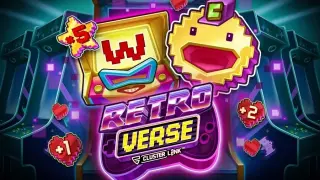
The core idea behind RetroVerse blends retro‑futurism and arcade nostalgia. The reels float above a glowing grid, with a distant synth skyline and geometric shapes pulsing softly in the background. It feels a bit like a mash‑up of an 80s sci‑fi movie intro and the attract screen of an old arcade machine.
During the base game, the atmosphere is relatively calm. Neon blues and purples dominate, with symbols that look like they were pulled from early vector graphics and pixel art. Small wins trigger short bursts of light and quick electronic chirps, but nothing overwhelms the screen or the eye.
Once a bonus round starts, the tone shifts. The background often deepens in colour, with hotter pinks and reds sliding in, and the grid starts to pulse more noticeably. Multipliers and special symbols light up with brighter edges, so you can instantly tell that the stakes have changed. It has the feel of an arcade cabinet that just flipped into “overtime” or high‑score mode.
The first impression when the game loads is clean and focused. In many versions there’s a short introductory animation: a quick sweep through a neon tunnel, then the reels fade in. It sets the mood without forcing you to sit through a long cinematic. After that, the game hands control over quickly, which keeps it friendly for short drop‑in sessions as well as longer play.
Graphics, Animations, and Interface
Visually, RetroVerse goes for a polished synthwave style rather than pure pixel art. Symbols have sharp outlines with a subtle glow, and the colour palette leans heavily on cyan, magenta, and rich purple gradients. The background is static enough not to distract, with slow moving light beams that you barely notice after a few minutes of play.
On desktop, the layout is standard but uncluttered:
- Reels in the centre, framed by thin neon borders.
- Balance, current bet, and win displayed along the bottom in large, legible fonts.
- Spin button on the right side, with auto‑spin and turbo mode typically nearby.
- Menu and paytable icons placed off to one corner, clearly labelled.
On mobile, the UI compresses neatly into portrait mode. The spin button becomes a thumb‑friendly circle at the bottom right, while bet controls tuck into a sliding panel. Text remains readable, and the important buttons are spaced well enough that accidental taps are rare, even on smaller phones.
Animations are smooth but not overdone. Reels spin quickly, with a light streak effect on symbols as they pass. When a win hits, the winning symbols flicker brighter and sometimes pulse outward, with a faint scanline effect reminiscent of old CRT monitors. Bigger wins add a brief zoom and screen shake, but the game rarely locks you into long, unskippable sequences that slow everything down.
In terms of responsiveness:
- Spin speed in normal mode feels moderate, roughly 2–3 seconds from click to result.
- Turbo or quick‑spin mode (if enabled by the casino) cuts that noticeably, which suits players who don’t like downtime.
- The controls for bet size, auto spin, and sound are intuitive. Bet adjustment often uses either plus/minus buttons or a bet menu that lists common stakes in CAD, clearly showing total bet per spin.
Canadian players used to mainstream online casinos should find the interface immediately familiar, without any odd labelling or confusing menus.
Soundtrack and Audio Effects
The soundtrack leans into a retro synth style: slow, looping arpeggios, warm pads, and a bassline that hums rather than thumps. It’s more atmospheric than aggressive, which helps it stay tolerable during longer sessions. Volume levels are balanced so that even basic laptop speakers don’t distort.
Sound cues are where the game adds character:
- Small wins trigger short electronic beeps and quick rising tones, similar to collecting coins in an old platform game.
- Medium hits bring slightly longer riffs, with a subtle reverb tail that makes them feel more satisfying.
- Big wins and feature triggers are announced with a fuller synth chord, sometimes layered with a brief drum fill and a pitch‑rising whoosh as the screen highlights the combination.
Near‑miss moments, like landing two scatter symbols and watching the third roll past, usually come with a rising “charge” sound that cuts off sharply when the reel stops. It’s a familiar device, but done with enough restraint that it doesn’t feel overly manipulative on every spin.
Sound controls are straightforward:
- A speaker icon lets you mute all audio in a single tap.
- In many casino implementations, you can separately mute music and keep effects, or vice versa, through the settings menu.
- Turning off sound has no influence on RTP, volatility, or any other game outcome; it is purely cosmetic.
For anyone who prefers to run a podcast, playlist, or TV in the background while spinning, RetroVerse fades into the back nicely once the music is off.
RetroVerse Symbols and Payout Structure
Low-Paying Symbols
The low‑pay symbols in RetroVerse are usually stylized card ranks: 10, J, Q, K, and A, all drawn with neon tubing and a faint internal glow. They’re clean and easy to distinguish even at smaller sizes, which is particularly helpful on phones.
These icons appear frequently and fill the reels in most dead spins and smaller wins. Their job is to bring cheap hits that recycle part of your stake and give the sense of activity without moving your balance too far either way.
For typical payout ranges (based on a 1 CAD total bet):
- A 3‑of‑a‑kind of low symbols might return around 0.1x to 0.25x your bet.
- 4‑of‑a‑kind can land somewhere between 0.3x and 0.6x.
- 5‑of‑a‑kind usually tops out around 1x to 1.5x your stake.
Those amounts are not going to define a session, but they help soften the blow of non‑feature stretches. A screen full of low‑pays, however, can still be decent if it lines up across multiple paylines, especially if a multiplier is active in a bonus round.
Medium and High-Paying Symbols
Above the card ranks, you get a set of mid‑tier icons tied more closely to the theme. These might include:
- Neon geometric shapes (triangles, cubes, prisms) with grid textures.
- Retro gadgets like cassette tapes, joysticks, and early console controllers.
- A glowing arcade token or chip symbol.
These mid‑range symbols are where noticeable wins start to appear. On a 1 CAD bet:
- 3‑of‑a‑kind usually sits around 0.3x to 0.7x your bet.
- 4‑of‑a‑kind might reach 1x to 2.5x.
- 5‑of‑a‑kind can land in the 4x to 8x zone, depending on the exact symbol.
The top‑paying symbols are typically the most thematic: perhaps a neon‑helmeted character, a glowing arcade cabinet, or a stylized RetroVerse logo. These are the ones you watch for on the right‑hand side of a spin.
Top symbols tend to pay roughly:
- 3‑of‑a‑kind: around 0.8x to 1.5x.
- 4‑of‑a‑kind: 3x to 6x.
- 5‑of‑a‑kind: 10x to 25x (sometimes more if the logo is the true premium).
A single line of the highest symbol usually feels decent, especially if it connects multiple paylines. The real “big win” sensation tends to come from:
- Several lines of high symbols at once.
- A full‑screen or near‑full‑screen hit, often in free spins with multipliers.
- High symbols combined with wilds that complete multiple payline paths.
In everyday play, anything around 20x to 50x your stake can feel like a proper moment in this game, while 100x+ wins usually require either a strong cluster of premiums or a lucky run inside a feature.
Special Symbols (Wilds, Scatters, Bonus Icons)
RetroVerse uses a clear set of special symbols that carry most of the excitement.
Wild Symbol
The wild is commonly represented by a neon “WILD” badge or a glowing cube with the word “Wild” across it. Its behaviour is straightforward:
- Substitutes for all regular pay symbols to help complete winning lines.
- Does not substitute for scatters or dedicated bonus icons.
- Pays on its own if you land multiple wilds on a payline, often at the same rate as one of the higher premium symbols.
Some versions of the slot add extra wild behaviour during features:
- Expanding wilds that fill an entire reel when they land.
- Sticky wilds that remain in place for the duration of a few free spins.
- Multiplier wilds that boost the line win by a certain factor (for example, 2x or 3x).
This is usually tied to specific bonus rounds, and your casino’s info screen will spell out which wild variant applies.
Scatter Symbol
The scatter is the key to free spins. It’s typically shown as a retro portal, fractal, or “BONUS” logo surrounded by neon rings. Scatters usually pay anywhere on the reels, not just on paylines.
Standard requirements:
- 3 scatters in a single spin trigger the main free spins feature.
- 4 scatters can award extra spins or a small coin prize on top.
- 5 scatters usually grant a larger upfront payout and the maximum number of free spins.
Because scatters don’t need to line up on a payline, they create those dramatic near‑miss moments when two are locked in and the final reel slows visibly.
Additional Special Symbols
RetroVerse may also use:
- Multiplier symbols: These can land as separate icons or overlay existing symbols. When part of a win, they increase the payout by their shown value (for example, 2x or 3x). In Arcade Spins, these multipliers may stack or climb on a visible ladder.
- Mystery symbols: Glowing question mark tiles or blank neon squares that transform into a matching symbol after the reels stop. These can create sudden blocks of mid or high‑pay icons.
- Collect symbols: In some variants, special tokens appear in the bonus round and feed a meter that unlocks extra spins, bigger multipliers, or added wilds.
Not every Canadian casino will have the exact same feature mix, but the base roles of wild and scatter tend to be consistent across implementations.
Paylines or Ways to Win
RetroVerse generally uses 20 fixed paylines. This means:
- Wins pay from left to right, starting from the first reel.
- You must land at least 3 identical symbols on a payline on consecutive reels to get a payout (except for some high symbols that may pay for 2‑of‑a‑kind).
- All 20 lines are always active; you can’t manually lower the number of paylines, only the total bet.
The line layout is typical:
- Straight lines across rows.
- Diagonal lines crossing from top on one side to bottom on the other.
- Zigzag patterns that jump between rows as they move across.
Because it’s a fixed‑line game rather than a “ways to win” or cluster slot, the hit pattern feels more traditional. You’re not chasing huge cluster connections, but rather multi‑line combinations when wilds drop in the right spots.
In terms of impact:
- Hit frequency in the base game is kept reasonably active by the 20‑line structure. You’ll see lots of small line wins, especially when card ranks line up.
- Meaningful wins, however, usually depend on premiums appearing in groups, wilds landing in reels 2 to 4, and bonus triggers.
- During features, added mechanics (like sticky wilds and multipliers) turn the same line structure into something much more volatile, especially when several lines of mid or high symbols connect at once.
For players who like to track exactly how a win was formed, the fixed payline system keeps everything transparent and easy to verify.
Math Model of RetroVerse: RTP, Volatility, and Hit Frequency
RTP (Return to Player) Details
Most versions of RetroVerse advertise an RTP in the neighbourhood of 96%, which sits right around the standard benchmark for modern online slots. That means that, in the long term, the game is designed to return about 96 CAD out of every 100 CAD wagered, in the form of wins spread across all players.
However, multiple RTP configurations often exist:
- A common “default” RTP is around 96%.
- Some casinos may opt for slightly lower settings, such as 94% or 95%, depending on their internal choices.
- Higher‑RTP promotional versions sometimes appear, especially in special lobbies or timed events.
For Canadian players, it’s important to:
- Open the in‑game information or help screen and look for the exact RTP value listed there.
- Understand that this figure is theoretical and calculated over millions of spins, not a guarantee for any single session or day.
Over short sessions, RTP doesn’t behave like a fixed return. You might:
- Lose your full balance quickly during a rough streak.
- Hit a big win early and sit well above your starting point.
- Hover around break‑even for a while if the game is dishing out lots of small wins.
The RTP simply tells you how the game is balanced overall, not what will happen in the next 50 spins.
Volatility and Game Rhythm
RetroVerse is generally tuned to medium‑high or high volatility. That has some clear implications:
- Bankroll swings can be sharp, especially if you are betting aggressively relative to your balance.
- Dry runs with no major hits are possible, particularly if features are slow to trigger.
- When the slot does connect, it tends to pay in more substantial chunks rather than constant trickles.
In the base game, the rhythm feels something like this:
- Many spins will return nothing or tiny payouts below your stake, driven mostly by card ranks.
- Occasional mid‑range wins in the 5x to 20x bet range come from premiums lining up across several paylines or wilds filling key spots.
- Real “wow” moments (50x and beyond) are less common in the base game but not impossible, especially with stacked symbols.
Once you enter free spins or Arcade Spins, volatility steps up. Multipliers and sticky symbols create a situation where:
- A dead bonus round can still happen, leaving you with only a small return on your triggering bet.
- A single strong spin with wilds and premiums overlaid by multipliers can dwarf dozens of previous base spins.
- The largest advertised wins (thousands of times your stake) almost always come from the bonus, not regular spins.
Players who prefer a smoother, low‑volatility ride might find RetroVerse a bit too spiky. Those who enjoy hunting for big hits and don’t mind the occasional cold streak will likely appreciate the risk‑reward profile more.
Hit Frequency and Win Distribution
Hit frequency describes how often any win occurs, regardless of amount. RetroVerse tends to sit around a mid‑range hit rate. You can expect:
- A reasonable number of small or very small wins that keep the reels feeling active.
- Fewer mid‑range and large wins, but when they appear, they tend to stand out.
In practice, that might translate to:
- Several losing spins in a row, then a small win, then another short dry patch, punctuated by something more meaningful.
- Streaks where low symbols keep paying back 20–50% of your bet, without actually pushing your balance up.
- Occasional bursts where you hit a few solid wins over a short span, especially when wilds start showing up together.
Feature triggers, like free spins, are typically not frequent. A rough expectation in games of this style is something like:
- One feature every 100 to 200 spins on average, though this can swing widely.
- Sometimes two bonuses within 30 spins.
- Other times several hundred spins between features, especially if you’re unlucky.
This is why bankroll management matters. On a high‑volatility game like RetroVerse, giving yourself enough spins to realistically see a few features can make the experience feel less punishing. Small stakes and patience usually work better than oversized bets and short sessions.
Base Game Features and Mechanics
Core Base Game Mechanics
The base game in RetroVerse is built around straightforward spinning with a few light modifiers. Every spin:
- Deducts your chosen total bet from your balance.
- Drops symbols randomly across the 5x3 grid.
- Checks for winning paylines from left to right.
Some versions also support optional features like:
- Turbo spins: Speeds up reel spin animations.
- Auto‑play: Lets you set a number of spins, stop limits on wins or losses, and sometimes a single‑win cap, depending on responsible gaming tools your casino uses.
There are no overly complex base game modifiers constantly interrupting play. The rhythm stays smooth, and the visuals and sound do most of the work in giving the game its character.
Random Modifiers in the Base Game
RetroVerse, in some builds, injects occasional random events into the base game to break up dry stretches. Typical examples include:
- Random wild reels: A single reel or multiple reels become fully wild for one spin.
- Symbol upgrade: A cluster of mid‑tier symbols on the screen get upgraded to a higher‑paying symbol.
- Scatter nudge or respin: One reel nudges up or down a position to bring a third scatter into view, or a non‑scatter reel respins while scatters remain locked.
These events don’t happen often, but when they do, they can turn a mediocre result into something more interesting. They also help bridge the gap between regular spins and the rarer free spins feature, especially during longer sessions.
Bonus Features in RetroVerse
Free Spins Feature
The main free spins feature is triggered by 3 or more scatters in a single spin. Once triggered, you’re usually presented with one of two structures, depending on the version:
- Fixed free spins with a growing multiplier
- Choice of volatility profiles (for example, more spins with a smaller starting multiplier, or fewer spins with a bigger multiplier)
In a standard fixed model, you might see something like:
- 3 scatters = 10 free spins.
- 4 scatters = 12–15 free spins plus a small immediate payout.
- 5 scatters = 18–20 free spins plus a larger scatter payout.
Inside free spins, one of several enhanced rules applies:
- A win multiplier that increases by 1 after every winning spin, and possibly every spin, regardless of win.
- Extra wilds added to the reels, often on the middle columns.
- Certain premium symbols stacked more heavily, increasing the chance of multi‑line hits.
Retriggers are sometimes possible if you land additional scatters during the round. These usually add a set number of extra spins and may cap at a particular maximum, which varies by version.
The feel of the free spins feature tends to be streaky:
- Some rounds give you a few small hits and then end just as the multiplier starts to look interesting.
- Others deliver a key spin late in the bonus, when the multiplier is already high, and suddenly the win jumps into triple digits relative to your bet.
The emotional swing from spin to spin can be sharp, which is part of what makes the bonus compelling for fans of higher‑volatility slots.
Arcade Spins or Special Bonus Game
Many RetroVerse implementations include a secondary feature often referred to as Arcade Spins or a similar term tied to the theme.
This mode, usually triggered via:
- A different set of bonus symbols appearing together, or
- Landing scatters in specific reels, or
- Filling a meter in the base game,
changes the structure of the reels. Common traits include:
- Sticky symbols: Winning symbols stay locked in place while the rest of the grid respins.
- Progressive multipliers: A visible multiplier bar climbs as you land consecutive wins or fill rows.
- Level‑up thresholds: Collecting a certain number of special tokens upgrades the reels, unlocking new symbol types or extra rows.
A typical Arcade Spins sequence might play out like this:
- You start with 3 “life” spins.
- Every time you land at least one new sticky symbol (for example, a special chip), the spin counter resets to 3.
From there, the bonus usually continues until you run out of life spins, or until you fill the grid or reach a top multiplier tier. The pace feels different from standard free spins, more like a mini‑game where each new symbol extends your run and nudges the potential payout higher.
Because this feature leans heavily on sticky positions and visible progress bars, it can create some tense moments near the end of a run, especially when only one or two empty spaces remain on the reels and the multiplier is already sitting high.
More Slots from Push Gaming







| Provider | Push Gaming |
|---|---|
| Layout | N/A |
| Betways | N/A |
| Max win | N/A |
| Min bet | N/A |
| Max bet | N/A |
| Hit frequency | N/A |
| Volatility | N/A |