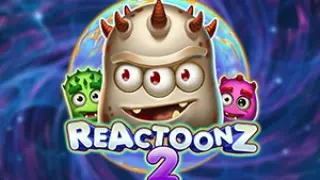
Reactoonz 2 Demo
Table of Contents
Introduction to Reactoonz 2 Slot
What is Reactoonz 2 and why do players talk about it?
Reactoonz 2 is a grid slot from Play’n GO that ditches the usual reels and paylines in favour of a 7x7 cluster pays setup filled with weird, bouncy alien creatures. Wins are created by matching groups of symbols that touch, not by lining things up along fixed lines. Each win disappears, new symbols drop in, and the game keeps building on itself through meters, wilds, and modifiers.
It attracts attention because it is not a “spin, win, move on” kind of game. The whole experience revolves around two meters (the Fluctometer and the Quantumeter) that charge up as you hit clusters. Those meters unlock wilds, modifiers, huge alien wilds, and the famous Gargantoon, which can take over the grid when everything lines up just right.
There are no standard free spins here. Instead, that “bonus game feeling” comes from those moments when one cluster triggers a second, then a third, the meters fill, wilds land, and the grid suddenly erupts into a chain of features. When Reactoonz 2 is “on”, it can feel like a tiny story playing out over a few seconds.
How Reactoonz 2 compares to the original Reactoonz
For anyone who played the first Reactoonz, the sequel feels both familiar and more layered. The grid size is the same, the alien aesthetic is back, and Gargantoon is still the star of the show. The core loop of cluster wins, cascading symbols, and charging a meter to unleash a giant wild remains intact.
The differences sit mainly in the mechanics wrapped around that loop:
- The original had one main Quantum meter; Reactoonz 2 adds both the Fluctometer and a more complex Quantumeter with multiple charge levels.
- Electric Wilds and the way they interact with regular symbols are more central here. In the sequel, connecting Electric Wilds with other symbols can recharge the grid in a serious way.
- Energoon wilds act as a more visible stepping stone before Gargantoon appears, giving a clearer sense of escalation.
Because of this, Reactoonz 2 feels more technical and slightly less “pure chaos” than the first game. The original comes across as more straightforward, while the sequel rewards players who enjoy tracking what each meter is doing and how close they are to the next feature.
Who is this slot best suited for?
This game is not for everyone, and that is part of its appeal. Different types of players will read it differently:
- Casual players: The visuals are friendly and cartoonish, and it is easy enough to grasp that clusters pay when they connect. The depth of the mechanics, combined with relatively high volatility, can be a lot for someone who just wants a simple 5‑reel slot with a clear free spins bonus. Casual players who enjoy puzzly games (like match‑3 mobile titles) may still find it surprisingly engaging.
- Grinders / session players: Those who like sitting with one slot for a longer session and learning its “mood” will likely appreciate Reactoonz 2. Understanding how to read the meters, how often modifiers tend to land, and when a grid has real potential can make it more satisfying over time.
- High‑volatility fans: This group is the natural audience. The game can go through stretches of smaller returns and then suddenly throw up a Gargantoon chain that fills a big part of the grid with wilds. Players who are comfortable with swings and enjoy the build‑up to rare, dramatic moments are very much the target.
Newer players can still give it a go, but it suits those who like slightly more demanding games, both in patience and in how much they want to understand what is happening.
Quick snapshot: key facts at a glance
For a quick overview, here are the important nuts and bolts of Reactoonz 2:
- Developer: Play’n GO
- Grid size: 7x7 cluster pays
- Paylines: No traditional paylines, wins via adjacent clusters
- Bet range: Typically from around $0.20 to $100 per spin (varies by casino)
- RTP: Usually around 96.2%, but can be lower depending on the operator
- Volatility: High
- Max win: Up to about 5,083x your stake (subject to cap and configuration)
- Main mechanics: Cascading wins, Fluctometer, Quantumeter, four Quantum features, Energoon wilds, Gargantoon wilds
- Platform: Available on desktop and mobile for most Canadian-facing sites
That mix of a grid layout, meters, and stacked features is what gives the game its identity.
Theme, Atmosphere and Visual Experience
Overall theme and setting: quirky aliens in a lab-style universe
Reactoonz 2 keeps the same playful alien universe from the original but frames it more like a laboratory experiment. The background is a deep blue, with floating shapes and machinery that suggest the aliens are being observed, charged, and transformed.
There is a sense that the grid is sitting inside some kind of intergalactic reactor. Meters, glowing coils, and delicate little lights sit on either side of the playing area. When the Quantumeter charges, it feels as if the entire “lab” starts to wake up. The charm comes from the contrast between the cute, bouncy aliens and this almost scientific setup around them.
Visual style and animation quality
The aliens themselves are bright and cleanly drawn, each with distinct expressions and silhouettes. The smaller one‑eyed symbols bounce slightly when they land, while the higher‑paying two‑eyed aliens are chunkier and more defined, so they stand out at a glance.
Cluster wins are handled with clear visual feedback: winning symbols glow, crackle, and then dissolve in a soft burst before new symbols drop down. When wilds or Quantum features trigger, you see arcs of electricity, swirling beams, and a bit of distortion on the grid, which helps you read that something bigger is happening.
Energoon and Gargantoon wilds have a heavier visual presence. When Gargantoon appears as a giant 3x3 wild, it looks like it has physically slammed onto the grid. The way Gargantoon breaks down into smaller wilds is well animated, with energy rippling outward instead of a simple symbol swap.
Nothing is overly flashy or harsh on the eyes, which matters if you tend to play longer sessions. The colour palette leans on blues, greens, and purples, with neon accents lighting up when features fire.
Sound design, soundtrack and how it feels over longer sessions
The soundtrack is a low‑key electronic bed, with small melodic lines that loop without demanding attention. Underneath, there is a constant gentle “lab” ambience: soft mechanical whirs, occasional bleeps, and distant pulses.
On wins, the game answers with sharper audio cues: a light chime for small hits, a richer, layered sound when larger clusters land or when the meters charge. When the Quantumeter fills enough to trigger a feature, the audio ramps up slightly, building a natural sense of escalation. Gargantoon’s arrival comes with a distinct, weightier sound that clearly signals a key moment.
Over long sessions, the soundscape stays surprisingly tolerable. It rarely shouts, and there are not many harsh stingers. For those who prefer to keep sound on, the game is designed to sit comfortably in the background. For silent play, the visual signalling is strong enough that it is easy to follow what is going on without hearing it.
Mobile vs desktop experience (performance, layout, touch controls)
On desktop, the 7x7 grid sits centrally with the meters and controls clearly framed around it. There is enough space for the symbols to breathe, so it is easy to track clusters and see how many wilds or special symbols are in play.
On mobile, especially in portrait mode, the grid fills most of the vertical area. Play’n GO tends to scale its grid games well, and Reactoonz 2 follows that pattern. Symbols stay crisp even on smaller screens, and touch controls for betting and spinning respond quickly.
A few small points Canadian players might notice on mobile:
- The grid can feel a bit busy on very small phones, especially when Gargantoon and multiple wilds are in play.
- Touch hitboxes for changing the bet are generous, which helps avoid mis‑taps when stakes are higher.
- The game usually loads quickly and runs smoothly on a stable connection. Any lag tends to appear during very complex feature chains, but it is typically brief and does not affect outcomes.
Overall, it feels intentionally built for both desktop and mobile, not like a desktop slot that was simply shrunk down.
Symbols and Paytable in Reactoonz 2
Overview of symbol types (low-paying vs high-paying aliens)
The grid is filled with a mix of one‑eyed and two‑eyed aliens:
- Low‑paying symbols are the smaller one‑eyed creatures, each in a different colour. They appear frequently and are mostly there to create constant small clusters and help charge the meters.
- High‑paying symbols are the larger, two‑eyed aliens. These stand out visually with more detailed designs and bolder colours. Clusters of these are where regular spin value really starts to pick up.
Because of the cluster system, a single small symbol can still be part of several big chains of wins and charges. Over time, though, players tend to scan the grid for the bigger two‑eyed icons as the main payoff symbols.
How cluster pays work (minimum cluster size, adjacency, cascading wins)
Reactoonz 2 does not use paylines. Instead, symbols pay when they form clusters:
- A cluster is formed when at least 5 matching symbols touch horizontally or vertically.
- Diagonal connections do not count; the symbols must share a side.
- The more symbols in a cluster, the higher the payout, with values stepping up as cluster size increases.
When a cluster pays:
- The winning group disappears from the grid.
- Symbols above drop down to fill the empty spaces.
- New symbols fall in from the top to fill any remaining gaps.
This cascading effect can chain several wins from a single paid spin. Each new cluster is counted separately, and all of them contribute to charging the Fluctometer and Quantumeter. In practice, a single spin can feel like multiple rounds rolling into each other.
Wild symbols and special symbols (Electric Wilds, Energoon, Gargantoon)
Wilds sit at the heart of Reactoonz 2’s design. There are several types:
- Electric Wilds: These substitute for regular symbols to help complete clusters. Their key role is how they interact with other symbols during cascades. When Electric Wilds are involved in wins, they also help charge the Quantumeter by zapping symbols around them.
- Energoon wilds: Larger, animated alien wilds that can appear after filling part of the Quantumeter. They land in 2x2 or smaller blocks, depending on the charge level, and act as wild symbols for cluster formation.
- Gargantoon wilds: The main attraction. Gargantoon initially lands as a big 3x3 wild that can cover a huge section of the grid. After its first involvement in wins, it breaks down into multiple 2x2 wilds, then into several 1x1 wilds. Each stage can create new clusters and cascades.
There is a clear hierarchy here: Electric Wilds tend to be frequent and tactical, Energoon is a mid‑tier power play, and Gargantoon is the big event that everything else seems to build toward.
Paytable structure and where the value really comes from
Like most high‑volatility grid slots, the paytable for basic clusters is not where the largest value sits. Even the best symbol in a minimum cluster size pays relatively modestly compared with what the game can do in a fully charged feature sequence.
The meaningful value usually comes from:
- Larger clusters (for example, 15+ of a high‑pay symbol), often formed with help from wilds.
- Consecutive cascades where multiple clusters hit one after another in the same spin.
- Feature sequences where Energoon or Gargantoon land, then split, creating overlapping wild areas that connect big groups of matching symbols.
The base paytable is calibrated around building potential rather than delivering frequent, isolated large wins. When the grid lines up properly with wilds and modifiers, the effective multipliers from cluster size act as the real “jackpot” element.
Game Mechanics and Grid Layout
Grid size, reel structure and lack of traditional paylines
Reactoonz 2 uses a 7x7 grid. Symbols fall from the top in columns, but there are no independent reels in the classic sense. Each new spin completely refills the grid with symbols, and everything that happens afterward is the result of cascades and feature triggers.
Because there are no paylines, players do not need to track line patterns. The focus shifts to noticing groups:
- Connected blocks of matching colours.
- Areas where wilds could bridge two almost‑touching clusters.
- The positioning of Electric Wilds relative to higher‑value aliens.
It feels closer to a puzzle board being constantly reshuffled than to a traditional five‑reel slot.
Cascading wins and symbol drops after a win
The cascading system is straightforward but crucial:
- Any time a cluster win is formed, all symbols in that cluster are removed.
- Remaining symbols drop down by gravity.
- New ones slide in from the top to refill the grid.
Each cascade can create new clusters. These, in turn, continue to charge the meters and can generate Electric Wilds or trigger Quantum features. All cascades that happen after a single paid spin are considered part of that same round. You are not paying extra for them; you are just watching the aftermath of one stake play out.
This structure also means a grid that looks weak at first glance can suddenly become powerful after one small cluster win opens space for wilds and higher‑pay symbols.
Quantumeter and Fluctometer as core mechanics
The Fluctometer and Quantumeter sit on either side of the grid and are key to understanding how Reactoonz 2 behaves.
-
Fluctometer:
- At the start of a spin, one of the one‑eyed aliens is randomly marked as the “fluctuating” symbol.
- When that chosen symbol forms part of a winning cluster, the Fluctometer charges.
- Once it is filled, it can add Electric Wilds to the grid, often reviving a spin that looked finished.
-
Quantumeter:
- This meter charges when Electric Wilds are involved in wins or interact with symbols.
- It has multiple charge levels, each associated with a different feature, from Energoon wilds through to Gargantoon.
- When fully charged, it can release the most powerful feature sequence the game has, often leading to the biggest wins.
These two meters give every spin a sense of progression. Even when the grid does not pay much, seeing a meter move can soften the impact, because you know you are at least edging closer to a potential big moment.
How rounds flow from spin to spin (a typical sequence)
A typical round in Reactoonz 2 unfolds something like this:
- You set your bet and hit spin.
- A fresh 7x7 grid appears, and one low‑pay symbol is highlighted as the fluctuating symbol.
- The game checks for clusters. If one or more exist, they pay, disappear, and charge the Fluctometer / Quantumeter according to which symbols were involved.
- Symbols drop down, new ones fall in, and the process repeats as long as new clusters form.
- If the Fluctometer fills during this chain, Electric Wilds are added, potentially starting a new series of cascades.
- If enough Electric Wild activity charges the Quantumeter, one of the Quantum features (or Energoon / Gargantoon) may trigger, again causing new drops and wins.
- When no more clusters appear and no features are pending, the spin ends, and you decide whether to spin again.
On some spins, very little happens: a small cluster, one cascade, then done. On others, the process stretches out, with meters triggering one after another. Those are the spins that feel closest to a traditional bonus round.
Reactoonz 2 Math Model: RTP, Volatility and Hit Frequency
RTP range and what it means for Canadian players
Reactoonz 2 generally comes with an RTP (Return to Player) setting around 96.2%. Many online casinos in Canada, however, use configurable RTP profiles for Play’n GO slots, which means the actual figure can be lower depending on the operator.
Key points to keep in mind:
- RTP is a long‑term statistical measure, not a guarantee for any single session.
- A slot at around 96% is fairly standard by modern online standards.
- Some sites may use versions closer to 94% or even below, so it is worth checking the game info panel where possible.
For a Canadian player, the practical takeaway is simple: treat RTP as a background factor. It matters more over thousands of spins than over a single evening. The volatility of Reactoonz 2 has a much stronger immediate impact on how your balance moves.
Volatility level and what to expect from the bankroll swings
Reactoonz 2 sits firmly in the high‑volatility category. That means:
- It can run cold for extended stretches, with many spins returning small fractions of your stake or nothing at all.
- A lot of the theoretical return is locked up in rare but powerful feature sequences, especially full Gargantoon events.
- When things do click, the game can jump from a slightly negative session to a solid profit in just one or two strong spins.
For bankroll planning:
- Short, aggressive sessions at high stakes are more likely to end abruptly.
- Medium to long sessions at modest stakes tend to align better with the game’s design, giving you enough time to actually see the bigger features.
This is not the slot to expect constant moderate wins. It is more about riding out quiet stretches while waiting for the grid to align.
Hit frequency and “dead spin” feel
Hit frequency (how often any win occurs) on Reactoonz‑style games is usually moderate, because small clusters appear relatively often. The feel, though, can still be streaky:
- There are many spins where you might get one small cluster and nothing else. Those technically count as “hits” but do not feel rewarding.
- Activity tends to arrive in bursts. Several quiet spins can be followed by a flurry of cascades, wilds, and meter charges.
This pattern can create the perception of more “dead spins” than the stats might show on paper. Emotionally, players remember the empty or near‑empty boards more than the small break‑even clusters. Being aware of that helps keep expectations in check.
Session length, bankroll planning and realistic expectations
For Canadian players considering longer sessions:
- Think in terms of total budget, not just bet size. Decide what you are comfortable losing before you start, and align your stake so you can get at least a few hundred spins from that budget.
- Reactoonz 2 reveals itself better over time. Seeing the full scope of its mechanics in just 20–30 spins is unlikely.
- The max win of over 5,000x is rare. Most “good” sessions will involve wins in the range of 50x to 300x, often coming from well‑timed Gargantoon chains rather than absolute top outcomes.
Treat big wins as a pleasant surprise, not an expectation. The appeal here lies as much in how spins unfold as in the final numbers.
Betting Range and Stake Customization
Minimum and maximum bet limits typically available
Most Canadian‑facing casinos that carry Reactoonz 2 offer a broad betting range. While exact limits can differ:
- Minimum bets are commonly around $0.20 per spin.
- Maximum bets can reach up to $100 per spin or sometimes higher, depending on the operator and any account restrictions.
These ranges keep the game accessible to casual, low‑stake players while still leaving room for high‑rollers who are comfortable with the volatility. It is always worth checking the on‑screen bet selector, since some sites adjust the top end based on local rules or internal policies.
Adjusting bet size: who the game is comfortable for (low stakes to mid/high)
Because of its volatility, Reactoonz 2 tends to feel most comfortable at low to mid stakes for most people:
- Low‑stake players (around $0.20–$0.60 per spin) get the full experience of the features without the bankroll draining too quickly. It suits those who like to explore the mechanics and watch the board develop.
- Mid‑stake players (roughly $1–$3 per spin) will feel the swings more clearly. A strong Gargantoon chain at these bets can be meaningful, but cold patches will also dent the balance faster.
- High‑stake players ($5+ per spin) are really leaning into the volatility. The game will feel intense, and session management becomes critical.
Since there is no “bonus buy” option, stake choice is the main lever for controlling your level of risk.
Coin value, total bet and how it affects feature potential
Reactoonz 2 uses a simple total bet system rather than complex coin/line configurations. You choose a single amount per spin, and all features and max win calculations scale directly from that value.
In practical terms:
- A spin at $0.20 has the same feature odds as a spin at $20; the only difference is the absolute payout size.
- The chances of filling the Quantumeter or triggering Gargantoon do not change with bet size.
- The maximum possible win in dollar terms is simply your stake multiplied by the advertised max multiplier (subject to any cap on your specific version).
This keeps things transparent. There is no need to worry about “activating” all features with a certain bet size, as sometimes happens with older line‑based games.
Autoplay considerations and responsible play tools (where available)
Many Canadian‑accessible casinos offer autoplay on Reactoonz 2, though some jurisdictions restrict or modify it. Where it is available, you can usually:
- Set a number of automatic spins.
- Define loss limits or single‑win stop points.
- In some cases, set a stop condition when a feature triggers.
Autoplay suits this game because a lot of the entertainment comes from watching cascades and meters build over sequences of spins. It also makes it easier to lose track of time and budget.
Responsible play tools (like deposit limits, time reminders, or self‑exclusion) are offered at the casino level rather than by the game itself. It is worth taking a moment to set up any limits that fit your comfort level before getting into a long session with a high‑volatility slot like this.
Core Features and Bonus Mechanics in Reactoonz 2
The Fluctometer feature
The Fluctometer sits on one side of the grid and quietly shapes many spins in Reactoonz 2. At the start of each round, one of the one‑eyed aliens is highlighted as the fluctuating symbol. Whenever that specific alien forms part of a winning cluster, the Fluctometer charges.
As the meter fills, it tracks how many of those chosen symbols you have cleared. Once it reaches its threshold, the Fluctometer can add a set of Electric Wilds to the grid. These wilds often land in spots that reconnect clusters or bridge gaps between high‑pay symbols, effectively giving a spin a second life after it looked finished.
Because the fluctuating symbol changes every spin, some rounds naturally feel more promising than others, depending on where that symbol happens to land on the opening grid. Experienced players often glance at the highlighted icon and the existing layout to judge whether a spin has extra potential or is more likely to be a quick one.
More Slots from Play'n GO


| Provider | Play'n GO |
|---|---|
| RTP | 94.20% [ i ] |
| Layout | 7-7 |
| Betways | Cluster pays |
| Max win | x5083.00 |
| Min bet | 0.2 |
| Max bet | 100 |
| Hit frequency | N/A |
| Volatility | High |