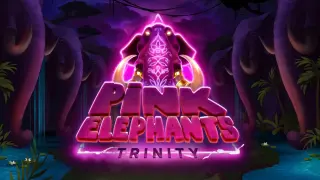
Pink Elephants Trinity Demo
Table of Contents
Overview of Pink Elephants Trinity Slot
What Pink Elephants Trinity Is All About
Pink Elephants Trinity is Thunderkick’s third trip into the weird, hallucinogenic desert of its cult elephant series. The original Pink Elephants became a fan favourite for its huge potential and free spins symbol collection. Pink Elephants 2 refined that formula. Trinity pushes things further with a more modern engine, faster pacing, and a stronger focus on chaining features together.
The “Trinity” angle isn’t just a name. The game weaves three core ideas together:
- the familiar symbol-upgrade free spins,
- escalating multipliers, and
- a special power-spin style feature that can combine multiple bonus modifiers in a single sequence.
On paper, it’s still a high-volatility, feature-heavy video slot. In practice, it feels like a more aggressive, punchy take on the original, tuned for players who like their sessions swingy and their bonus rounds layered with moving parts. Those who enjoy Dead or Alive–style patience probably won’t mind the occasional dry spell here. Anyone who prefers low-volatility, steady trickles of wins may find it a bit intense.
Structurally, Pink Elephants Trinity sticks to a classic layout:
- 6 reels
- 4 rows
- 4,096 ways to win (no fixed paylines)
It’s a ways-to-win slot where matching symbols pay from left to right on adjacent reels, similar to many modern high-volatility games. Thunderkick keeps its usual clean interface and crisp animation style, and the release sits comfortably in the studio’s later era: visually polished, feature-rich, and tuned for fast play on both desktop and mobile.
First Impressions: How It Feels to Play
Once the reels start spinning, the pace feels snappier than in the original. Reels drop in with a smooth, gliding motion rather than a heavy mechanical stop. The spin cycle is fairly short, especially with quick spin enabled, so it’s easy to rattle through 20–30 spins in just a few minutes. That alone gives the slot a modern feel compared with some of the slower, more theatrical older titles.
The screen is busy, but not chaotic. The 6×4 grid fills most of the display with glowing orbs, peanuts, and vivid animal faces. Feature triggers are signposted clearly: scatter symbols pulse with a soft glow, and special Trinity-related symbols are highlighted with bolder colours and subtle particle effects. During features, you do get more visual noise — symbol transformations, light beams, and upgraded elephants — but the game mostly keeps the main action in the centre, so it’s not hard to track what’s going on.
Within the first 20–30 spins, a few impressions tend to stand out:
Immediate positives:
- Spins feel fast and responsive, especially useful if you’re bonus hunting.
- Hit feedback is satisfying: premium symbols stretch or shimmer slightly on wins without overwhelming the screen.
- Early teases for the free spins and Trinity-style feature help convey what the slot is building toward, even if you haven’t read the rules.
Potential annoyances:
- Dead spins can come in long clusters. With 4,096 ways you might expect constant small hits, but the high volatility under the hood says otherwise.
- When several features overlap — wilds, symbol upgrades, multipliers — the animations can chain for a while, which some will love and others may find a touch drawn out.
- On smaller screens, the distinction between some of the low symbols can feel slightly compressed, especially during turbo play.
Taken together, the opening feel is that of a polished, high-octane ways slot that wants to get to the good part quickly, but also isn’t shy about making you wait for a serious bonus round.
Theme, Setting & Visual Style
Overall Theme and Atmosphere
The Pink Elephants universe has always sat in that fuzzy space between dream and hallucination: a glowing desert at twilight, swirling dust, and a mystical elephant that looks halfway between a spirit guide and a psychedelic poster. Pink Elephants Trinity leans into that aesthetic again, with a slightly sharper, more saturated edge.
The core concept is still a surreal desert where glowing peanuts act as magical catalysts and pink pachyderms appear in a kind of cosmic trance. Backgrounds show distant rock formations drenched in magenta and orange, with faint heat haze shimmering over the sand. There’s a subtle sense of elevation, like the reels are floating above a plateau at dusk.
The “Trinity” idea isn’t shouted at you through the theme, but it’s there in smaller touches:
- triple-echo light effects when special features kick in,
- layered auras behind key symbols hinting at three overlapping powers,
- and bonus screens using triangular framing for some UI elements.
It doesn’t hammer home a literal story about three elephants or three worlds. Instead, it feels more like a stylistic nod to three converging energies. The mood sits between dreamy and intense: colours are soft and glowing, but the pacing and sound design give it a slightly urgent undertone, especially when multipliers start to climb.
Nothing about it is dark or grim, and it doesn’t try to be serious. Think of it as a strange, semi-psychedelic, almost playful vision quest that occasionally snaps into laser focus when a big win is on the line.
Graphics, Animations, and Sound Design
The artwork is one of Thunderkick’s strong points, and Pink Elephants Trinity stays on brand. On desktop, the high-resolution symbols look clean and rounded, with a painted-cartoon style that avoids harsh lines. On mobile, the art scales down well: edges stay crisp, and colours hold their saturation without turning into neon blur.
Symbol motion is smooth and carefully timed:
- Low symbols fade in and out with a simple slide, never drawing too much attention.
- Premium symbols — especially the elephants — have more personality, with a slight “breathing” animation and a gentle glow at rest.
- On wins, symbols pulse, expand slightly, or send small sparks along the winning path, making it easy to see where the win formed, even in a dense grid.
Near-miss animations are present but not oppressive. Scatter teases cause reels to slow a touch, accompanied by a soft rising hum. When two scatters land and the last reel spins, the framing brightens slightly at the edges, but it avoids the full-screen drama some slots use. That’s good news if constant over-the-top teases tend to grate.
The soundtrack leans into mystical ambient. Light percussion sits under a drifting pad of synths and distant chimes, with the occasional deep note that rolls under the reels when you’re close to a feature. Wins trigger short musical phrases that layer over the base track without feeling jarring. Bigger hits bring in fuller, more melodic cues, though they stop short of turning into a full victory anthem every time.
Feature sounds are more assertive. Multipliers and upgrades are often accompanied by rising whooshes, crystalline pings, and a bassy hit when a key threshold is crossed. In long sessions, the soundscape can be quite absorbing if volume is kept moderate. At full volume with turbo spins, it may become a bit dense, so it’s the kind of game where most players will probably fine-tune audio levels early on.
Altogether, the audio-visual feedback supports the atmosphere and makes extended play more engaging, provided you’re comfortable with a slightly trippy presentation and a fairly active sound design.
User Interface and Layout
Thunderkick has a pretty consistent UI philosophy, and that carries through here. Controls are clustered to the right (or at the bottom on some mobile layouts), with clear icons and minimal clutter.
You’ll typically find:
- A large central spin button, easy to hit even on smaller screens.
- A smaller autoplay button nearby, opening a simple menu with spin counts and, depending on jurisdiction, optional loss or win limits.
- Bet size controls positioned just off the main action area, using plus/minus or a bet ladder for quick adjustment.
- A fast-play or quick-spin toggle, reducing reel travel time without skipping win animations entirely.
Balance, current bet, and last win are displayed in a straightforward bar, usually at the bottom. Fonts are legible against the dark, semi-transparent panel, and numbers don’t jump around between spins, which matters when you’re tracking bankroll during a volatile run.
The paytable is laid out in a scrollable panel with sectioned tabs: symbol values, special symbols, bonus features, and technical info. Descriptions are short but clear, usually supported by small visual diagrams showing how features behave on the reels. The help section gives the math basics — RTP, volatility comments, and ways-to-win description — in readable, non-technical language.
On mobile, portrait mode feels natural: reels occupy most of the screen, with controls tucked to the sides or bottom. Button spacing is generous, reducing accidental touches. In landscape, there’s a bit more breathing room for the background art, and the controls shift into a more console-style layout. Performance on smaller devices is smooth; the game doesn’t appear to be overly resource-hungry, and animations remain fluid even during heavier feature sequences.
Symbols and Payout Structure
Low-Value Symbols
The low-paying symbols are the usual card ranks, but stylised to fit the dream-desert theme: 9, 10, J, Q, K, and A, each drawn with soft curves and a slight glow around the edges. Colours are distinct — blues, greens, purples, and reds — so they don’t blur into each other when reels are spinning quickly.
These low symbols appear frequently and are responsible for the bulk of your minor hits. On a 4,096-ways grid, it’s common to see combinations of four or five of a kind stretching across the first few reels. The individual payouts per line are modest, so even hitting several low-symbol ways at once often results in a small net change to your balance, especially if your bet size is on the higher end.
Typical patterns include:
- 3-of-a-kind hits that barely cover a fraction of your spin cost.
- 4- and 5-of-a-kind lines that, when combined, might nudge a spin into slight profit.
- Occasional full-screen leanings of one or two ranks that produce a more notable, but still “medium” result relative to the slot’s overall potential.
In fast play, it’s easy to distinguish them in peripheral vision, which is important. The stylised fonts are bold enough that you can tell at a glance whether a spin is dominated by low ranks, or whether a few premium symbols have landed in key spots.
High-Value Symbols
Premium symbols are where the theme really comes alive. Instead of generic animals, each has a mildly caricatured, almost spiritual look, with bright eyes and softly rendered features. You’ll usually see:
- A set of desert creatures (such as meerkat-style figures, goats, or similar stylised animals) forming the mid-tier premiums.
- The iconic pink elephant as the top symbol, often framed in glowing energy.
These symbols pay significantly more than the card ranks. Even a 3-of-a-kind of a mid-tier premium can feel noticeable compared to a low-symbol line, and 4 or 5 elephants in a row can deliver a respectable base-game hit, especially when they appear in multiple ways configurations.
A “good” high-symbol hit on a typical medium stake might look like this:
- Several ways of the top symbol across four or more reels, possibly stacked on one or two reels,
- Combined with a couple of mid-tier premiums forming extra lines,
- Resulting in a win of somewhere in the region of 20x–50x your bet, depending on exact distribution.
That sort of outcome doesn’t happen constantly but appears often enough to keep the base game from feeling completely barren, especially when paired with wilds. Still, given the slot’s volatility, the truly memorable wins tend to involve high symbols interacting with multipliers or feature enhancements.
Special Symbols: Wilds, Scatters, and Feature Icons
Wilds are the backbone of the game’s win construction. The wild symbol is usually easy to spot — a glowing icon set against a vivid background — and it substitutes for all regular pay symbols. It typically appears on the inner reels (2–6), serving as glue between clusters of matching symbols. There’s no built-in multiplier on standard wilds in the base game, which keeps them frequent enough to matter without breaking the math model.
Scatters are your entry ticket to the main free spins bonus. These often take the form of glowing peanuts or a dedicated bonus emblem, standing out sharply from other symbols. You generally need at least three scatters in view anywhere on the reels to trigger free spins, with additional scatters granting extra spins or a slightly boosted starting setup. Scatters sometimes carry their own small pay values, but the real value comes from triggering the feature.
Trinity-related symbols or feature icons add an extra layer. Depending on the final implementation, you might see:
- Special orbs or marked positions that, when collected, feed into an upgrade meter.
- A unique feature trigger symbol that activates a combined power spin or a sequence where multiple modifiers — such as symbol upgrades, extra wilds, or guaranteed premium stacks — come into play in rapid succession.
These special icons are generally rare in the base game and often appear more frequently, or with enhanced effects, inside the bonus. Their presence is crucial to creating the “Trinity” feeling of several mechanics converging in a short burst of high potential.
Paytable Behavior and Win Construction
Pink Elephants Trinity uses a 4,096 ways-to-win system. There are no traditional paylines. Instead, a win forms whenever:
- you land at least three matching symbols on consecutive reels,
- starting from the leftmost reel,
- with at least one instance of the symbol on each reel in the sequence.
If you have multiple matching symbols on a reel, they multiply the number of ways. For example, 2 symbols on reel 1, 2 on reel 2, and 1 on reel 3 form 2 × 2 × 1 = 4 ways of that symbol. These are all tallied and multiplied by the symbol’s pay for that length.
This structure means:
- Stacked symbols can transform what looks like a modest hit into a surprisingly strong one.
- Wilds in the centre reels can explode the number of ways for a given symbol.
- Single-symbol “gaps” on crucial reels can destroy what otherwise would have been a very solid win.
Symbol distribution feels tuned to support this volatility. You’ll see many spins with scattered low symbols and no real connection, then the occasional spin where one or two symbols heavily populate a few reels and everything clicks into place.
A medium-sized hit in practical terms might be something like:
- A premium animal symbol appearing stacked on reel 2, with extras on 3 and 4,
- At least one wild bridging a slight gap,
- Producing multiple 4- or 5-of-a-kind combinations across the grid,
- Resulting in a payout in the region of 10x–25x your bet.
Big wins — 100x and above — usually require either the top symbol landing in great numbers across several reels, or a feature spin where upgraded symbols, wilds, or multipliers converge. The ways system ensures that when reels do line up, the result often feels more explosive than in a traditional 20-line slot.
Math Model: RTP, Volatility, and Hit Frequency
RTP Details and Versions
Thunderkick usually publishes a default theoretical RTP around the mid-96% mark for its main releases, and Pink Elephants Trinity follows that pattern with a value commonly in the 96% region. That number represents the long-term statistical return over a huge volume of spins, not a guarantee for any single session, but it does indicate a modern, reasonably player-friendly setup.
Like many contemporary slots, there are often multiple RTP configurations available for casinos to choose from. Typical alternatives might be around:
- 96% (default)
- 94%
- 92%
The lower versions don’t change the gameplay feel dramatically in the short term — volatility and feature frequency are broadly similar — but they do shave off a slice of long-term expected value in favour of the house. That’s something more serious players pay attention to.
To see which version you’re playing, it’s worth:
- opening the game’s info or paytable menu,
- scrolling to the technical section where RTP is usually listed explicitly,
- and checking the figure against the default published rate on the studio’s website or reliable review sources.
If the value is significantly below the “headline” number, it doesn’t necessarily make the game unplayable, but it’s useful context when deciding how long to stick with a session or whether to chase extended bonus hunts.
Volatility Profile
Pink Elephants Trinity sits firmly in the high-volatility camp. That means it’s designed to deliver larger wins less frequently, with notable swings in either direction. Compared to many medium-volatility slots, you should expect:
- More dead spins where nothing much happens.
- Bonus features that, when they do hit well, can spike your balance noticeably.
- A wider range of outcomes for the same number of spins, from quick bust-outs to strong upswings.
In practice, the volatility feels sharper than many generic ways slots. It’s not uncommon to go 50–100 spins with only small, break-even hits and no feature, especially at higher bet levels. On the flip side, a single strong bonus round or a high-symbol base hit with wild support can more than compensate for a long quiet period.
This kind of profile tends to appeal to:
- bonus hunters who are patient enough to wait for the right trigger and are comfortable with bankroll swings,
- players who enjoy taking shots at larger wins in relatively short sessions,
- those who aren’t fazed by streaky behaviour and don’t expect slow, steady “wage grinding.”
More casual players who prefer consistent small returns and frequent but modest features may find the ride tense. For them, a lower bet size and shorter sessions can soften the impact of variance without losing the game’s visual charm.
Hit Frequency and Session Rhythm
The overall hit frequency — how often any win occurs — is typically somewhere in the mid-20% to low-30% range on games like this, depending on the final tuning. That means you’ll see a win roughly every three to five spins on average, but many of those wins will be very small, especially when built from low symbols only.
Session rhythm tends to settle into patterns:
- short bursts of small and medium hits, sometimes with a mini-feature tease or near-miss scattered in,
- followed by stretches where spins go by with little result, occasionally punctuated by a decent base hit,
- with the rare, important inflection point: a bonus trigger, or a base game spin where multiple premiums align.
The relationship between frequent small wins and rare spikes is key here. Small wins help slow the drain on your balance but generally don’t generate real profit. The rare spikes — usually from free spins or a Trinity-style power sequence — carry most of the game’s potential. That’s where the emotional peaks of a session tend to happen.
Players who like reading patterns into streaks will find plenty of fodder here, though the underlying randomness doesn’t change. It’s more useful to view the rhythm as a psychological cue: when the game has gone quiet for a while, it’s easy to feel that a feature is “due,” but the math doesn’t track your personal history. Planning your session length and budget up front is more effective than chasing perceived cycles.
Balance Between Base Game and Features
Pink Elephants Trinity is very much weighted towards its bonus features for serious wins. The base game is capable of delivering solid payouts when wilds and premiums combine, but the design clearly expects the bulk of the slot’s potential to come from:
- free spins with symbol upgrades or collection mechanics,
- Trinity-style boosted spins where several modifiers can collide on the same sequence,
- possibly retriggers or extended bonus rounds that accumulate multipliers or upgraded symbols over time.
During ordinary play, most of the excitement comes from teases — two scatters landing, special icons appearing but not quite lining up, or a near-miss on a promising set of premiums. That tension keeps the base game from feeling entirely flat, even though the underlying returns are modest.
When the bonus finally triggers, the pace changes. Extra visual effects, highlighted meters, and more frequent wilds or upgraded symbols make each spin feel more loaded. The best bonuses tend to be those where:
- early spins secure upgrades or multipliers, and
- later spins capitalise on that preparation with strong symbol layouts.
Because of this structure, it’s often sensible to think in cycles: base game as a qualifying period, features as the main event. How many qualifying spins you’re willing to play without a meaningful bonus will depend on your bankroll and risk tolerance. For players who like quick, hit-and-run sessions, it may make sense to set a clear stop point if the game stays stubbornly in base mode without progression.
Bonus Features & Trinity Mechanics
(This section expands the feature side, which is where most players will focus.)
Core Free Spins Feature
The main free spins feature in Pink Elephants Trinity builds on the concept from earlier entries in the series: collecting special symbols to upgrade animals into higher-paying elephants.
A typical structure looks something like this:
- 3+ scatters trigger a set number of free spins.
- One or more animal symbols are marked with meters.
- Landing special collection symbols (often peanuts or orbs) fills these meters.
- When a meter is filled, the corresponding animal is upgraded to the next tier, eventually turning into the top-paying elephant.
Each upgrade not only boosts potential future wins but can also convert existing symbols on the reels into their upgraded version on the spin where the upgrade is completed. That’s where big hits often occur: a final collection symbol drops, the meter fills, and suddenly a large cluster of mid-tier animals becomes elephants, creating multiple high-paying ways simultaneously.
Retriggers are usually possible. Extra scatters during the feature may:
- add more free spins,
- unlock upgrades for additional animal symbols,
- or extend the window in which your upgraded symbols can do their work.
The free spins feature has a strong sense of progression, which suits longer bonus rounds. Early spins can feel “setup-heavy” with relatively modest returns, while later spins — once a couple of symbols are fully upgraded — can swing hard.
Trinity-Style Power Feature
The distinctive twist in Pink Elephants Trinity is the special Trinity-style power feature (naming may vary by market), which acts like an amplified sequence of enhanced spins. This is generally triggered by either:
- a dedicated special symbol landing in a particular configuration,
- or by filling an on-screen meter through base-game action, such as collecting certain orbs.
When activated, the feature plays out as a short series of spins where several modifiers are active at the same time. Common elements might include:
- extra wilds added to the reels,
- guaranteed upgraded symbols on certain reels,
- a rising win multiplier that steps up after each successful spin.
The key appeal is that multiple aspects of the game’s design — upgrades, wilds, multipliers — converge in a compact burst. Each spin in the sequence feels more meaningful than a standard base-game spin, with the potential for a cascading effect if wins continue to land and keep the multiplier or feature going.
This kind of feature is particularly suited to players who like high-intensity, short-lived bursts of action rather than long, drawn-out bonuses. If a Trinity feature happens to trigger inside the free spins (assuming the rules allow that interaction), you get the hallmark combination scenario where the game’s full potential can surface.
More Slots from Thunderkick

| Provider | Thunderkick |
|---|---|
| RTP | 94.15% [ i ] |
| Max win | 14,400x |
| Volatility | High |
| Rows | 4 |