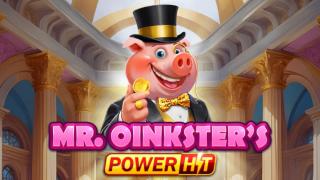
Mr. Oinkster's Power Hit Demo
Table of Contents
When Mr. Oinkster’s Power Hit actually wakes up
The entire personality of Mr. Oinkster’s Power Hit flips the moment the Power Hit feature locks in. Until then, spins feel measured and almost restrained, with modest line wins and a sense that the real story has not started yet. The instant those special symbols land and the screen shifts into the Power Hit board, the game abandons its chip‑damage posture and moves into a far more binary mode: this run either climbs the payout ladder or fizzles out quickly.
Canadian players familiar with Aristocrat’s Power Hit titles or Light & Wonder’s hold‑and‑spin games will recognize the rhythm, but Mr. Oinkster handles the switch with a slightly sharper contrast. The base game often pays in small, frequent flickers, while the feature phase compresses a lot of the game’s theoretical value into a tight burst of spins. That sense of “now the real stakes are in play” is stronger here than in many IGT hold‑and‑win hybrids where the base game still carries decent weight.
Before the feature kicks in, the reels roll by with a gentle cadence. Premium symbols involving Mr. Oinkster and his props can connect often enough to keep the balance from freefall, but isolated big hits are relatively rare. The main excitement in the base game comes from seeing Power Hit symbols land in teasing combinations, interrupting the otherwise steady stream of small wins and blanks. Once the feature triggers, that tension is replaced by a more focused, ladder‑climbing mindset, where each new sticky symbol feels like another rung toward a jackpot.
The Power Hit sequence in this slot leans closer to Aristocrat’s older, more volatile style than, say, some of Light & Wonder’s gentler link games frequently found in Canadian land‑based casinos. It is capable of running cold, offering a quick cluster of small prize icons and then cutting out. But when the feature rolls well, it stacks prize values and boosters in a way that makes the base game look like a minor prelude. That skew is where the game’s personality lives.
Shifting from chip damage to spike hunting
Across longer play, the base game behaves more like background scaffolding than a main event. Line wins tend to land often enough that you rarely go ten or fifteen spins without something back, but the amounts are usually at the “reduced loss” level rather than meaningful profit. Hitting a full line of premium Mr. Oinkster symbols can nudge a session, yet it does not redefine it. Most of the time, those hits soften the drop while you wait to see whether the Power Hit mechanic will show up.
What that creates is a deliberate pivot from chip damage to spike hunting. Your balance moves in modest ripples for a while, with a sequence of small wins and near‑miss feature setups. The moment the Power Hit actually lands, expectations change: now the question is whether this single sequence can cover the last batch of spins, nudge you near even, or push the session into profit. For players used to older 20‑line video slots where a lucky stacked premium could rival any bonus, this can feel more polarized.
Compared with more linear, payline‑focused games, one feature here often has more sway over your short‑term outcome than a dozen ordinary base‑game spins. A 30‑minute session might involve hundreds of small line wins that barely register next to a single strong Power Hit board. If that board never appears, the session tends to be a controlled drip; if it arrives early and behaves, you can have a very different story. That hinge effect is central to how Mr. Oinkster’s Power Hit plays.
Bonus‑centric design vs more evenly distributed pay curves
Stack Mr. Oinkster’s Power Hit against something like an IGT classic with stacked symbols and free spins, and the contrast in pay curve becomes obvious. Those older titles, still common in Canadian casinos and many online lobbies, often let stacked premiums in the base game deliver genuinely session‑defining hits. Here, you can feel that more of the math is tucked into the Power Hit feature. Base‑game value exists, but it feels like a bridge rather than a destination.
That shift changes how “value between features” is perceived. In a slot where the base game carries more of the return, even a feature‑less session can include a standout hit that makes the grind feel worthwhile. Mr. Oinkster leans harder into the modern Power Hit / hold‑style design where the feature is the intended high point, and the main purpose of interim wins is to keep you from feeling completely stalled. The result is a game that encourages a wait‑for‑it mindset instead of a reel‑to‑reel hope that any spin could be the big one.
Interestingly, the slot signals that you have moved into the “good part” more through structural and pacing cues than through a complete sensory overhaul. The screen tightens around the Power Hit grid, spin cadence changes to a step‑by‑step advance, and the regular line evaluation is replaced by the familiar incremental reveal of sticky icons. Even without leaning too heavily on extra audio or flashy overlays, the game communicates that this is the crucial phase. That quiet confidence suits players who have seen dozens of over‑the‑top hold‑and‑spin clones and simply want clear stakes.
Win potential in Mr. Oinkster’s Power Hit: ceiling vs everyday reality
The advertised max win on Mr. Oinkster’s Power Hit follows the usual Power Hit trend: a headline number that looks very bold relative to a single spin, often presented as several thousand times your bet once you factor in top ladders and jackpots. It is large enough to put the game in the “serious hit possible” category, but not so extreme that it feels like a pure fantasy promo figure. The ceiling sits in roughly the same band as mid‑to‑high volatility hold‑and‑win games from Aristocrat and Light & Wonder that Canadian players will have seen in both land‑based and online environments.
Reality, of course, is a different story. A typical 30‑ to 60‑minute session tends to produce modest swings rather than headline moments. Many runs will hover within a band where you see a few Power Hit features, some average, one maybe slightly above par, and then a slow drift depending on how those play out. Those extreme multi‑thousand‑times outcomes live in the very far tail of the distribution, where you need the feature to both trigger and then stack upgrades or big prize values in a way most sessions never touch.
What a “decent” session actually looks like
Most reasonable sessions fall into a few recognizable patterns. There are the slightly losing runs where no particularly strong feature appears, but base game wins and one or two weaker Power Hit boards keep you from crashing quickly. Then you have the breakeven or small‑profit sessions, where at least one feature pays a bit above the average, buoyed by a couple of better‑than‑usual base hits. The rare standout experiences come when two things line up: the feature triggers within your early spins and then builds into a board that feels clearly out of step with the rest.
Compared with grindy, line‑win‑heavy slots, the outcome of a Mr. Oinkster session depends more heavily on whether the Power Hit shows at all. You can spin for a while on base‑game drips and end up with a similar net result, but emotionally it feels very different if you never see the feature. A single solid Power Hit round often defines how you remember the session, whereas in more evenly distributed games, a cluster of base‑game events can share that spotlight.
Pocket piggybank: betting range and bankroll sizing for Canadian players
Across Canadian‑facing casinos, Mr. Oinkster’s Power Hit generally follows the modern online range: low micro‑stakes at the bottom end, with a per‑spin minimum around $0.20 or $0.25, and a ceiling that can reach into the tens or even low hundreds of dollars per spin, depending on the operator. Some sites may cap the maximum lower, especially in provinces with more conservative risk settings, while others let you push the envelope for high‑roller play. The key point is that the game is not locked into a narrow mid‑roller band; it is accessible at a wide variety of stakes.
Framed against comparable Power Hit and hold‑and‑spin titles, that spread positions the game as broadly approachable. Casual players can test the mechanic at low stakes without feeling forced into $1+ spins, and more serious bankrolls can scale up if they want the feature to matter more per hit. High‑limit enthusiasts used to land‑based cabinets may notice that the online version sometimes tops out lower than physical machines in certain Canadian casinos, but for most online sessions the available range is more than enough.
Matching stake size to the game’s temperament
Because Mr. Oinkster’s Power Hit leans on a volatile, bonus‑driven profile, stake selection benefits from acknowledging that features can be spaced out. A player sitting down with a $50 session bankroll, for example, will typically be more comfortable in the $0.20–$0.40 per‑spin range, aiming for a few hundred spins’ worth of runway in case the first Power Hit takes its time to appear. That leaves enough room for the base game’s small wins to recycle some spins while waiting on a better feature.
Move up to a $200 budget and the middle ground opens. Bets around $0.80–$1.50 per spin still give you a decent spin count while making any strong feature more impactful. Those with $500 or more can treat $2–$4 spins as a workable compromise between meaningful hits and survivability, assuming they are comfortable with sharper swings if the bonus stays quiet. By contrast, a softer‑volatility game would tolerate more aggressive stake jumps on the same bankroll, because it relies less on a single feature run to set the result. Mr. Oinkster simply rewards a slightly more conservative approach relative to your total balance.
Symbol hierarchy in Mr. Oinkster’s Power Hit
Symbol ordering in Mr. Oinkster’s Power Hit looks familiar at first glance, but the way value is distributed tells you a lot about the design. Premium icons focus on Mr. Oinkster himself and his more extravagant props: think poses that clearly signal “top of the board”, along with related high‑value items. Below that, mid‑tier symbols cover secondary objects tied to his world, sitting in a band where they feel decent when stacked but rarely transform a spin by themselves. The lowest rung is filled by simple shapes or card ranks, which appear constantly and do most of the low‑level housekeeping.
That hierarchy means that, outside of features, you are mostly working with modest returns. Landing a full line of the main Mr. Oinkster premium on the standard reel set can be satisfying, but it does not carry the same knockout punch as in some older line‑win‑centric games. Mid‑tier connections help offset a run of emptier spins, while the low symbols keep dribbling back very small amounts. From a practical standpoint, a significant slice of the game’s overall value is not housed in these ordinary symbol hits at all, but in the Power Hit symbols and their associated board.
How the paytable quietly nudges you toward the feature
Look closely at how top symbol hits feel during longer sessions and a pattern shows itself. They are pleasant when they appear, sometimes enough to restore a chunk of the balance after a lean stretch. Yet they rarely feel like the true target. The most memorable spins nearly always involve Power Hit symbols or the feature grid, and the base game’s best lines function more as pacing adjusters than the main attraction. The paytable, without saying it outright, teaches you that the bonus is where the real ambition lies.
In older video slots that many Canadian players grew up with, a full screen of stacked premiums or a five‑of‑a‑kind on a high‑paying icon could easily rival the free spins or bonus round. Those games allowed you to think of every spin as potentially decisive. Mr. Oinkster’s structure leans in a different direction: strong top‑symbol combinations are almost “nice‑to‑have” moments while you wait to see whether the Power Hit mechanic kicks in. The math shifts your emotional focus from line construction to board accumulation, and once you have felt that, it is hard to go back to caring about low‑value symbol cascades.
Provider context: where Mr. Oinkster’s Power Hit sits in the studio’s lineup
To understand Mr. Oinkster’s Power Hit, it helps to see it as part of its studio’s broader Power Hit family, which mixes land‑based DNA with online‑first polish. The provider behind this game has built a reputation among Canadian players for bridging those two worlds: cabinets and themes that feel at home on physical casino floors, translated into online titles that keep the core mechanics but often layer in more refined math. Names like “Power Hit”, “Lightning Link”, and various hold‑and‑spin frameworks have trained players to look for familiar grids of locked symbols and incremental prize climbing.
Within that catalogue, Mr. Oinkster is a character‑driven twist on a framework the studio already knows well. Earlier Power Hit‑style games often leaned on more generic themes: jewels, coins, or elemental motifs with straightforward symbols. Here, the pig‑themed mascot and his props give the studio an excuse to flex a bit more personality while recycling a proven mechanic. For Canadian lobbies that already carry several Power Hit options, this one slots in as the slightly cheekier cousin without doing anything too outlandish to the core engine.
What stands out when comparing it to earlier siblings is the balance between base game and feature. Some older titles in this family had slightly more forgiving line‑win structures, letting players feel semi‑steady returns even when the feature stayed away. Mr. Oinkster nudges the needle more firmly toward bonus‑centric design. The base game can still surface respectable hits, but the gap between an average spin and a successful Power Hit sequence is wider. That makes it more polarizing than the studio’s softer entries, but also more in tune with the current online appetite for high‑impact boards.
The provider’s habit of offering multiple RTP configurations also matters here. Different Canadian casinos may host Mr. Oinkster’s Power Hit at slightly different theoretical returns, usually within a band that runs from respectable to slightly trimmed. The volatility profile, however, remains recognizably high across variants. So, while one site might feel a touch kinder over very long play due to a higher setting, the core experience of waiting on those big Power Hit boards is consistent.
The result is a slot that feels like a midpoint between the studio’s completely stripped‑back hold‑and‑spin games and its more feature‑rich, multi‑level bonus extravaganzas. Compared with some of its own catalogue, Mr. Oinkster is relatively clean: no labyrinth of side features, just a clear base‑to‑feature pipeline with one mechanic occupying the spotlight. For players who found certain previous releases overloaded with add‑ons, this is a more focused expression of what the studio tends to do well.
Evolution of the studio’s Power Hit mechanic family
Looking back through the studio’s earlier Power Hit‑style titles, you can trace a clear evolution in how the “lock and collect” idea is handled. The earliest examples often had smaller boards, fewer special symbols, and relatively straightforward prize ladders. Triggering the feature mostly meant trying to fill spaces with coin‑style icons and hoping to land a static jackpot symbol. The pacing was simple, and the math leaned to the conservative side, reflecting the transition from land‑based cabinets where session length expectations were different.
Later releases started to experiment with board size, introducing larger grids and more complex behaviours. Some games added booster tiles that multiplied values or extended the number of spins; others layered on mini‑jackpots that could combine with main prizes. That shift made the feature more dynamic but also blurred the line between average and exceptional outcomes, as players had to track more variables on screen. Online variants often amplified this trend, since the digital format allowed more rapid iteration than regulatory‑bound physical cabinets.
Mr. Oinkster’s Power Hit feels like a deliberate trim back from that complexity without returning to bare‑bones simplicity. The board still offers enough variety in prize icons to keep each feature feeling distinct, but it does not overload you with five different booster types or nested mini‑games. Instead, the focus is on whether your board reaches meaningful clusters of higher‑value tiles and any top‑tier prizes, echoing older cabinet instincts while accepting that online players expect punchier peaks. It comes across less as a radical innovation and more as a refinement: tighter math around a familiar core, with a clearer sense of what a “good” feature should look like.
In that sense, Mr. Oinkster occupies a bridge position. Fans of the studio’s original Power Hit releases will recognize the bones instantly, yet the pacing and reward distribution feel more tuned to modern online habits. Canadian players who bounce between land‑based floors and provincial or offshore online sites will probably see it as a natural continuation of where this mechanic line has been heading.
Math model as lived experience
On paper, Mr. Oinkster’s Power Hit sits firmly in the medium‑high to high volatility bracket, with RTP options that cluster around the usual online figures but vary by operator. In play, that translates into a game where you can easily go through spells of modest returns while waiting for a single feature to justify the session, especially at higher stakes. Hit frequency in the base game feels acceptable, with plenty of small wins and near‑miss combinations, but those hits are rarely large enough to counter a long sequence of non‑events on their own.
Compared with some of the studio’s gentler Power Hit titles, this one is more willing to let you spin without much forward progress while the math waits for an opportunity to drop a strong board. That does not mean every Power Hit is huge; many features land and then pay only slightly better than a decent base‑game hit. Yet the difference between an average and a standout feature is significant, so the math encourages longer runs if you are hunting that outlier. Players who prefer predictable, slowly churning balances may find the swings here sharper than ideal, while those who are comfortable with volatility will recognize a familiar pattern.
Mobile vs desktop: how Mr. Oinkster plays on different screens
On desktop, Mr. Oinkster’s Power Hit benefits from the extra horizontal space, especially during the feature where the Power Hit grid can breathe a bit. Symbol details are easier to distinguish at a glance, and the payline overlays, while not the main focus, are clearer for those who like to track exact line structures. The spin and bet controls sit in a conventional lower panel, making adjustments straightforward with a mouse.
On mobile, the studio has done the usual vertical optimization: the reels compress slightly, some interface elements tuck into expandable menus, and the spin button shifts to a thumb‑friendly corner. The Power Hit board still feels comfortable on a mid‑size phone, but on smaller screens the individual prize values can require an extra second’s focus. One small quirk is that adjusting the bet size can take an extra tap or two on mobile because of the nested menus, which is less fluid than drag‑style sliders seen in competing games. Once set, though, the actual spin‑to‑spin experience is smooth, and the mechanic translates well to short, on‑the‑go sessions.
Comparisons to adjacent Power Hit and hold‑style slots
Put Mr. Oinkster’s Power Hit alongside other Power Hit / hold‑and‑spin games that Canadians commonly see and its intentions become clearer. Relative to Aristocrat’s more traditional Power Hit cabinets, this slot lands somewhere in the middle in terms of aggression. The board can deliver comparable spike potential, yet the base game is a touch more active, with slightly more mid‑tier wins cushioning the wait for a feature. Against Light & Wonder’s friendlier hold‑and‑win titles, Mr. Oinkster feels a bit less forgiving but more capable of startling feature outcomes when everything lines up.
IGT’s approach to similar mechanics often involves grafting hold‑and‑spin features onto otherwise classic line‑win frameworks, creating games where the bonus is important but not the sole attraction. Mr. Oinkster diverges from that philosophy by making its Power Hit mechanic the primary narrative thread. You notice fewer attempts to create elaborate line‑win stories or elaborate stacked symbol tricks. Instead, the comparison makes clear that this slot belongs to the “board‑driven” tribe, closer in spirit to Lightning Link descendants than to line‑win purists.
Against its own studio’s back catalogue, Mr. Oinkster’s Power Hit reads as a more focused, character‑led entry. It strips away some of the clutter seen in other titles that crammed multiple jackpots, free spin variations, and side features into a single package. The result is a game where expectations are easier to articulate: you are here for the Power Hit, you know what a successful board looks like, and you can judge your session against that yardstick. Players who grew tired of feature bloat in other releases may appreciate this more streamlined version of the formula.
Where it may divide opinion is in the tension between feature frequency and feature impact. Some adjacent games offer more frequent but milder hold‑and‑spin rounds, creating a rhythm where you see the mechanic often but rarely at life‑changing levels. Mr. Oinkster plants its flag closer to the impactful side: features feel more important, and missing them over a session bites harder, yet their potential to shift your results is higher when they go well. This is a conscious trade‑off, and one that will appeal most to players comfortable treating each feature as a make‑or‑break event.
Slot fingerprint
- Power Hit feature carries a large share of the game’s practical return, with base wins mostly smoothing the path between boards.
- Symbol ladder makes premium Mr. Oinkster icons feel helpful but rarely session‑defining outside of the bonus.
- Volatility skewed toward high‑impact feature spikes rather than a dense distribution of medium‑sized line wins.
- Character‑driven twist on a familiar Power Hit / hold‑and‑spin framework, trimmed of excessive side features.
- Mobile version keeps the board readable but hides bet controls in nested menus, adding a small layer of friction to stake changes.
Pacing map
Mr. Oinkster’s Power Hit plays in distinct chapters. The base game chapter is usually long, with many modest hits and occasional premium lines that nudge the balance but seldom rewrite it. During these stretches, you tend to watch the appearance rate of Power Hit symbols more than the actual line wins, because they hint at whether the session is warming up or just idling.
When the feature finally triggers, the pacing condenses into a sharp spike of attention. Each locked symbol feels consequential, and you can usually tell within the first few re‑spins whether the board is shaping into something special or stalling out at an average level. Sessions that see an early feature, followed by at least one above‑average board, almost always feel better, regardless of the net result, than runs where the feature arrives late or not at all.
Subtler signs of a “warmer” session include stretches where mid‑tier symbols seem to land more cooperatively, supporting the balance between features, and sequences where Power Hit icons show up in clusters even when they do not quite trigger the bonus. Those patterns do not guarantee a big result, but they often coincide with the runs where the math is willing to give you a shot at the higher rungs of the ladder.
More Slots from Booming Games





| Provider | Booming Games |
|---|---|
| RTP | 95.90% [ i ] |
| Layout | 3-4-4-4-3 |
| Betways | 576 |
| Max win | x5000.00 |
| Min bet | 0.2 |
| Max bet | 100 |
| Hit frequency | N/A |
| Volatility | Med-High |